Project-Based Learning for Student-Produced PSA on Mental Health and the SDGs
DOI:
https://doi.org/10.21512/humaniora.v17i1.13829Keywords:
Project-Based Learning (PBL), Public Service Announcement (PSA), mental health, Sustainable Development Goals (SDGs), visual analysisAbstract
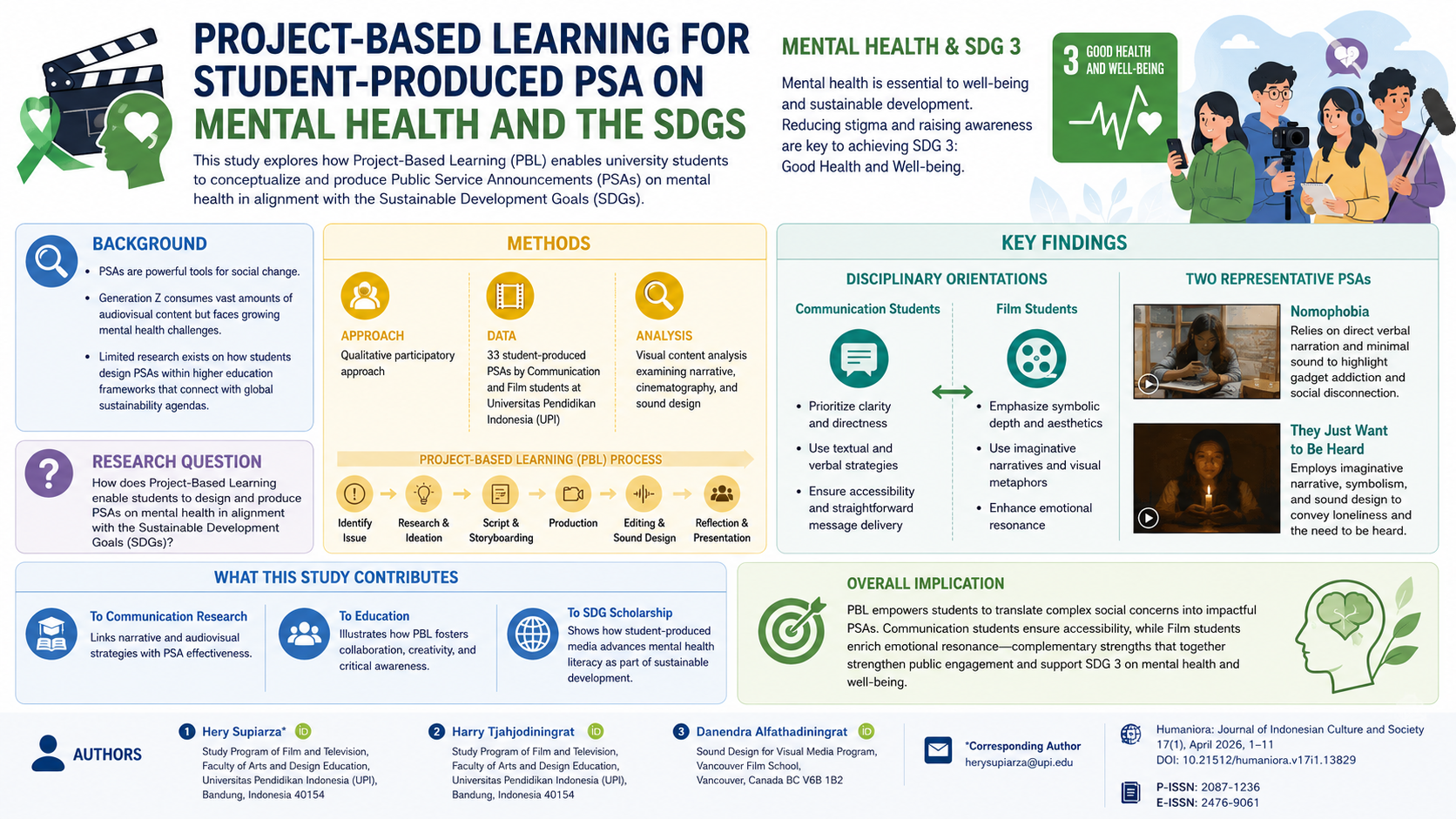
Public Service Announcements (PSAs) represent a powerful medium for social communication, particularly in addressing complex issues such as mental health. However, limited research explores how students, as members of Generation Z, design PSAs within higher education frameworks that integrate global sustainability agendas. This study investigates how Project-Based Learning (PBL) enables students to conceptualize and produce PSAs on mental health in alignment with the Sustainable Development Goals (SDGs). Using a qualitative participatory approach combined with visual content analysis, this study examines 33 PSAs produced by Communication and Film students at Universitas Pendidikan Indonesia. The findings reveal distinct disciplinary orientations in PSA design. Communication students prioritize clarity and directness through textual and verbal strategies, whereas Film students emphasize symbolic depth and aesthetic experimentation. Two representative PSAs, Nomophobia and They Just Want to Be Heard, are analyzed in detail to illustrate these differences. The analysis highlights contrasts in narrative structure, cinematography, and sound design across disciplines. The results demonstrate that Communication students ensure accessibility, while Film students enhance emotional resonance, suggesting complementary strengths. Overall, the study contributes to communication research by linking narrative and audiovisual strategies with PSA effectiveness. It also contributes to education by illustrating the role of PBL in fostering collaboration and critical awareness among students. Additionally, the findings support SDG-related scholarship by demonstrating how student-produced media advances mental health literacy as part of sustainable development.

References
Acuña-Rodríguez, M. P., Fiorillo-Moreno, O., Montoya-Quintero, K. F., & Mansaray, F. T. (2025). Mental health workforce inequities across income levels: Aligning global health indicators, policy readiness, and disease burden. Psychology Research and Behavior Management, 18, 1449-1454. https://doi.org/10.2147/PRBM.S532912
Alhabash, S., Dong, Y., Moureaud, C., Muraro, I. S., & Hertig, J. B. (2022). Effects of fear and humor appeals in public service announcements (PSAs) on intentions to purchase medications via social media. International Journal of Environmental Research and Public Health, 19(19), 1-24. https://doi.org/10.3390/ijerph191912340
Bulley, B. K., Tirumala, S., Mahamkali, B. S., Sakib, M. N., Ahmed, S., & Dey, S. (2024). The dual role of student and creator: Exploring the TikTok experience. Proceedings of the ACM Conference on Computer Supported Cooperative Work, CSCW, 635-641. https://doi.org/10.1145/3678884.3681918
Butler, N., Quigg, Z., Bates, R., Jones, L., Ashworth, E., Gowland, S., & Jones, M. (2022). The contributing role of family, school, and peer supportive relationships in protecting the mental wellbeing of children and adolescents. School Mental Health, 14(3), 776-788. https://doi.org/10.1007/s12310-022-09502-9
Chahine, I. C. (2023). Advancing innovation in global education: Reflective experiences of prospective teachers as difference makers. Education as Change, 27, 1-17. https://doi.org/10.25159/1947-9417/12772
Chen, P., & Ha, L. (2023). Gen Z’s social media use and global communication. Online Media and Global Communication, 2(3), 301-303. https://doi.org/10.1515/omgc-2023-2006
Cinar, A. B., & Bilodeau, S. (2022). Sustainable workplace mental well being for sustainable SMEs: How? Sustainability (Switzerland), 14(9), 1-9. https://doi.org/10.3390/su14095290
Cohn, N., & Foulsham, T. (2020). Zooming in on the cognitive neuroscience of visual narrative. Brain and Cognition, 146, 1-13. https://doi.org/10.1016/j.bandc.2020.105634
da Costa Júnior, E. P. (2021). Memories from the darkness in the films of Pedro Costa and Affonso Uchôa. Comparative Cinema, 9(17), 38-56. https://doi.org/10.31009/cc.2021.v9.i17.03
Devkota, G., Basnet, P., Thapa, B., & Subedi, M. (2021). Factors affecting utilization of mental health services from Primary Health Care (PHC) facilities of western hilly district of Nepal. PLoS ONE, 16(4), 1-22. https://doi.org/10.1371/journal.pone.0250694
Ecker, U. K., Butler, L. H., & Hamby, A. (2020). You don’t have to tell a story! A registered report testing the effectiveness of narrative versus non-narrative misinformation corrections. Cognitive Research: Principles and Implications, 5(1), 1-26. https://doi.org/10.1186/s41235-020-00266-x
Ejiohuo, O., Onyeaka, H., Unegbu, K. C., Chikezie, O. G., Odeyemi, O. A., Lawal, A., & Odeyemi, O. A. (2024). Nourishing the mind: How food security influences mental wellbeing. Nutrients, 16(4), 1-17. https://doi.org/10.3390/nu16040501
Serin, H. (2023). Teaching mathematics: The role of project-based learning. International Journal of Social Sciences & Educational Studies, 10(2), 378-382. https://doi.org/10.23918/ijsses.v10i2p378
Haryono, H. E., Zayyadi, M., Marzuqi, I., & Kaniawati, I. (2024). The effectiveness of collaborative e-learning-based learning in reducing student misconceptions on heat in East Java high schools during Merdeka Belajar. Jurnal Penelitian Pendidikan IPA, 10(8), 4543-4550. https://doi.org/10.29303/jppipa.v10i8.8179
Iyer, A., Webster, J., Hornsey, M. J., & Vanman, E. J. (2014). Understanding the power of the picture: The effect of image content on emotional and political responses to terrorism. Journal of Applied Social Psychology, 44(7), 511-521. https://doi.org/10.1111/jasp.12243
Jamaludin, J. (2024). Optimizing the role of mosques in supporting the implementation of Sustainable Development Goals (SDGs) to improve the mental health of Generation Z in Mataram City: A conceptual research. JISIP (Jurnal Ilmu Sosial Dan Pendidikan), 8(2) 1286-1292. http://dx.doi.org/10.58258/jisip.v8i2.6766
Kalla, M., Jerowsky, M., Howes, B., & Borda, A. (2022). Expanding formal school curricula to foster action competence in sustainable development: A proposed free-choice project-based learning curriculum. Sustainability, 14(23), 16315. https://doi.org/10.3390/su142316315
Karaba Bäckström, M., Girdler, S., Jonsson, U., Håkansson, C., & Lexén, A. (2025). ‘Navigating a lonely road to adulthood with an ever-changing map’; a framework and case study protocol exploring the transition to adulthood, mental health literacy and occupational balance among Swedish young adults. Plos one, 20(7), e0327617. https://doi.org/10.1371/journal.pone.0327617
Kearney, M. D., Eaton, T. M., Grabill, M., Anderson, S., & Kumanyika, S. (2025). Evaluating operation good food & beverages, a black youth-driven public advocacy campaign. Journal of racial and ethnic health disparities, 12(5), 3473-3491. https://doi.org/10.1007/s40615-024-02150-6
Kemp, E., Cho, Y. N., Bui, M., & Kintzer, A. (2024). Music to the ears: The role of sonic branding in advertising. International Journal of Advertising, 43(6), 1039-1059. https://doi.org/10.1080/02650487.2023.2273645
Kullolli, T., & Trebicka, B. (2023). Generation Z and the evolution of social media: A two-decade analysis of impact and usage trends. Interdisciplinary Journal of Research and Development, 10(3), 77-83. https://doi.org/10.56345/ijrdv10n311
Lazard, A. J., Bamgbade, B. A., Sontag, J. M., & Brown, C. (2016). Using visual metaphors in health messages: A strategy to increase effectiveness for mental illness communication. Journal of Health Communication, 21(12), 1260-1268. https://doi.org/10.1080/10810730.2016.1245374
Lestari, A. N., Leksono, T. P., Khaidar, R., Alam, E. N., & Lazuardi, L. (2020). User acquisition and profile of COVID-19’s health education website: A descriptive study. Journal of Community Empowerment for Health, 3(2), 102-107. https://doi.org/10.22146/jcoemph.57050
Li, Y., Wu, C., & Wang, J. (2024). Enhancing early childhood education: Integrating theory and practice. Communications in Humanities Research, 32(1), 202-207. https://doi.org/10.54254/2753-7064/32/20240071
Llopis-Albert, C., Rubio, F., Mata-Amela, V., Devece, C., Torner-Feltrer, M. E., & Zeng, S. (2024). Project-Based Learning methodology (PBL) for the acquisition of Transversal Competences (TCs) and integration of Sustainable Development Goals (SDGs) in mechanical engineering subjects. Multidisciplinary Journal for Education, Social and Technological Sciences, 11(1), 99-126. https://doi.org/10.4995/muse.2024.21101
López, B. (2022). How higher education promotes the integration of sustainable development goals—An experience in the postgraduate curricula. Sustainability (Switzerland), 14(4), 1-13. https://doi.org/10.3390/su14042271
Lozano, A., López, R., Pereira, F. J., & Blanco Fontao, C. (2022). Impact of cooperative learning and project-based learning through emotional intelligence: A comparison of methodologies for implementing SDGs. International Journal of Environmental Research and Public Health, 19(24), 1-17. https://doi.org/10.3390/ijerph192416977
Mackie, T. I., Ramella, L., Schaefer, A. J., Sridhar, M., Carter, A. S., Eisenhower, A., Ibitamuno, G. T., Petruccelli, M., Hudson, S. V., & Sheldrick, R. C. (2020). Multi-method process maps: An interdisciplinary approach to investigate ad hoc modifications in protocol-driven interventions. Journal of Clinical and Translational Science, 4(3), 260-269. https://doi.org/10.1017/cts.2020.14
Maltby, J., Rayes, T., Nage, A., Sharif, S., Omar, M., & Nichani, S. (2024). Synthesizing perspectives: Crafting an interdisciplinary view of social media’s impact on young people’s mental health. PLoS ONE, 19(7), 1-20. https://doi.org/10.1371/journal.pone.0307164
Marengo, D., Settanni, M., Mastrokoukou, S., Fabris, M. A., & Longobardi, C. (2024). Social media linked to early adolescent suicidal thoughts via cyberbullying and internalizing symptoms. International Journal of Bullying Prevention. https://doi.org/10.1007/s42380-024-00269-y
Mejia, C. R., Alvarez-Risco, A., Chamorro-Espinoza, S., Castillón-Lozano, J. A., Paucar, M. C., Padilla-F, V. J., Armada, J., Vilela-Estrada, M. A., Serna-Alarcón, V., Del-Aguila-Arcentales, S., & Yáñez, J. A. (2023). Crisis due to war: Anxiety, depression and stress in the population of 13 Latin American countries. Frontiers in Psychiatry, 14, 1-8. https://doi.org/10.3389/fpsyt.2023.1218298
Miconi, D., Santavicca, T., Frounfelker, R. L., Mounchingam, A. N., & Rousseau, C. (2024). Digital media use, depressive symptoms and support for violent radicalization among young Canadians: A latent profile analysis. BMC Psychology, 12(1), 1-15. https://doi.org/10.1186/s40359-024-01739-0
Mishra, K. G., Afreen, A., & Patnaik, N. (2025). Effectiveness of a multi-component intervention including pictorial warnings to reduce sugar-sweetened beverage consumption - a randomized controlled trial. International Journal of Behavioral Nutrition and Physical Activity, 22(1), 115. https://doi.org/10.1186/s12966-025-01800-0
Morganstein, J. C., & Ursano, R. J. (2020). Ecological disasters and mental health: Causes, consequences, and interventions. Frontiers in Psychiatry, 11, 1-15. https://doi.org/10.3389/fpsyt.2020.00001
Muhorakeye, O., & Biracyaza, E. (2021). Exploring barriers to mental health services utilization at Kabutare district hospital of Rwanda: Perspectives from patients. Frontiers in Psychology, 12, 1-13. https://doi.org/10.3389/fpsyg.2021.638377
Omelianenko, O., & Artyukhova, N. (2024). Project-based learning: Theoretical overview and practical implications for local innovation-based development. Economics & Education, 9(1), 35-41. https://doi.org/10.30525/2500-946x/2024-1-6
Pimpa, N. (2023). Teaching social business to Thai students: A case of LGBTIQ+ social business. Heliyon, 9(11).https://doi.org/10.1016/j.heliyon.2023.e21324
Pratiwi, D., & Perdana, A. S. (2019). Circuit of culture: Advocating suicide prevention and eradication of mental illness associated stigma through “Into The Light Indonesia” campaign. Expose: Jurnal Ilmu Komunikasi, 2(2), 191-212. http://dx.doi.org/10.33021/exp.v2i2.959
Prkno, D., Grafe, N., Schulz, M. S., Kiess, W., & Poulain, T. (2025). Children’s and adolescents’ negative internet experiences and the association with quality of life and behavioural difficulties: A cross-sectional study. BMJ Paediatrics Open, 9(1), 1-9. https://doi.org/10.1136/bmjpo-2024-003135
Quinapallo-Quintana, A. M., & Baldeón-Zambrano, A. X. (2024). Project-based learning. International Research Journal of Management, IT and Social Sciences, 11(1), 58-65. https://doi.org/10.21744/irjmis.v11n1.2415
Rahiem, M. D. H. (2021). Storytelling in early childhood education: Time to go digital. International Journal of Child Care and Education Policy, 15(4), 1-20. https://doi.org/10.1186/s40723-021-00081-x
Riordan, J. P., Hardman, M., & Cumbers, D. (2023). Pedagogy analysis framework: A video-based tool for combining teacher, pupil & researcher perspectives. Research in Science and Technological Education, 41(3), 906-927. https://doi.org/10.1080/02635143.2021.1972960
Ritchie-Dunham, J. L., Gonçalves, A. C., Huerta, M. A., Mataix, C., Lumbreras, J., Moreno-Serna, J., Spengler, J. D., & Purcell, W. M. (2023). Advancing sustainability leadership by shifting relational ‘agreement structures’: A transformational higher education change program. Journal of Integrative Environmental Sciences, 20(1), 1-18. https://doi.org/10.1080/1943815X.2023.2190385
Robertson, E., Thomas, J., & Bailey, M. (2022). Creativity and the trauma of COVID-19: How do foundation level art and design students navigate a liminal journey during a pandemic? International Journal of Art and Design Education, 41(2), 268-282. https://doi.org/10.1111/jade.12405
Savić, N., Lazarević, J., Jeličić, A., & Grujić, F. (2024). Digital economy and new capitalism: Generation Z as consumer. Ekonomika Preduzeca, 72(1–2), 107-123. https://doi.org/10.5937/ekopre2402107s
Song, X., & A. Bakar, K. (2025). Visual emotive meaning in conservation advocacy: An analysis of WWF’s public service announcements. SAGE Open, 15(1). https://doi.org/10.1177/21582440251318416
Squires, J. S., & Affara, N. I. (2024). Encouraging undergraduate interdisciplinary engagement: A case study of biology in text and film. Journal of Language, Literature and Culture, 71(1), 8-23. https://doi.org/10.1080/20512856.2024.2427565
Troncoso, A., Soto, V., Gomila, A., & Martínez-Pernía, D. (2023). Moving beyond the lab: Investigating empathy through the Empirical 5E approach. Frontiers in Psychology, 14, 1-18. https://doi.org/10.3389/fpsyg.2023.1119469
Tseng, H. Y., Chuang, H. C., Tang, D. L., & Wen, C. W. (2024). Using eye movement to determine whether closed-frame shots attract viewers’ attention. SAGE Open, 14(4). https://doi.org/10.1177/21582440241290629
Wicka, A., & Wicki, L. (2024). The importance of current megatrends and trends in the opinion of X and Z generations. Ekonomia, 29(4), 97-115. https://doi.org/10.19195/2658-1310.29.4.8
Wildy Hernanda, R., Rahma Sapitri, A., Al Adawiyah, K., Amalia, R., & Iman Muthaqin, D. (2022). SOMEAH (Solidaritas Mental Health) platform as an effort to increase civic disposition to Generation Z mental illness in the digital age. Advances in Social Science, Education and Humanities Research, Volume 636 Annual Civic Education Conference (ACEC 2021).
Yadav, D. I. (2023). Sustainable development goals, education and psychological wellbeing: Challenges and way forward. International Journal of Social Science and Economic Research, 08(11), 3446-3452. https://doi.org/10.46609/ijsser.2023.v08i11.008
Yeremenko, J., Ulanovskaya, O., & Remesnik, E. (2021). Study of semiotic aspect in youth communication based on neurotechnologies. Advances in Social Science, Education and Humanities Research, 527, 226-230. https://doi.org/10.2991/assehr.k.210322.113
Younes, N., & Hronis, A. (2023). A qualitative evaluation of a video gambling campaign among young Australians. Discover Psychology, 3(1). https://doi.org/10.1007/s44202-023-00084-4
Yung, V. (2021). A visual approach to interpreting the career of the network metaphor. Poetics, 88, 101566. https://doi.org/10.1016/j.poetic.2021.101566
Zeng, J., & Abidin, C. (2021). ‘#OkBoomer, time to meet the Zoomers’: Studying the memefication of intergenerational politics on TikTok. Information, Communication & Society, 24(16), 2459-2481. https://doi.org/10.1080/1369118X.2021.1961007
Zhu, J., Yang, H., He, H., Wang, W., Tuo, Z., Cheng, W. H., Gao, L., Song, J., & Fu, J. (2023). MovieFactory: Automatic movie creation from text using large generative models for language and images. Proceedings of the 31st ACM International Conference on Multimedia, 9313-9319. https://doi.org/10.1145/3581783.3612707
Zips, S., & Holendová, J. (2023). An in-depth analysis of Generation Z selected motives for active TikTok usage. ACC JOURNAL, 29(2), 112-124. https://doi.org/10.2478/acc-2023-0009
Downloads
Published
How to Cite
Issue
Section
License
Copyright (c) 2026 Hery Supiarza, Harry Tjahjodiningrat, Danendra Alfathadiningrat

This work is licensed under a Creative Commons Attribution-ShareAlike 4.0 International License.
Authors who publish with this journal agree to the following terms:
a. Authors retain copyright and grant the journal right of first publication with the work simultaneously licensed under a Creative Commons Attribution License - Share Alike that allows others to share the work with an acknowledgment of the work's authorship and initial publication in this journal.
b. Authors are able to enter into separate, additional contractual arrangements for the non-exclusive distribution of the journal's published version of the work (e.g., post it to an institutional repository or publish it in a book), with an acknowledgment of its initial publication in this journal.
c. Authors are permitted and encouraged to post their work online (e.g., in institutional repositories or on their website) prior to and during the submission process, as it can lead to productive exchanges, as well as earlier and greater citation of published work.
USER RIGHTS
All articles published Open Access will be immediately and permanently free for everyone to read and download. We are continuously working with our author communities to select the best choice of license options, currently being defined for this journal as follows: Creative Commons Attribution-Share Alike (CC BY-SA)