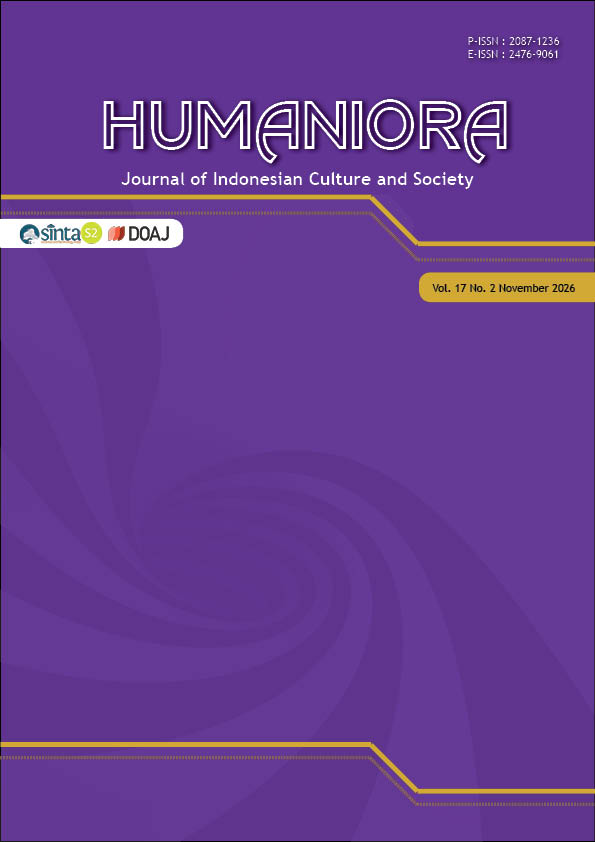
Cultural Appropriation as Local Identity: The Case of Dangdut Makassar
DOI:
https://doi.org/10.21512/humaniora.v17i2.14723Keywords:
music, cultural appropriation, dangdut Makassar, local identityAbstract
This study examines cultural appropriation in dangdut Makassar. While existing studies on dangdut and cultural appropriation tend to emphasize musical hybridity or commercialization, they rarely examine the role of local community agency in transforming appropriated forms into recognized local identities. Employing a qualitative approach with data collected through observation, interviews, documentation, and literature review, the analysis was conducted using data triangulation to ensure validity. Fieldwork was conducted in Makassar through observations of live performances and community events, complemented by in-depth interviews with musicians, cultural practitioners, and audience members. The findings reveal three main factors driving cultural appropriation in dangdut Makassar: musical, economic, and socio-cultural factors. Borrowings from Malay, Arab, Sundanese, koplo, and Western musical styles appear in melodic structures, arrangements, and performance practices. Despite these external influences, dangdut Makassar is widely perceived as a distinctive local identity due to regional cultural markers such as traditional costumes, local instruments (pui-pui, kacaping, and gandrang), and the use of the Makassar language in its lyrics. Furthermore, dangdut Makassar is broadly accepted and utilized in various community contexts, including economic activities, political events, socio-cultural practices, and digital or technological spaces. These findings suggest that cultural appropriation in dangdut Makassar should be understood not as a unidirectional borrowing process, but as a socially negotiated practice through which external influences are localized, legitimized, and re-signified as markers of regional identity.
References
Abidin, C., & Lee, J. (2023). K-pop TikTok: TikTok’s expansion into South Korea, TikTok stage, and platformed glocalization. Media International Australia, 188(1), 86–111. https://doi.org/10.1177/1329878X231186445
Aditya, B., & Muttaqin, M. (2025). BRODUT: Adaptasi musik dangdut dalam kesenian kubro siswo di dusun gunung lemah kabupaten Magelang. Ranah Research: Journal of Multidisciplinary Research and Development, 7(6), 4106–4118. https://doi.org/10.38035/rrj.v7i6.1728
Adriyani, A., Putera, A. S., Amran, S. O., Triyandra, A. C., Hendra, M. D., & Giswhandani, M. (2024). Populisme dangdut dalam bingkai budaya populer. Jurnal Perspektif, 7(1), 102–111. https://doi.org/10.24036/perspektif.v7i1.897
Alfien, Moh. F., & Wardani, N. E. (2025). Ketidakadilan gender dalam lirik lagu tarling dangdut. Bahtera Indonesia: Jurnal Penelitian Bahasa Dan Sastra Indonesia, 10(1), 126–137. https://doi.org/10.31943/bi.v10i1.955
Anugrah, S., Ferdinal, F., & Sudarmoko, S. (2023). Penampil dan khalayak dalam pertunjukan sastra lisan bagurau saluang dendang klasik di kecamatan lima kaum. Stilistika: Jurnal Pendidikan Bahasa Dan Sastra, 16(1), 131–144. https://doi.org/10.30651/st.v16i1.16329
Budiawan, H., Torondek, T. R. A., Nyarong, W. W., & Koswara, J. (2024). Public responsibility towards Indonesian idol’s music talent: An adorno perspective. Resital: Jurnal Seni Pertunjukan, 25(2), 1–20. https://doi.org/10.24821/resital.v25i2.13421
Colpani, Gianmaria. (2022). Two theories of Hegemony: Stuart hall and Ernesto Laclau in conversation. Political Theory, 50(2), 221-246. https://doi.org/10.1177/00905917211019392
Darlene, E. (2024). Identitas kultural musik pop Indonesia dalam konteks seni urban. Tonika: Jurnal Penelitian Dan Pengkajian Seni, 7(1), 49–61. https://doi.org/10.37368/tonika.v7i1.573
Dila, D. A. F. (2025). Music, ritual, and community practice: An applied ethnomusicological analysis of kelentangan belian namang in kedang Ipil’s tepung tawar tradition. Applied Ethnomusicology Journal, 1(1), 59–70. https://doi.org/10.24821/ae.v1i1.15289
Fauzi, L., & Prasetyo, K. B. (2024). The existence of singa dangdut as a form of cultural reproduction of sisingaan art in Subang regency. Jurnal Sosiologi Dialektika Sosial, 10(1), 1–12. https://doi.org/10.29103/jsds.v10i1.14551
Gossin, A. (2000). Makassar Doeloe Makassar Kini Makassar Nanti. Yayasan Losari Makassar.
Hananta, F. G. (2023). Pergeseran instrumentasi dan karakteristik musik dangdut era digital di Jawa Timur. Repertoar Journal, 4(1), 14–25. https://doi.org/10.26740/rj.v4n1.p14-25
Hanifah, C. T., & Firdaus, D. (2026). Hipdut (Hip Hop Dangdut): Percampuran budaya ala generasi Z di ruang digital. Journal of Innovative and Creativity, 6(1), 825–829. https://doi.org/10.31004/joecy.v6i1.6630
Khabibah, S. U., & Gunawan, G. (2024). Respons generasi Z terhadap konser musik dalam kampanye politik 2024. Sasdaya: Gadjah Mada Journal of Humanities, 8(2), 153–167. https://doi.org/10.22146/sasdaya.14693
Liu, H., Kun Jiang, H. G., Tingting Xue, T. S. (2022). Bell shape embodying zhongyong: The pitch histogram of traditional Chinese anhemitonic pentatonic folk songs. Applied Sciences, 12(16). https://doi.org/10.3390/app12168343
Muhtar, S. W., Aris Setiawan, & Budi Setiyono. (2025). Dangdut Makassar as cultural representation: a study of musical identity. Viperarts: International Journal of Visual and Performing Arts, 7(2), 530–553. https://dx.doi.org/10.31763/viperarts.v7i2.2147
Qorib, F., & Indra Dewi, S. (2021). Sobat Ambyar: the phenomenon of fans, social media, and modern campursari music in popular culture. Jurnal Pekommas, 6(2), 67–76. https://doi.org/10.30818/jpkm.2021.2060209
Ramadhan & Wulandari. (2023). Hibriditas dalam musik campursari: kajian estetika musik. Visual Heritage: Jurnal Kreasi Seni dan Budaya, 5(2), 264–271. https://doi.org/10.30998/vh.v5i2.8236
Rubiyanto. (2025). Hybridity and media in dangdut music: origins, evolution, and its role in Indonesian and intercultural popular culture. Asian-European Music Research Journal, 16, 95–110. https://doi.org/10.30819/aemr.16-8
Rusnalasari, Z. Dwi. (2025). Cultural resilience in the digital era: A qualitative study on traditional music and urban adolescents in Makassar. Harmonia: Journal of Music and Arts, 3(3), 168–178. https://doi.org/10.61978/harmonia.v3i3.671
Rustanta, A. (2023). Dangdut koplo as a manifestation of popular culture in Indonesia. Jurnal Komunikasi, 15(2), 259–269. https://doi.org/10.24912/jk.v15i2.20684
Susanto, D., Risnita, & Jailani, M. S. (2023). Teknik pemeriksaan keabsahan data dalam penelitian ilmiah. Qosim: Jurnal Pendidikan, Sosial & Humaniora, 1(1), 53–61. https://doi.org/10.61104/jq.v1i1.60
Sutton, R. A. (2002). Calling back the spirit (music, dance, and cultural politics in lowland south Sulawesi. Oxford University Press.
Wahyudi, A., Laksono, J. T., Abdullah, Z., & Sriwulan, W. (2024). Campursari as a hybrid music: A case study on three models of campursari music. Resital : Jurnal Seni Pertunjukan, 25(3), 555–578. https://doi.org/10.24821/resital.v25i3.14343
Young, J. O. (2008). Cultural appropriation and the arts. In Cultural Appropriation and the Arts. Blackwell Publishing Ltd. https://doi.org/10.1002/9780470694190
Downloads
Published
How to Cite
Issue
Section
License
Copyright (c) 2026 Sri Wahyuni Muhtar, Aris Setiawan, Budi Setiyono

This work is licensed under a Creative Commons Attribution-ShareAlike 4.0 International License.
Authors who publish with this journal agree to the following terms:
a. Authors retain copyright and grant the journal right of first publication with the work simultaneously licensed under a Creative Commons Attribution License - Share Alike that allows others to share the work with an acknowledgment of the work's authorship and initial publication in this journal.
b. Authors are able to enter into separate, additional contractual arrangements for the non-exclusive distribution of the journal's published version of the work (e.g., post it to an institutional repository or publish it in a book), with an acknowledgment of its initial publication in this journal.
c. Authors are permitted and encouraged to post their work online (e.g., in institutional repositories or on their website) prior to and during the submission process, as it can lead to productive exchanges, as well as earlier and greater citation of published work.
USER RIGHTS
All articles published Open Access will be immediately and permanently free for everyone to read and download. We are continuously working with our author communities to select the best choice of license options, currently being defined for this journal as follows: Creative Commons Attribution-Share Alike (CC BY-SA)