Children’s Social Interaction in the Adaptation Process Due to Parent’s Job Mobility
DOI:
https://doi.org/10.21512/humaniora.v17i1.14150Keywords:
interaction, child, adaptation, mobilityAbstract
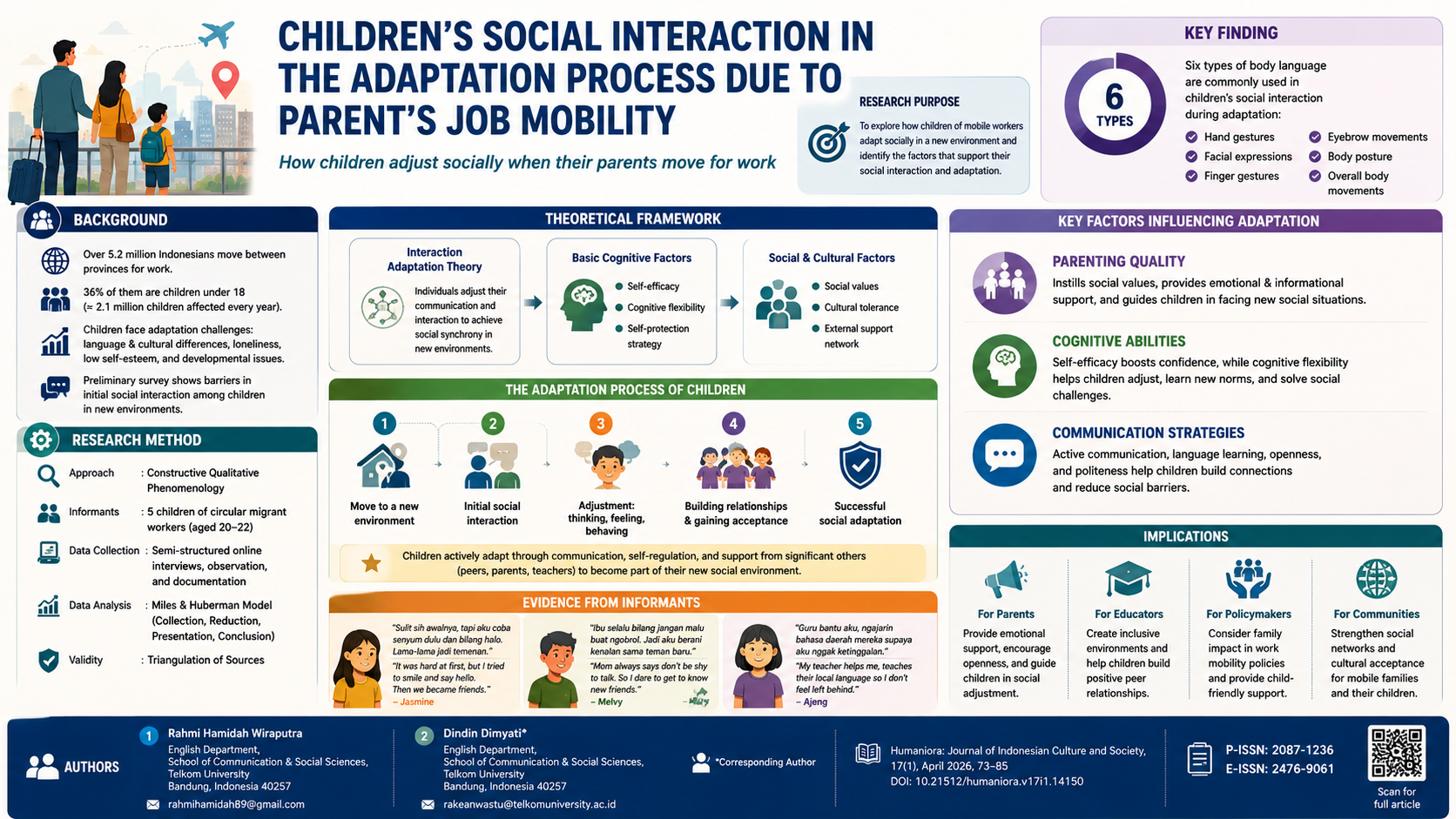
This research examines how parents' occupational mobility affects children's social relationships as they adjust to a new environment. Over 5.2 million people in Indonesia migrate between provinces to find work, of whom 36% have children under 18. Such a phenomenon leads to social and cultural adaptation problems for about 2.1 million children every year. Among the negative effects are difficulty with socialisation, loneliness, low self-esteem, and various developmental maladies, all of which stem from cultural, language, and communication differences in the new place. Results from the researcher's preliminary survey also confirm barriers to initial social interaction among children. Accordingly, this research uses constructive qualitative phenomenology to assess the social adaptation experiences of children of circular migrant workers. The data are collected through semi-structured online interviews with five informants (aged 20–22) based on specific criteria and are supplemented by observation and documentation. Data analysis follows the Miles and Huberman interactive model (collection, reduction, presentation, and conclusion) with source validity triangulation. Research findings indicate that the social adaptation of children of circular migrant workers is mediated by the quality of parenting, which instills social values to guide adaptation; cognitive abilities, such as self-efficacy and cognitive flexibility; and active communication strategies. The children develop language and interactional adjustment patterns based on Interaction Adaptation Theory to achieve social synchrony while drawing social capital from peer networks and significant figures such as teachers and parents.

References
Adhani, D. N. (2019). Peran orang tua terhadap anak usia dini (usia 2 tahun) yang mengalami picky eater. Aulad: Journal on Early Childhood, 2(1), 39-44. https://doi.org/10.31004/aulad.v2i1.18
Antara. (2024). Panglima TNI mutasi 61 perwira, dari Kadispenau hingga Asintel Kasad. Tempo.co. https://www.tempo.co/politik/panglima-tni-mutasi-61-perwira-dari-kadispenau-hingga-asintel-kasad-87476
Arndt, S., Smith, K., & Yelland, N. (2025). Conceptualising “the more-than-migrant child”. Qualitative Research Journal, 25(5), 527-534. https://doi.org/10.1108/QRJ-03-2024-0065
Padilah, A. H., & Afhiani, S. N. (2024). Successful team strategy in winning regional head candidate pairs (A study of the Sambas district elections from 2011, 2015 and 2020). International Journal of Sustainable Applied Sciences, 2(1), 13-28. https://doi.org/10.59890/ijsas.v2i1.1209
Azpiazu, L., Antonio-Aguirre, I., Izar-de-la-Funte, I., & Fernández-Lasarte, O. (2024). School adjustment in adolescence explained by social support, resilience and positive affect. European Journal of Psychology of Education, 39(4), 3709-3728. https://doi.org/10.1007/s10212-023-00785-3
Badan Pusat Statistik. (2021). Analisis mobilitas tenaga kerja hasil Sakernas 2020. https://www.bps.go.id/id/publication/2021/11/17/bf53c37506d4a38a2a700f5a/analisis-mobilitas-tenaga-kerja-hasil-survei-angkatan-kerja-nasional-2020.html
Badan Pusat Statistik. (2023). Analisis Mobilitas Tenaga Kerja Hasil Sakernas 2022. https://www.bps.go.id/id/publication/2023/10/27/83d4aaefa732e79efa75107b/analisis-mobilitas-tenaga-kerja-hasil-sakernas-2022.html
Barkhordari-Sharifabad, M., Alipour, Z., & Jahantab, R. (2025). The role of reflective capacity in clinical self-efficacy of nursing students: A cross-sectional study. BMC Medical Education, 25(1), 614. https://doi.org/10.1186/s12909-025-07201-y
Biasutti, M., & Concina, E. (2021). Including migrant students in the primary school: Perspectives of Italian principals. International Journal of Educational Management, 35(5), 984-999. https://doi.org/10.1108/IJEM-01-2021-0028
BKN RI. (2019). Peraturan Badan Kepegawaian Negara Republik Indonesia Nomor 5 Tahun 2019 tentang Tata Cara Pelaksanaan Mutasi. https://www.bkn.go.id/regulasi/peraturan-bkn-no-5-tahun-2019/
BKN RI. (2024). Rencana Kerja Deputi Bidang Mutasi Kepegawaian. https://www.bkn.go.id/unggahan/2024/05/Rencana-Kerja-Kedeputian-Bidang-Mutasi-Kepegawaian-Tahun-2024.pdf
Compas, B. E., Connor-Smith, J. K., Saltzman, H., Thomsen, A. H., & Wadsworth, M. E. (2001). Coping with stress during childhood and adolescence: Problems, progress, and potential in theory and research. Psychological bulletin, 127(1), 87-127. https://doi.org/10.1037/0033-2909.127.1.87
Doolittle, B. R. (2021). Association of burnout with emotional coping strategies, friendship, and institutional support among internal medicine physicians. Journal of clinical psychology in medical settings, 28(2), 361-367. https://doi.org/10.1007/s10880-020-09724-6
Ewert, C., Buechner, A., & Schröder-Abé, M. (2024). Stress perception and coping as mediators of the link between self-compassion and affective well-being? Evidence from two longitudinal studies. Mindfulness, 15(2), 372-388. https://doi.org/10.1007/s12671-023-02295-1
García, J. L., & Heckman, J. J. (2023). Parenting promotes social mobility within and across generations. Annual Review of Economics, 15, 349-388. https://doi.org/10.1146/annurev-economics-021423-031905
Gasiorek, J., Weatherall, A., & Watson, B. (2021). Interactional adjustment: Three approaches in language and social psychology. Journal of Language and Social Psychology, 40(1), 102-119. https://doi.org/10.1177/0261927X20965652
Goncalves, D. C. (2020). Distinctive ethical challenges in qualitative research with migrant children. Qualitative Research Journal, 20(3), 293-303. https://doi.org/10.1108/QRJ-10-2019-0076
Hockenbury, D. (2018). Discovering Psychology. Worth Publishers.
Hoehl, S., Fairhurst, M., & Schirmer, A. (2021). Interactional synchrony: Signals, mechanisms and benefits. Social cognitive and affective neuroscience, 16(1-2), 5-18. https://doi.org/10.1093/scan/nsaa024
Jiang, R., Xiao, Z., Jiang, Y., & Jiang, X. (2025). The neural mechanisms of private speech in second language learners’ oral production: An fNIRS study. Brain Sciences, 15(5), 451. https://doi.org/10.3390/brainsci15050451
Jin, J. (2023). The impact of parenting styles on children’s social adjustment and development. Journal of Education, Humanities and Social Sciences, 22, 867-872. https://doi.org/10.54097/ehss.v22i.14554
Khoirunnisa, K., Aquino, A., Parestorian, P. H., & Kurniawan, K. (2023). Strategi coping stres orang tua yang memiliki anak berkebutuhan khusus: A scoping review. Jurnal Keperawatan Jiwa, 11(1), 110-120. http://dx.doi.org/10.26714/jkj.11.1.2023.110-120
Latifah, S. I., & Karni, A. (2025). Pendidikan multikultural sebagai alat untuk mencegah diskriminasi di sekolah: Peran guru sebagai pemimpin. RAYAH AL-ISLAM: STIBA Arraayah Sukabumi, 8(4), 2420-2431.
Magara, I. (2025). Interaksi sosial dan pembentukan nilai-nilai budaya. In Mosaik Peradaban: Interaksi Manusia dan Kebudayaan (p. 277). CV. Gita Lentera.
Martinez-Yarza, N., Solabarrieta-Eizaguirre, J., & Santibáñez-Gruber, R. (2024). The impact of family involvement on students’ social-emotional development: The mediational role of school engagement. European Journal of Psychology of Education, 39(4), 4297-4327. https://doi.org/10.1007/s10212-024-00862-1
Mengxia, L. (2024). Preschoolers’ cognitive flexibility and emotion understanding: A developmental perspective. Frontiers in psychology, 15, 1280739. https://doi.org/10.3389/fpsyg.2024.1280739
Morissan. (2024). Teori komunikasi individu hingga massa (Ed Revisi). Prenada Media.
Nainggolan, G. R., & Nababan, P. N. (2024). Peran pendidikan multikultural dalam mempromosikan toleransi dan mengatasi diskriminasi di sekolah. Jurnal Pendidikan Merdeka Belajar, 1(2), 37-40.
Ningsih, E. P. (2024). Peran interaksi sosial dalam pengembangan keterampilan sosial anak usia dini: studi kasus di taman kanak-kanak. Journal of Gemilang, 1(1), 1-7. https://doi.org/10.62872/tpvbw823
Rahayu, D. K., & Martini, S. (2022). Peran moda transportasi darat dalam mobilitas tenaga kerja. Jurnal Transportasi, 22(2), 109-116. https://doi.org/10.26593/jtrans.v22i2.6061.109-116
Rubin, J. D., Chen, K., & Tung, A. (2024). Generation Z’s challenges to financial independence: Adolescents’ and early emerging adults’ perspectives on their financial futures. Journal of Adolescent Research, 07435584241256572. https://doi.org/10.1177/07435584241256572
Shiiku, S., & Takeuchi, Y. (2024). Exploring the mutual adaptation of large language models and emergent decision-making in simulated small group interactions. In Proceedings of the 12th International Conference on Human-Agent Interaction (pp. 270-277). https://doi.org/10.1145/3687272.3688317
Silveira-Zaldivar, T., Özerk, G., & Özerk, K. (2020). Developing social skills and social competence in children with autism. International Electronic Journal of Elementary Education, 13(3), 341–363. https://doi.org/10.26822/IEJEE.2021.195
Tualaka, Y. N. (2023). Dukungan sosial orang tua: Pilar pengembangan kecerdasan interpersonal pada anak usia dini. Buletin K-PIN, 6(1).
Widyarto, W. G., & Rifauddin, M. (2024). Problematika anak pekerja migran di Tulungagung dalam perspektif bimbingan dan konseling. Jurnal Kajian Bimbingan Dan Konseling, 5(3), 91-103. https://dx.doi.org/10.17977/um001v5i32020p091
Yazid, S., & Lie, L. D. J. (2020). Dampak pandemi terhadap mobilitas manusia di Asia Tenggara. Jurnal Ilmiah Hubungan Internasional, 75-83. https://doi.org/10.26593/jihi.v0i0.3862.75-83
Zhao, N., Yang, S., Zhang, Q., Wang, J., Xie, W., Tan, Y., & Zhou, T. (2024). School bullying results in poor psychological conditions: Evidence from a survey of 95,545 subjects. Frontiers in psychology, 15, 1279872. https://doi.org/10.3389/fpsyg.2024.1279872
Downloads
Published
How to Cite
Issue
Section
License
Copyright (c) 2026 Rahmi Hamidah Wiraputra, DINDIN DIMYATI

This work is licensed under a Creative Commons Attribution-ShareAlike 4.0 International License.
Authors who publish with this journal agree to the following terms:
a. Authors retain copyright and grant the journal right of first publication with the work simultaneously licensed under a Creative Commons Attribution License - Share Alike that allows others to share the work with an acknowledgment of the work's authorship and initial publication in this journal.
b. Authors are able to enter into separate, additional contractual arrangements for the non-exclusive distribution of the journal's published version of the work (e.g., post it to an institutional repository or publish it in a book), with an acknowledgment of its initial publication in this journal.
c. Authors are permitted and encouraged to post their work online (e.g., in institutional repositories or on their website) prior to and during the submission process, as it can lead to productive exchanges, as well as earlier and greater citation of published work.
USER RIGHTS
All articles published Open Access will be immediately and permanently free for everyone to read and download. We are continuously working with our author communities to select the best choice of license options, currently being defined for this journal as follows: Creative Commons Attribution-Share Alike (CC BY-SA)