Inclusive Game-Based Learning with Design Thinking for Vocational Slow Learner Students
DOI:
https://doi.org/10.21512/humaniora.v17i1.14083Keywords:
design thinking, Game-Based Learning, inclusive, slow learner, vocational schoolAbstract
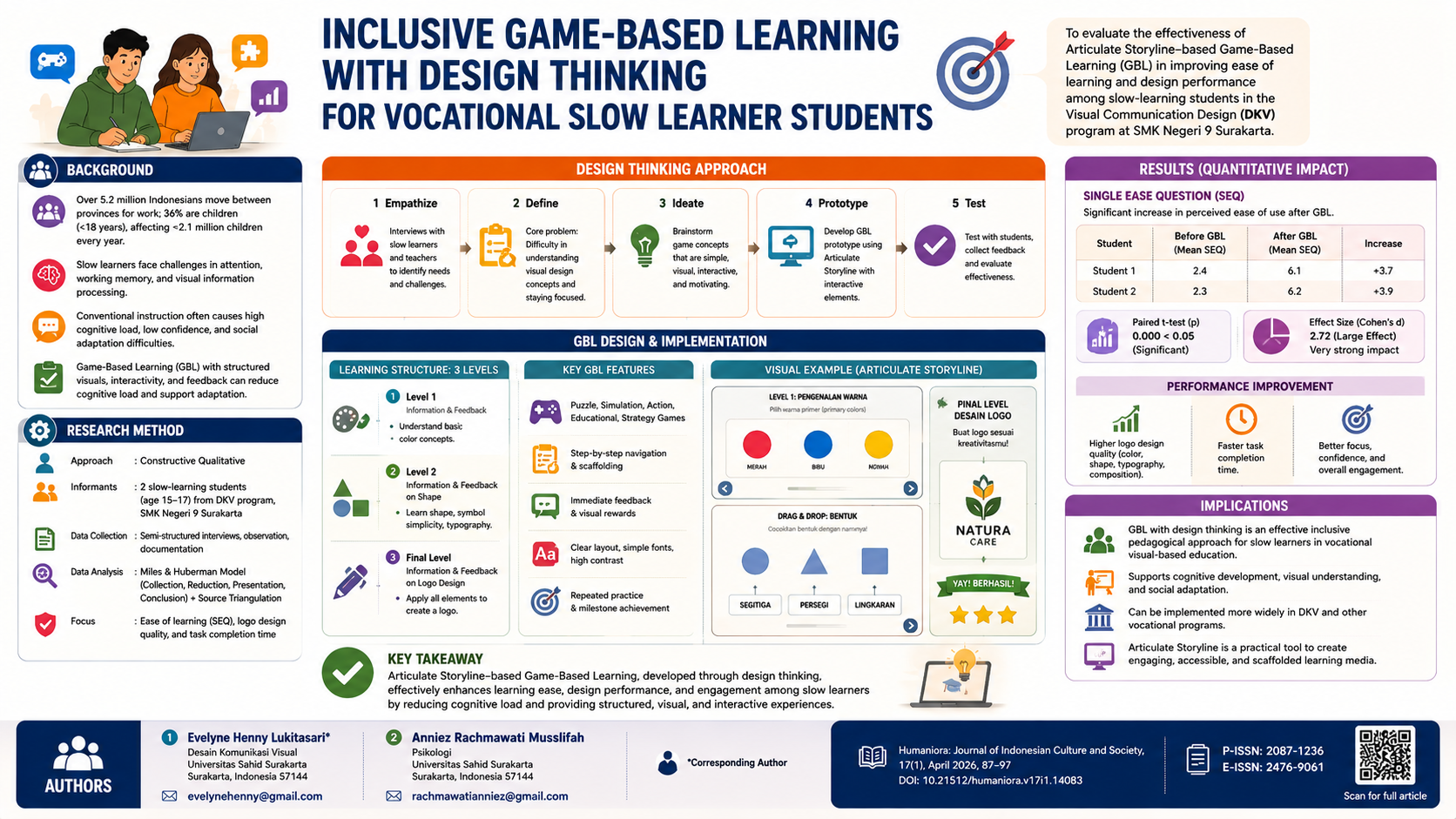
Slow-learning students in the Visual Communication Design (DKV) Expertise Program face challenges in attention, working memory, and visual information processing that are often suboptimal for conventional learning environments. Information technology-based Game-Based Learning (GBL) offers an interactive learning experience that reduces cognitive load through visualization, structured navigation, and immediate feedback. This research aims to evaluate the effectiveness of Articulate Storyline-based GBL in improving ease of learning and design performance among slow-learning students at SMK Negeri 9 Surakarta. The GBL model is developed using a design thinking approach and tested on two slow-learning students. Effectiveness is measured using the Single Ease Question (SEQ), logo design quality analysis, and task completion time. Statistical analysis employs a paired t-test and effect size calculation (Cohen’s d) to assess pedagogical impact. The SEQ results show a significant increase in perceived ease of use following GBL implementation. Student 1’s score increases from 2.4 to 6.1, while Student 2’s score increases from 2.3 to 6.2. These improvements indicate that GBL effectively supports slow-learning students in understanding learning tasks in a more structured and accessible manner. GBL features such as step-by-step interactions, mini-games, and immediate feedback help reduce cognitive barriers, improve focus, and strengthen students’ confidence in completing visual design assignments. Overall, Articulate Storyline-based GBL demonstrates effectiveness as an inclusive pedagogical approach in DKV learning and shows strong potential for wider implementation in visual-based vocational education.

References
Aghasafari, S., Needles, T., & Malloy, M. (2025). Multimedia arts learning: Connecting STEAM among special education students. Discover Education, 4(1), 44217. https://doi.org/10.1007/s44217-025-00440-7
Barz, N., Benick, M., Dörrenbächer-Ulrich, L., & Perels, F. (2024). The effect of digital game-based learning interventions on cognitive, metacognitive, and affective-motivational learning outcomes in school: A meta-analysis. Review of Educational Research, 94(2), 193-227. https://doi.org/10.3102/00346543231167795
Chang, C. C., Hwang, G. J., & Ou, L. S. (2025). Fostering the life skills of learners with intellectual disabilities using interactive technologies: A motivational model-based digital game-based training approach. Journal of Computer Assisted Learning, 41(2), 70026. https://doi.org/10.1111/jcal.70026
Chang, C. C., & Yang, S. T. (2023). Interactive effects of scaffolding digital game-based learning and cognitive style on adult learners’ emotion, cognitive load and learning performance. International Journal of Educational Technology in Higher Education, 20(1). https://doi.org/10.1186/s41239-023-00385-7
Chumairo, P. Z., Efendi, M., Samawi, A., Hidayaturrahman, D., Ediyanto, E., & Sunandar, A. (2022). Game interaktif berbasis universal design learning bagi siswa slow learner di sekolah inklusi. Jurnal Pendidikan (Teori dan Praktik), 6(2), 123-128. https://doi.org/10.26740/jp.v6n2.p123-128
Dahalan, F., Alias, N., & Shaharom, M. S. N. (2024). Gamification and game based learning for vocational education and training: A systematic literature review. Education and information technologies, 29(2), 1279-1317. https://doi.org/10.1007/s10639-022-11548-w
Darmawan, I., Anwar, M. S., Rahmatulloh, A., & Sulastri, H. (2022). Design thinking approach for User Interface design and User Experience on campus academic information systems. International Journal on Informatics Visualization, 6(2), 327-334. https://doi.org/10.30630/joiv.6.2.997
Dignath, C., Rimm-Kaufman, S., van Ewijk, R., & Kunter, M. (2022). Teachers’ beliefs about inclusive education and insights on what contributes to those beliefs: A meta-analytical study. Educational psychology review, 34(4), 2609-2660. https://doi.org/10.1007/s10648-022-09695-0
Doyle, A. J., O’Toole, M., Cassidy, D., & Condron, C. M. (2025). Universal Design for Learning (UDL) in simulation-based health professions education. Advances in Simulation, 10(1), 1-12. https://doi.org/10.1186/s41077-025-00361-3
Goodall, G., Mjøen, O. M., Witsø, A. E., Horghagen, S., & Kvam, L. (2022). Barriers and facilitators in the transition from higher education to employment for students with disabilities: A rapid systematic review. Frontiers in Education, 7(April), 1-15. https://doi.org/10.3389/feduc.2022.882066
Gui, Y., Cai, Z., Yang, Y., Kong, L., Fan, X., & Tai, R. H. (2023). Effectiveness of digital educational game and game design in STEM learning: A meta-analytic review. International Journal of STEM Education, 10(1), 36. https://doi.org/10.1186/s40594-023-00424-9
Heliawati, L., Lidiawati, L., & Pursitasari, I. D. (2022). Articulate storyline 3 multimedia based on gamification to improve critical thinking skills and self-regulated learning. International Journal of Evaluation and Research in Education, 11(3), 1435-1444. https://doi.org/10.11591/ijere.v11i3.22168
Jääskä, E., Lehtinen, J., Kujala, J., & Kauppila, O. (2022). Game-based learning and students’ motivation in project management education. Project Leadership and Society, 3, 100055. https://doi.org/10.1016/j.plas.2022.100055
Joseph, B., & Abraham, S. (2023). Identifying slow learners in an e-learning environment using K-Means clustering approach. Knowledge Management & E-Learning, 15(4), 539-553. https://doi.org/10.34105/j.kmel.2023.15.031
Kala, N., & Ayas, A. (2023). Effect of instructional design based on cognitive load theory on students’ performances and the indicators of element interactivity. Journal of Turkish Science Education, 20(3), 468-489. https://doi.org/10.36681/tused.2023.027
Downloads
Published
How to Cite
Issue
Section
License
Copyright (c) 2026 Evelyne Henny Lukitasari, Anniez Rachmawati Musslifah

This work is licensed under a Creative Commons Attribution-ShareAlike 4.0 International License.
Authors who publish with this journal agree to the following terms:
a. Authors retain copyright and grant the journal right of first publication with the work simultaneously licensed under a Creative Commons Attribution License - Share Alike that allows others to share the work with an acknowledgment of the work's authorship and initial publication in this journal.
b. Authors are able to enter into separate, additional contractual arrangements for the non-exclusive distribution of the journal's published version of the work (e.g., post it to an institutional repository or publish it in a book), with an acknowledgment of its initial publication in this journal.
c. Authors are permitted and encouraged to post their work online (e.g., in institutional repositories or on their website) prior to and during the submission process, as it can lead to productive exchanges, as well as earlier and greater citation of published work.
USER RIGHTS
All articles published Open Access will be immediately and permanently free for everyone to read and download. We are continuously working with our author communities to select the best choice of license options, currently being defined for this journal as follows: Creative Commons Attribution-Share Alike (CC BY-SA)