Body Language in Youtube-Based Product Endorsements by Indonesian Influencers
DOI:
https://doi.org/10.21512/humaniora.v17i1.14074Keywords:
body language, online communication, business endorsementAbstract
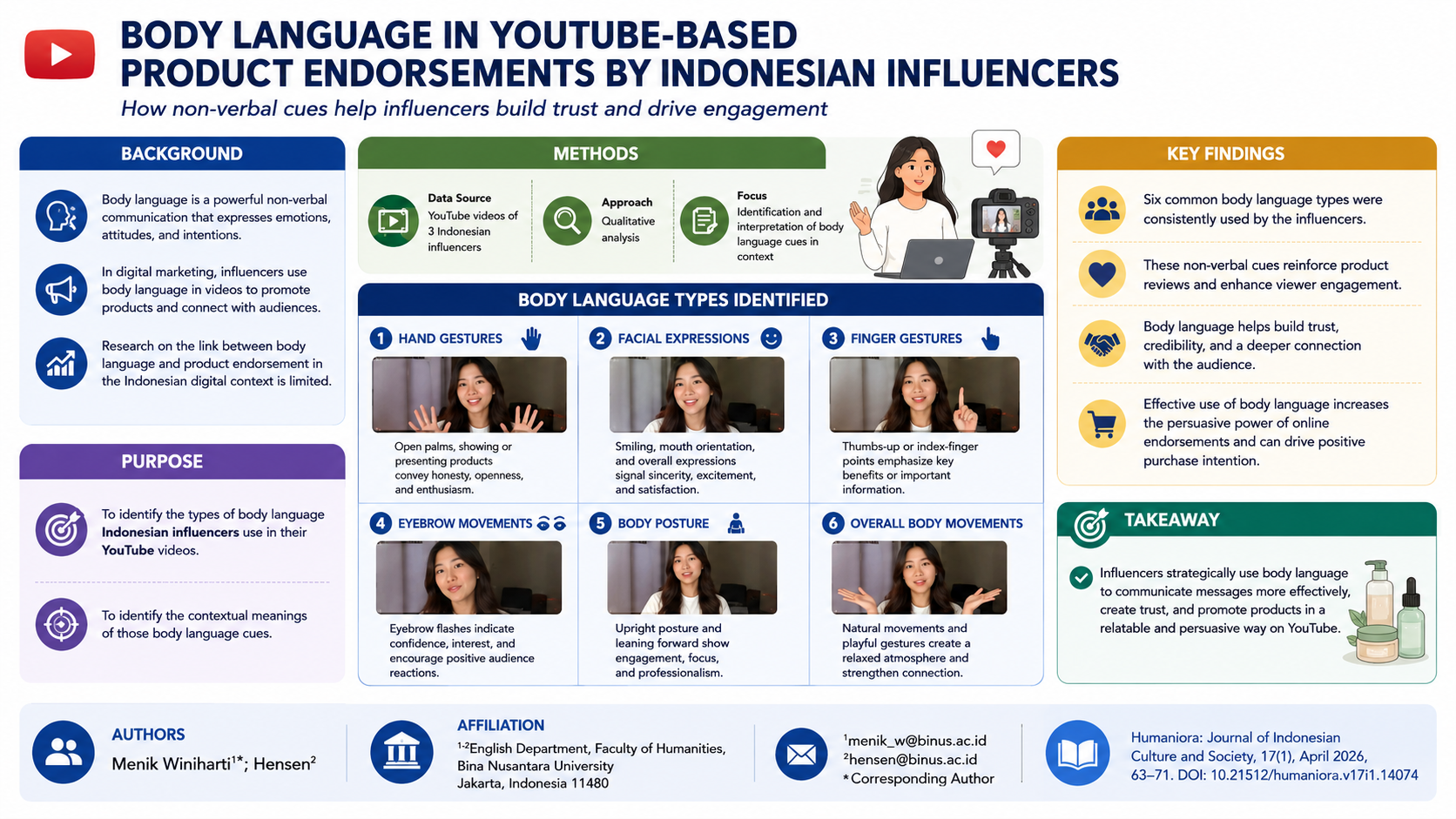
Body language plays a crucial role in non-verbal communication by expressing emotions, attitudes, and intentions. Its dynamic nature allows individuals to convey diverse meanings, particularly in professional and business settings. Given the limited studies on the association between body language and product endorsement in the Indonesian digital context, the present research aims to fill this gap. Therefore, the goal is to identify the types of body language Indonesian influencers use in their YouTube videos. It also aims to identify their contextual meanings. The data for this research are collected from videos of three Indonesian YouTube influencers. A qualitative approach is employed to analyze body language. The findings highlight six common types of body language used by the influencers: hand gestures, facial expressions, finger gestures, eyebrow movements, body posture, and overall body movements. These non-verbal cues are strategically used to reinforce product reviews and increase viewer engagement. By incorporating these physical expressions, influencers can more effectively communicate their promotional messages and foster a deeper connection with their audience. These findings underscore the importance of body language in enhancing the persuasive power of online endorsements, particularly on social media platforms, within the Indonesian cultural context.

References
Abdulghafor, R., Turaev, S., & Ali, M. A. H. (2022). Body language analysis in healthcare: An overview. Healthcare, 10(7), 1251. https://doi.org/10.3390/healthcare10071251
Armstrong, D. F. (2002). Original signs: Gesture, sign, and the sources of language. Gallaudet University Press.
Cialdini, R. B. (2009). Influence: Science and practice. Pearson.
Clift, R., & Rossi, G. (2024). Speaker eyebrow raises in the transition space. Social interaction. Video-based studies of human sociality, 6(3). https://doi.org/10.7146/si.v6i3.142897
Clough, S., & Duff, M. C. (2020). The role of gesture in communication and cognition: Implications for understanding and treating neurogenic communication disorders. Frontiers in Human Neuroscience, 14(323), 1-22. https://doi.org/10.3389/fnhum.2020.00323
Cuilan, J. T., Chavez, J. V., Soliva, K. J. G., Jaafar, S. H., Savellon, K. I. S., Tantalie, E. M., & Alban, S. E. (2024). Verbal and non-verbal communication patterns of persuasive selling among live online sellers. Environment and Social Psychology, 9(8). https://doi.org/10.59429/esp.v9i8.2519
Dahlan, S., Wulandari, S., & Ramdani, A. (2024). Facial expressions: Non-verbal communication in Eastern Indonesia. In Proceedings of ICoLT-Hybird Conference, 1(1), 202-211.
Ebbesen, C. L., & Froemke, R. C. (2021). Body language signals for rodent social communication. Current Opinion in Neurobiology, 68, 91-106. https://doi.org/10.1016/j.conb.2021.01.008
Figueiro, M., & Law, C. (2024, September 24). Smirking psychology: Decoding the subtle art of facial expression. https://neurolaunch.com/psychology-of-smirking/
Gillespie-Lynch, K. (2017). Gestural theory of language evolution. City University of New York.
Haq, M. D., & Chiu, C. M. (2024). Boosting online user engagement with short video endorsement content on TikTok via the image transfer mechanism. Electronic Commerce Research and Applications, 64, 101379. https://doi.org/10.1016/j.elerap.2024.101379
Hömke, P., Levinson, S. C., Emmendorfer, A. K., & Holler, J. (2025). Eyebrow movements as signals of communicative problems in human face-to-face interaction. Royal Society Open Science, 12(3), 1-32. https://doi.org/10.1098/rsos.241632
Ismail, N. A. S., Mageswaran, N., Bujang, S. M., & Besar, M. N. A. (2024). Beyond words: Analyzing non-verbal communication techniques in a medical communication skills course via synchronous online platform. Frontiers in Medicine, 11, 1-17. https://doi.org/10.3389/fmed.2024.1375982
Galdón-Salvador, J. L., Gil-Pechuán, I., AlFraihat, S. F. A., & Tarabieh, S. M. Z. A. (2024). Effect of social media influencers on consumer brand engagement and its implications on business decision making. Profesional de La Información, 33(2). https://doi.org/10.3145/epi.2024.0210
Keck, J., Zabicki, A., Bachmann, J., Munzert, J., & Krüger, B. (2022). Decoding spatiotemporal features of emotional body language in social interactions. Scientific Reports, 12(1), 15088. https://doi.org/10.1038/s41598-022-19267-5
Lin, K., & Broadbent, E. (2023). Understanding embodied effects of posture: A qualitative study. Psych, 5(2), 447-460. https://doi.org/10.3390/psych5020030
Liu, M., Schwab, J., & Hess, U. (2023). Language and face in interactions: Emotion perception, social meanings, and communicative intentions. Frontiers in Psychology, 14, 1-12. https://doi.org/10.3389/fpsyg.2023.1146494
Lombardo, S. M. (2024). The role of YouTube channel characteristics in shaping followers’ purchase intentions and behavioural engagement: The serial mediation of satisfaction and channel loyalty. Italian Journal of Marketing, 2024(3), 247-265. https://doi.org/10.1007/s43039-024-00095-6
Luo, C., Hasan, N. A. M., Zamri bin Ahmad, A. M., & Lei, G. (2025). Influence of short video content on consumers purchase intentions on social media platforms with trust as a mediator. Scientific Reports, 15(1), 16605. https://doi.org/10.1038/s41598-025-94994-z
Macuch Silva, V., Holler, J., Ozyurek, A., & Roberts, S. G. (2020). Multimodality and the origin of a novel communication system in face-to-face interaction. Royal Society Open Science, 7(1), 182056. https://doi.org/10.1098/rsos.182056
Milazzo, F., Augello, A., Pilato, G., Gentile, V., Gentile, A., & Sorce, S. (2017). Exploiting correlation between body gestures and spoken sentences for real-time emotion recognition. In Proceedings of the 12th Biannual Conference on Italian SIGCHI Chapter, 1-6. https://doi.org/10.1145/3125571.3125590
Ruth, M. (2022). Eye Contact. https://www.ebsco.com/research-starters/communication-and-mass-media/eye-contact
Sajjad, T., Khan, H. F., Yasmeen, R., & Waqas, A. (2023). Language of actions: The effects of teacher’s kinesics on student learning and learning environment. Journal of Education and Health Promotion, 12(1), 1-6. https://doi.org/10.4103/jehp.jehp_992_22
Sathik, M., & Jonathan, S. G. (2013). Effect of facial expressions on student’s comprehension recognition in virtual educational environments. SpringerPlus, 2(1), 455. https://doi.org/10.1186/2193-1801-2-455
Sheng, X., Qiao, K., Li, Z., Li, Z., & Zhang, Y. (2025). “Welcoming with a smile”: How anchors’ facial expressions drive consumer purchasing behavior. Aslib Journal of Information Management. https://doi.org/10.1108/AJIM-11-2024-0883
Shoukat, M. H., Selem, K. M., & Shah, S. A. (2023). How does social media influencer credibility blow the promotional horn? A dual mediation model. Journal of Relationship Marketing, 22(3), 172-201. https://doi.org/10.1080/15332667.2023.2197767
Sokolov, A. A., Zeidman, P., Erb, M., Pollick, F. E., Fallgatter, A. J., Ryvlin, P., Friston, K. J., & Pavlova, M. A. (2020). Brain circuits signaling the absence of emotion in body language. Proceedings of the National Academy of Sciences, 117(34), 20868-20873. https://doi.org/10.1073/pnas.2007141117
Tipper, C. M., Signorini, G., & Grafton, S. T. (2015). Body language in the brain: Constructing meaning from expressive movement. Frontiers in Human Neuroscience, 9. https://doi.org/10.3389/fnhum.2015.00450
Xia, Y. X., Chae, S. W., & Xiang, Y. C. (2024). How social and media cues induce live streaming impulse buying? SOR model perspective. Frontiers in Psychology, 15. https://doi.org/10.3389/fpsyg.2024.1379992
Yang, H., Xu, X., & Wang, B. (2025). The power of body language: Understanding anchor’s body language and the success of live-streaming e-commerce. Nankai Business Review International, 16(2), 332-358. https://doi.org/10.1108/NBRI-01-2024-0010
Yoo, J. J., Kim, H., & Choi, S. (2024). Expanding knowledge on emotional dynamics and viewer engagement: The role of travel influencers on YouTube. Journal of Innovation & Knowledge, 9(4), 100616. https://doi.org/10.1016/j.jik.2024.100616
Zhang, M. M., & Ng, Y. M. M. (2024). Beyond dislike counts: How YouTube users react to the visibility of social cues. New Media & Society, 28(1), 230-249. https://doi.org/10.1177/14614448241287510
Zhang, Z., Bowcher, W. L., & Yang, B. (2025). Toward a system of gesture–speech relations in elementary science teaching. Journal of Research in Science Teaching, 62(5), 1298-1318. https://doi.org/10.1002/tea.21997
Zhu, L., & Wang, Y. (2025). Acting real: A cross-cultural investigation of finfluencer strategic authenticity. International Journal of Advertising, 44(1), 164-183. https://doi.org/10.1080/02650487.2024.2437289
Zloteanu, M., Krumhuber, E. G., & Richardson, D. C. (2021). Sitting in judgment: How body posture influences deception detection and gazing behavior. Behavioral Sciences, 11(6), 85. https://doi.org/10.3390/bs11060085
Downloads
Published
How to Cite
Issue
Section
License
Copyright (c) 2026 Menik Winiharti, Hensen Hensen

This work is licensed under a Creative Commons Attribution-ShareAlike 4.0 International License.
Authors who publish with this journal agree to the following terms:
a. Authors retain copyright and grant the journal right of first publication with the work simultaneously licensed under a Creative Commons Attribution License - Share Alike that allows others to share the work with an acknowledgment of the work's authorship and initial publication in this journal.
b. Authors are able to enter into separate, additional contractual arrangements for the non-exclusive distribution of the journal's published version of the work (e.g., post it to an institutional repository or publish it in a book), with an acknowledgment of its initial publication in this journal.
c. Authors are permitted and encouraged to post their work online (e.g., in institutional repositories or on their website) prior to and during the submission process, as it can lead to productive exchanges, as well as earlier and greater citation of published work.
USER RIGHTS
All articles published Open Access will be immediately and permanently free for everyone to read and download. We are continuously working with our author communities to select the best choice of license options, currently being defined for this journal as follows: Creative Commons Attribution-Share Alike (CC BY-SA)