Disaster Resilience Through Social Capital Among Indonesian Migrant Workers in Taiwan
DOI:
https://doi.org/10.21512/humaniora.v17i1.14044Keywords:
migrant workers, disaster resilience, social capital, informal networks, TaiwanAbstract
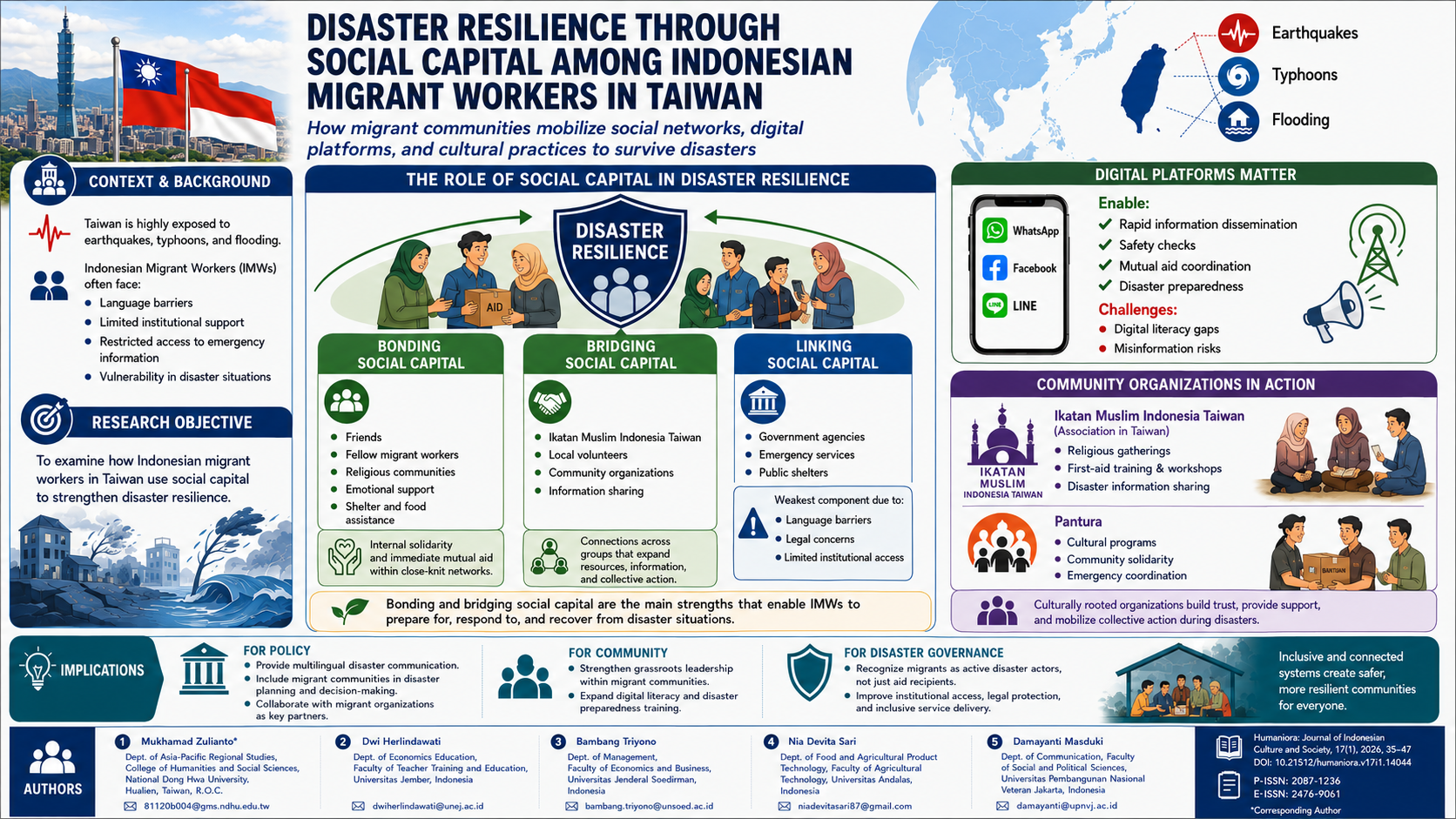
This research examines how Indonesian Migrant Workers (IMWs) in Taiwan build disaster resilience by mobilizing social capital, particularly in contexts where formal institutional support is limited or absent. Using an interpretive qualitative approach, the study adopts a case study design that includes semi-structured interviews and participant observation. The findings reveal that bonding and bridging social capital, developed through informal community connections, digital platforms, and shared religious and cultural practices, serve as critical assets for disaster preparedness and response. These networks enable mutual aid, timely information exchange, and collective action among IMWs during disaster situations. However, linking social capital appears weak, indicating limited engagement with formal institutions and restricted access to public resources and legal protections. Informal leadership structures and culturally rooted coping strategies continue to play a significant role in fostering grassroots resilience. Nonetheless, systemic challenges such as language barriers, precarious legal status, and digital exclusion continue to impede broader institutional integration. By highlighting the experiences and agency of IMWs, this research contributes meaningfully to the discourse on disaster governance. It underscores the importance of inclusive frameworks that acknowledge the capabilities of migrant communities as active disaster actors rather than passive recipients of aid. It advocates for the inclusion of community-based organizations in national disaster policies and recommends comparative studies across different migrant-receiving contexts to deepen understanding of transnational resilience dynamics.

References
Ahmad, Z., Soroya, S. H., & Mahmood, K. (2023). Bridging social capital through the use of social networking sites: A systematic literature review. Journal of Human Behavior in the Social Environment, 33(4), 473-489. https://doi.org/10.1080/10911359.2022.2064025
Akrim, A., Rudianto, R., & Adhani, A. (2021). Interactive effects of stoicism and religious coping on psychological distress, fatigue, and intercultural communication: Muslim health workers in Bali. Journal of Ethnic and Cultural Studies, 8(4), 214-237. https://doi.org/10.29333/ejecs/920
Alkilani, S., Loosemore, M., Hammad, A. W. A., & Kerr, S.-M. (2025). Refugees’, asylum seekers’ and migrants’ experiences of finding meaningful work in the Australian construction industry: A Bourdieusean analysis. Engineering, Construction and Architectural Management, 32(7), 4651-4672. https://doi.org/10.1108/ecam-11-2023-1212
Auethavornpipat, R., & Palmer, W. (2022). Indonesia’s promotion of UN Migrant Protection Norms in ASEAN. Pacific Affairs, 95(1), 75-97. https://doi.org/10.5509/202295175
Azad, M. J., & Pritchard, B. (2023). Bonding, bridging, linking social capital as mutually reinforcing elements in adaptive capacity development to flood hazard: Insights from rural Bangladesh. Climate Risk Management, 40, 100498. https://doi.org/10.1016/j.crm.2023.100498
Balraj, S., Gajendran, N., Palanivel, N., Murugesan, N., & Gopalan, K. (2025, April). Disaster response using social media. In AIP Conference Proceedings Vol. 3279, No. 1, p. 020093. AIP Publishing LLC. https://doi.org/10.1063/5.0262882
Banerjee, S. (2021). “Who leaves home if there is a choice?”: Migration decisions of women workers on tea plantations in India. Transfers, 11(2), 53-75. https://doi.org/10.3167/trans.2021.110205
Boddy, J., O’Leary, P., & Panagiotaros, C. V. (2021). Hope during and post-disasters: Social work’s role in creating and nurturing emancipatory hope. The British Journal of Social Work, 51(5), 1917-1934. https://doi.org/10.1093/bjsw/bcab140
Chen, G., Nie, Q., & Zhao, H. (2023). The influence factors of organizational resilience from a CSR perspective and their impact on business growth. Sustainability, 15(22), 15712. https://doi.org/10.3390/su152215712
Chen, M., & Li, W. (2024). Social capital development on interest-based networks: Examining its antecedents, process, and consequences. Humanities and Social Sciences Communications, 11(1), 1-10. https://doi.org/10.1057/s41599-024-02609-1
Collier, S. J. (2025). The disaster contradiction of contemporary capitalism: Resilience, vital systems security, and ‘post-neoliberalism.’ Geoforum, 159, 104204. https://doi.org/10.1016/j.geoforum.2025.104204
Hellerstein, J. K., & Neumark, D. (2020). Social capital, networks, and economic wellbeing. The Future of Children, 30(1), 127-152. https://doi.org/10.1353/foc.2020.0002
Jackson, M. O. (2020). A typology of social capital and associated network measures. Social Choice and Welfare, 54(2), 311-336. https://doi.org/10.1007/s00355-019-01189-3
Kim, Y., Boulware, J. N., Nusbaum, H. C., & Henly, A. (2024). Civic virtues, wisdom, and psychological resilience. In N. E. Snow, The Self, Civic Virtue, and Public Life (1st Ed., pp. 21-36). Routledge. https://doi.org/10.4324/9781003367857-3
Kivi, H. K., Rezaee, R., Peyravi, M., & Marzaleh, M. A. (2023). Identifying the components and effective factors in disaster education to improve adolescents’ resilience: A thematic analysis. Journal of Education and Health Promotion, 12(1), 185. https://doi.org/10.4103/jehp.jehp_847_22
Kovács, Á. J., Juhász, S., Bokányi, E., & Lengyel, B. (2023). Income-related spatial concentration of individual social capital in cities. Environment and Planning B: Urban Analytics and City Science, 50(4), 1072-1086. https://doi.org/10.1177/23998083221120663
Lim, S., Min, B. H., & Berlan, D. G. (2024). The non-profit role in building community social capital: A moderated mediation model of organizational learning, innovation, and shared mission for social capital creation. Non-profit and Voluntary Sector Quarterly, 53(1), 210-235. https://doi.org/10.1177/08997640221146965
Liu, W., & Ni, L. (2022). Natural disaster preparedness, response, and recovery crisis communication. In Y. Jin & L. Austin, Social Media and Crisis Communication (2nd Ed., pp. 348-359). Routledge. https://doi.org/10.4324/9781003043409-42
Liu, Y., Rakthin, C., & Budianto, L. (2025). Religious moderation and community cohesion: Exploring social memory, identity, and solidarity in the Phu Khao Thong Muslim community, Ayutthaya. Millah: Journal of Religious Studies, 24(1), 379-392. https://doi.org/10.20885/millah.vol24.iss1.art10
Maksum, A., Tsay, C., & Muhammad, A. (2021). Indonesian migrant workers in Taiwan: The state dilemma and people’s realities. Jurnal Ilmu Sosial Dan Ilmu Politik, 24(1), 80. https://doi.org/10.22146/jsp.51303
Marshall, A., Wilson, C. A., & Dale, A. (2023). Telecommunications and natural disasters in rural Australia: The role of digital capability in building disaster resilience. Journal of Rural Studies, 100, 102996. https://doi.org/10.1016/j.jrurstud.2023.03.004
Nowell, B., & Steelman, T. (2025). The weakness of weak ties: Do social capital investments among leaders pay off during times of disaster? Journal of Public Administration Research and Theory, 35(2), 180-198. https://doi.org/10.1093/jopart/muaf002
Ogie, R. I., James, S., Moore, A., Dilworth, T., Amirghasemi, M., & Whittaker, J. (2022a). Social media use in disaster recovery: A systematic literature review. International Journal of Disaster Risk Reduction, 70, 102783. https://doi.org/10.1016/j.ijdrr.2022.102783
Ogie, R. I., Moore, A., Wickramasuriya, R., Amirghasemi, M., James, S., & Dilworth, T. (2022b). Twitter data from the 2019–20 Australian bushfires reveals participatory and temporal variations in social media use for disaster recovery. Scientific Reports, 12(1), 16914. https://doi.org/10.1038/s41598-022-21265-6
Pénard, T., & Poussing, N. (2010). Internet use and social capital: The strength of virtual ties. Journal of Economic Issues, 44(3), 569-595. https://doi.org/10.2753/jei0021-3624440301
Ruiu, M. L. (2016). The social capital of cohousing communities. Sociology, 50(2), 400-415. https://doi.org/10.1177/0038038515573473
Saja, A. M. A., Teo, M., Goonetilleke, A., & Ziyath, A. M. (2021). A critical review of social resilience properties and pathways in disaster management. International Journal of Disaster Risk Science, 12(6), 790-804. https://doi.org/10.1007/s13753-021-00378-y
Sharp, E. N., & Carter, H. (2020). Examination of how social media can inform the management of volunteers during a flood disaster. Journal of Flood Risk Management, 13(4), 1-10. https://doi.org/10.1111/jfr3.12665
Sienkiewicz-Małyjurek, K. (2022). Social capital and transformational leadership in building the resilience of local governance networks. Sustainability, 14(8), 1-18. https://doi.org/10.3390/su14084720
Spratt, C., Hong, J., McAreavey, K., & Liu, W. (2019). Community-based measures for social capital. In L. M. Aiello, C. Cherifi, H. Cherifi, R. Lambiotte, P. Lió, & L. M. Rocha (Eds.), Complex Networks and Their Applications VII (Vol. 813, pp. 327-338). Cham: Springer International Publishing. https://doi.org/10.1007/978-3-030-05414-4_26
Su, H., Zhao, X., Wang, L., & Li, Y. (2024). How rural community resilience evolves after a disaster? A case study of the eastern Qinghai-Tibetan plateau, China. Applied Geography, 165, 103238. https://doi.org/10.1016/j.apgeog.2024.103238
Theodosopoulos, L., Fradelos, E. C., Panagiotou, A., Dreliozi, A., & Tzavella, F. (2024). Delivering culturally competent care to migrants by healthcare personnel: A crucial aspect of delivering culturally sensitive care. Social Sciences, 13(10), 530. https://doi.org/10.3390/socsci13100530
Vanderhorst, H. R., Suresh, S., Renukappa, S., & Heesom, D. (2021). Strategic framework of unmanned aerial systems integration in the disaster management public organisations of the Dominican Republic. International Journal of Disaster Risk Reduction, 56, 102088. https://doi.org/10.1016/j.ijdrr.2021.102088
Yildiz, C. Ç., & Yildirim, D. (2022). The effects of disaster nursing education program on beliefs in general disaster preparedness, disaster response self-efficacy, and psychological resilience in nursing students: A single-blind, randomized controlled study. Nursing Education Perspectives, 43(5), 287-291. https://doi.org/10.1097/01.nep.0000000000001011
Zhang, X., Ye, J., Wang, D., Tian, F., & Fu, S. (2023). Leadership mindsets, cultural norms and organizational resilience in China: The moderating effect of supportive human resource practices. Asia Pacific Business Review, 29(1), 248-265. https://doi.org/10.1080/13602381.2022.2139452
Zulianto, M., Budiono, A., Nanda, I., Ramadhan, I., Masduki, D., Triyono, B., & Indriawati, P. (2025). The social media of migrant workers: A bibliometric analysis. Salud, Ciencia y Tecnología, 5, 1-18. https://doi.org/10.56294/saludcyt20251890
Downloads
Published
How to Cite
Issue
Section
License
Copyright (c) 2026 Mukhamad Zulianto, Dwi Herlindawati, Bambang Triyono, Nia Devita Sari, Damayanti Masduki

This work is licensed under a Creative Commons Attribution-ShareAlike 4.0 International License.
Authors who publish with this journal agree to the following terms:
a. Authors retain copyright and grant the journal right of first publication with the work simultaneously licensed under a Creative Commons Attribution License - Share Alike that allows others to share the work with an acknowledgment of the work's authorship and initial publication in this journal.
b. Authors are able to enter into separate, additional contractual arrangements for the non-exclusive distribution of the journal's published version of the work (e.g., post it to an institutional repository or publish it in a book), with an acknowledgment of its initial publication in this journal.
c. Authors are permitted and encouraged to post their work online (e.g., in institutional repositories or on their website) prior to and during the submission process, as it can lead to productive exchanges, as well as earlier and greater citation of published work.
USER RIGHTS
All articles published Open Access will be immediately and permanently free for everyone to read and download. We are continuously working with our author communities to select the best choice of license options, currently being defined for this journal as follows: Creative Commons Attribution-Share Alike (CC BY-SA)