Online Reviews as Marketing Communications and Impact on Aloha Pantai Indah Kapuk
DOI:
https://doi.org/10.21512/humaniora.v17i1.14037Keywords:
online reviews, tourist decision-making, quantitative analysis, destination marketing, digital reputation managementAbstract
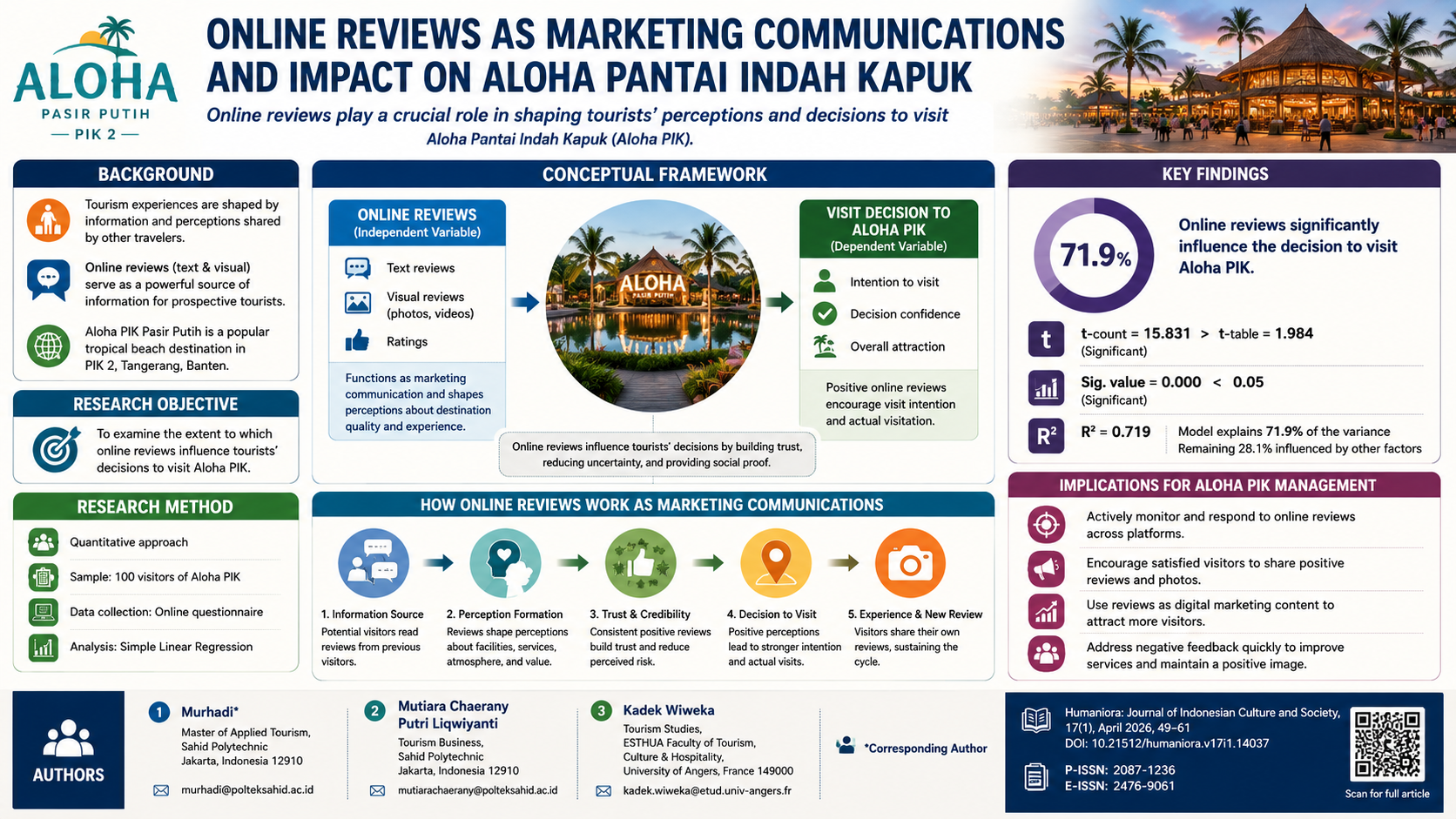
This research examines the extent to which online reviews influence tourists’ decisions to visit Aloha PIK tourist attractions. Reviews from visitors, in both text and visual forms, serve as a source of information that greatly influences prospective tourists’ perceptions and decisions. This research uses a quantitative method with a sample of 100 Aloha PIK visitors and collects data through an online questionnaire. Based on the test results using simple linear regression, the t-count (15.831) is greater than the t-table value (1.984), and the significance value is 0.000 < 0.05. These results show that the independent variable has a significant effect on the dependent variable. In addition, the coefficient of determination (R²) of 0.719 indicates that the research model explains 71.9% of the variance, with the remaining 28.1% attributable to factors outside the model. In conclusion, 71.9% of respondents are influenced by online reviews in their decision to visit Aloha PIK. These findings confirm that managing digital reviews should be an integral part of a tourist destination’s marketing communication strategy. The implications of this research suggest that tourist destination managers should actively monitor, respond to, and manage online reviews as part of their digital marketing strategy. Positive reviews strengthen the destination’s image and encourage interest in visiting, while negative reviews require a measured response to avoid eroding potential tourists’ trust.

References
Alhamdi, R. (2023). Pengaruh online review dan harga terhadap keputusan pemesanan kamar hotel di online travel agent (studi kasus Kota Batam). Jurnal Manajemen Perhotelan, 9(2), 63-70. https://doi.org/10.9744/jmp.9.2.63-70
Ariansyah, K., Prawiro, J. W. H., & Sanjaya, R. D. (2023). Pengaruh ulasan online terhadap keputusan wisatawan dalam memilih hotel. Jurnal Pariwisata dan Perhotelan, 2(2), 1-8. https://doi.org/10.47134/pjpp.v2i2.3559
Aureliano-Silva, L., Leung, X., & Spers, E. E. (2021). The effect of online reviews on restaurant visit intentions: Applying signaling and involvement theories. Journal of Hospitality and Tourism Technology, 12(4), 672-688. https://doi.org/10.1108/JHTT-06-2020-0143
Chelbi, A., Chabou Othmani, M., & Ben Said, F. (2020). Market segmentation in urban tourism: Exploring the influence of personal factors on tourists' perception. Journal of Tourism and Services, 20(11), 74-108. https://doi.org/10.29036/jots.v11i20.144
Dini, F., Fanggidae, R., Salean, D., & Fanggidae, R. (2023). Pengaruh Electronic Word of Mouth (E-WOM) dan promosi wisata terhadap minat berkunjung wisatawan ke objek wisata Pantai Motadikin, Kabupaten Malaka. Glory Jurnal Ekonomi dan Ilmu Sosial, 4(5), 1069-1087. https://doi.org/10.35508/glory.v4i5.11704
Devkota, N., Karjdka, K., Siwakoti, R., Klimova, M., & Dhahal, K. (2022). Promoting sustainable tourist behavior through promotional marketing. Journal of Tourism and Services, 26(14), 219-241. https://doi.org/10.29036/jots.v14i26.512
Fadillah, N., & Harmawan, V. (2025). Pengaruh online review terhadap brand image di UNP Hotel & Convention Center Padang. Nawasena: Jurnal Ilmiah Pariwisata, 4(1), 15-28. https://doi.org/10.56910/nawasena.v4i1.1916
Fatchudin, M. A., & Santoso, A. B. (2022). Analisis kesesuaian dan daya dukung kawasan wisata Pantai Marina Kecamatan Semarang Barat Kota Semarang. Geo Image (Spatial-Ecological-Regional), 11(2), 189-197. https://doi.org/10.15294/geoimage.v11i2.59171
Filieri, R., & McLeay, F. (2021). E-WOM and accommodation: An analysis of the factors that influence travelers’ adoption of information from online reviews. Journal of Travel Research, 60(3), 685-703. https://doi.org/10.1177/0047287513481274
Goker, G., & Ayar, İ. (2022). Intermediary role of nostalgia tendency in the effect of electronic word of mouth communication on tourists' destination visit intentions. Journal of Tourism & Services, 20(11), 44-58. https://doi.org/10.29036/jots.v11i20.140
Gour, A., Aggarwal, S., & Erdem, M. (2021). Reading between the lines: Analyzing online reviews by using a multi-method Web-analytics approach. International Journal of Contemporary Hospitality Management, 33(2), 490-512. https://doi.org/10.1108/IJCHM-07-2020-0760
Hervás-Cortina, C. M., Gil-Saura, I., & Ruiz-Molina, M. E. (2024). Exploring the role of tourism destination communications in shaping tourist E-WOM intentions. Journal of Tourism and Services, 29(15), 111-131. https://doi.org/10.29036/jots.v15i29.756
I Agustí, D. P. (2021). Mapping gender in tourist behaviour based on Instagram. Journal of Outdoor Recreation and Tourism, 35, 100381. https://doi.org/10.1016/j.jort.2021.100381
Kadi, D. C. A., Purwanto, H., & Vonseica, B. R. (2021). Pengaruh destination image terhadap revisit intention dan intention to recommend melalui satisfaction sebagai variabel intervening. Management and Business Review, 5(2), 176-187. https://doi.org/10.21067/mbr.v5i2.5820
Kara, N. S., & Mkwizu, K. H. (2020). Demographic factors and travel motivation among leisure tourists in Tanzania. International Hospitality Review, 34(1), 81-103. https://doi.org/10.1108/IHR-01-2020-0002.
Marder, B., Erz, A., Angell, R., & Plangger, K. (2021). The role of photograph aesthetics on online review sites: Effects of management-versus traveler-generated photos on tourists’ decision making. Journal of Travel Research, 60(1), 31-46. https://doi.org/10.1177/0047287519895125
Marques, J., Gomes, S., Ferreira, M., Rebuá, M., & Marques, H. (2024). Generation Z and travel Motivations: The impact of age, gender, and residence. Journal Tourism and Hospitality, 6(82), 2-16. https://doi.org/10.3390/tourhosp6020082
Matalas, A., Panaretos, D., Tzoutzou, M., & Lazaridis, G. (2023). Food-related behaviours of female and male tourists before and during the COVID-19 pandemic. Sexes, 4(1), 167-187. https://doi.org/10.3390/sexes4010014
Prayag, G., Hosany, S., Muskat, B., & Del Chiappa, G. (2021). Understanding the relationships between tourist's emotional experiences, perceived overall image, satisfaction, and intention to recommend. Journal of Travel Research, 60(7), 1510-1529. https://doi.org/10.1177/0047287515620567
Pratiwi, Z., & Prakosa, A. (2021). Pengaruh media sosial, event pariwisata dan fasilitas pelayanan terhadap minat berkunjung kembali di Sandboarding Gumuk Pasir Parangkusumo. Jurnal Fokus Manajemen Bisnis, 11(1), 74-94. https://doi.org/10.12928/fokus.v11i1.3851
Qustolani, A., Hernita, N., & Nurazizah, E. (2023). Pengaruh Electronic Word of Mouth, harga tiket dan lokasi terhadap keputusan berkunjung ke objek wisata Panyaweuyan. Jurnal Bisnis Manajemen dan Kewirausahaan, 4(2), 222-239. https://doi.org/10.31949/entrepreneur.v4i2.5678
Setiawan, W., & Azizah, N. (2024). From feeds to beaches: Social media driving coastal tourism. Proceedings International Conference on Marine Tourism and Hospitality Studies, 1(1), 147-154. https://doi.org/10.33649/iconmths.v1i1.442
Setyowati, H., & Liliyan, A. (2022). Pengaruh E-WOM, fasilitas, daya tarik wisata, dan harga terhadap minat berkunjung Taman Satwa Taru Jurug. Jurnal Manajemen Perhotelan dan Pariwisata, 5(1), 24-31. https://doi.org/10.23887/jmpp.v5i1.44773
Sugiarti, T., & Fikri, M. A. (2021). Tingkat kepuasan wisatawan terhadap Sapta Pesona Wisata Air Terjun Sududo. Jurnal Ekonomi Pertanian dan Agribisnis (JEPA), 5(1), 245-256. https://doi.org/10.21776/ub.jepa.2021.005.01.23
Suparno, I. N., & Asti, N. M. (2023). Pengaruh experiential marketing dan electronic word of mouth terhadap revisit intention melalui brand image sebagai variabel mediasi. Jurnal Penelitian dan Pengembangan Sains dan Humaniora, 7(2), 244-255. https://doi.org/10.23887/jppsh.v7i2.54873
Rif’an, A., Maarif, F., & Situmorang, D. A. G. (2024). Understanding Generation Z’s ecotourism motivation and perception in Central Sulawesi. Journal Wasian, 11(2), 39-46. https://doi.org/10.62142/4wsdga12
Utama, I. P. H. B., & Giantari, I. G. A. K. (2020). Peran citra destinasi memediasi pengaruh E-WOM terhadap niat berkunjung kembali wisatawan (studi pada objek wisata Taman Edelwies Bali). E-Jurnal Manajemen, 9(4), 1230-1251. https://doi.org/10.24843/EJMUNUD.2020.v09.i04.p01
Verma, K., Dhodi, R. K., & Dhodi, R. (2021). The influence of Instagram on Generation Z travel motivation and destination choice making to the actual travelling. Technology and Social Transformations in Hospitality, Tourism and Gastronomy, 42(1), 54-63. https://doi.org/10.1079/9781800621244.0005
Virtarini, A., & Ngatno. (2020). Pengaruh Electronic Word of Mouth dan electronic Service Quality pada akun Instagram @Explore Semarang terhadap keputusan berkunjung melalui minat berkunjung sebagai variabel mediasi (studi pada pengunjung tempat wisata Lawang Sewu, Sam Poo Kong dan Masjid Agung Jawa Tengah). Jurnal Administrasi Bisnis, 9(1), 316-332. https://doi.org/10.14710/jiab.2020.26369
Wibisono, M. R., & Arifiansyah, R. (2024). Pengaruh E WOM, citra destinasi, dan persepsi harga terhadap keputusan berkunjung di Taman Mini Indonesia Indah. Jurnal Manajemen Perhotelan dan Pariwisata, 7(1), 67-78. https://doi.org/10.23887/jmpp.v7i1.76082
Zhang, J., Lai, I. K. W., & Wong, J. W. C. (2024). Female travellers in hospitality and tourism industry: A systematic literature review. Heliyon, 10(5), e27256. https://doi.org/10.1016/j.heliyon.2024.e27256
Downloads
Published
How to Cite
Issue
Section
License
Copyright (c) 2026 Murhadi Isnandar

This work is licensed under a Creative Commons Attribution-ShareAlike 4.0 International License.
Authors who publish with this journal agree to the following terms:
a. Authors retain copyright and grant the journal right of first publication with the work simultaneously licensed under a Creative Commons Attribution License - Share Alike that allows others to share the work with an acknowledgment of the work's authorship and initial publication in this journal.
b. Authors are able to enter into separate, additional contractual arrangements for the non-exclusive distribution of the journal's published version of the work (e.g., post it to an institutional repository or publish it in a book), with an acknowledgment of its initial publication in this journal.
c. Authors are permitted and encouraged to post their work online (e.g., in institutional repositories or on their website) prior to and during the submission process, as it can lead to productive exchanges, as well as earlier and greater citation of published work.
USER RIGHTS
All articles published Open Access will be immediately and permanently free for everyone to read and download. We are continuously working with our author communities to select the best choice of license options, currently being defined for this journal as follows: Creative Commons Attribution-Share Alike (CC BY-SA)