Unlocking Architecture and Heritage Potential for Village Tourism in Lahat Regency
DOI:
https://doi.org/10.21512/humaniora.v17i1.13807Keywords:
cultural heritage tourism, megaliths and architecture, rumah baghi, villagesAbstract
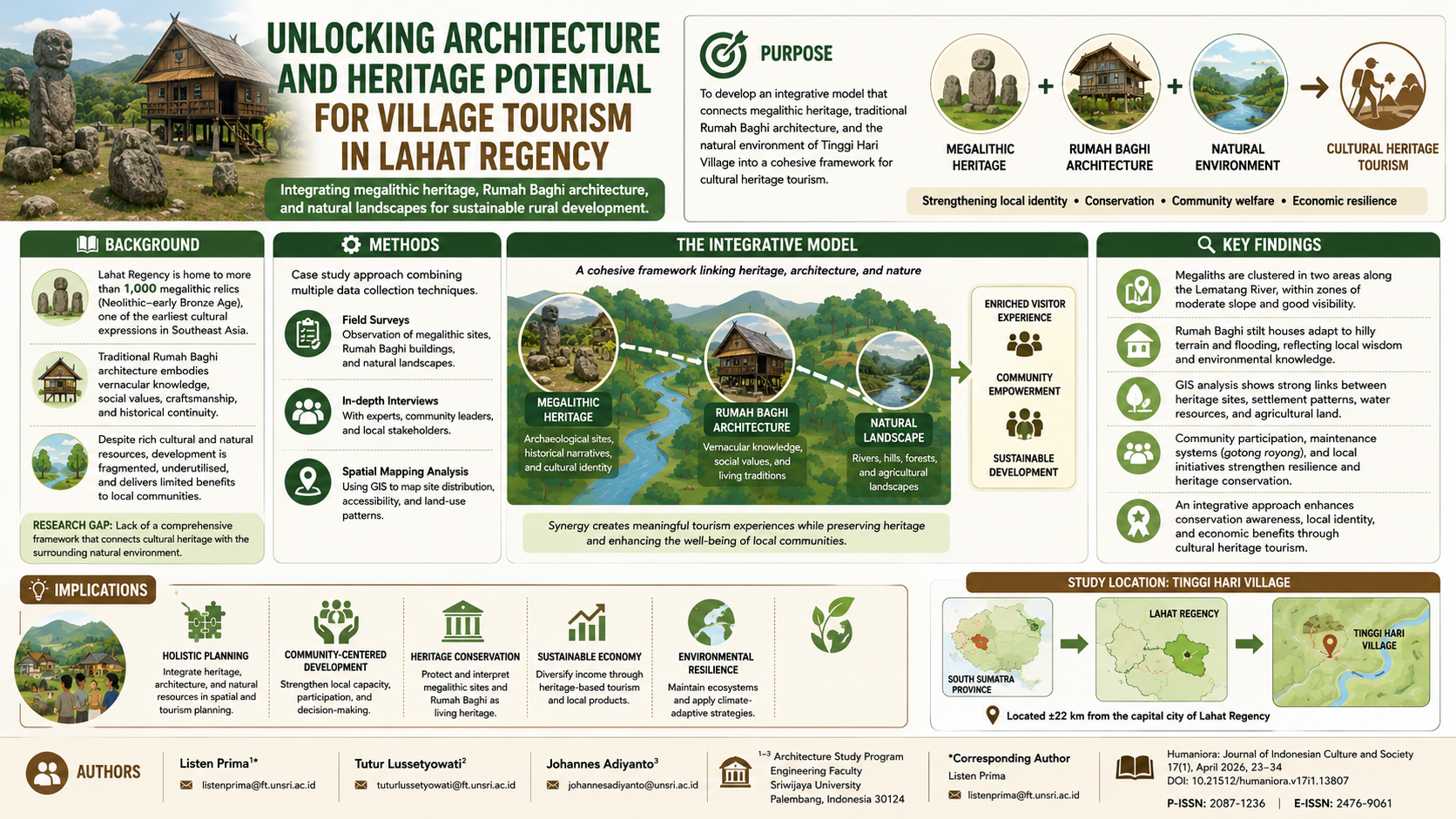
Cultural heritage plays a vital role in supporting sustainable development, particularly within the growing field of heritage-based tourism. Tinggi Hari Village in Lahat Regency, South Sumatra Province, offers a distinctive combination of cultural and natural attractions, which positions it as a valuable site for integrated tourism development. The village’s key heritage assets include the megalithic sites, which are considered among the oldest in Southeast Asia, and the traditional Rumah Baghi architecture, which embodies vernacular knowledge, social values, craftsmanship, and historical continuity. Despite the richness of these resources, existing development programs tend to manage them in isolation or to overlook their interconnected significance, resulting in underutilised potential, fragmented planning, and limited benefits for local communities. This research addresses the lack of a comprehensive framework that connects cultural heritage with the surrounding natural environment. Adopting a case study methodology, this study combines field surveys, in-depth interviews with experts and community leaders, and spatial mapping analysis to explore viable pathways for integrating megalithic heritage, Rumah Baghi architecture, and natural landscapes into a cohesive cultural heritage tourism strategy. The findings reveal that aligning tangible heritage assets with environmental features not only enriches the visitor experience but also reinforces local identity, enhances conservation awareness, and contributes to economic resilience. The proposed integrative model provides practical insights and strategic guidance for heritage-rich rural areas that seek to advance sustainable development through culturally grounded and community-centred tourism initiatives.

References
Abdullah, Y. A., & Zulkifli, F. L. (2018). A conceptual paper on the theory of happiness in the neighbourhood. Asian Journal of Behavioural Studies (AjBeS), 3(912), 1-12. https://doi.org/10.21834/ajbes.v3i12.117
Adam, M. R., & Munanjar, M. C. (2025). Potensi kayu ulin (Eusideroxylon zwageri) sebagai material konstruksi berkelanjutan untuk infrastruktur jembatan kayu: Kajian literatur sistematis. Journal of Infrastructural in Civil Engineering, 6(2), 139-149. https://doi.org/10.33365/jice.v6i02.693
Alauwiyah, F., Prima, F. J., Azizah, S., Waicang, Y., Susanti, R., & Yati, R. M. (2025). Analisis corak megalitik pada tinggalan arkeologi di situs Tinggihari Kabupaten Lahat Sumatera Selatan. JIMPS: Jurnal Ilmiah Mahasiswa Pendidikan dan Sejarah, 10(1), 238-249. https://doi.org/10.24815/jimps.v10i1.30872
Al-Faris, R. S., & Herwandi, H. (2024). Acculturation of Malay and Javanese culture in Limas house building art: A comparative study of Limas houses and Joglo Limasan houses. Warisan: Journal of History and Cultural Heritage, 5(1), 7-15. https://doi.org/10.34007/warisan.v5i1.2082
Anggraeni, A., Tedjomurti, F., & Sudrajat, A. (2025). Peran pariwisata dalam pelestarian budaya lokal wisata Jopuro Banyuwangi. Jurnal Pariwisata dan Budaya, 1(2), 110-116. https://doi.org/10.33153/ranataya.v1i2.7859
Arni, Y., Fitri, E. A., Rahayu, C., & Darsin, D. (2026). The integration of local stilt-house architecture into natural disaster mitigation education in South Sumatra, Indonesia. Jàmbá-Journal of Disaster Risk Studies, 18(1), 1987. https://doi.org/10.4102/jamba.v18i1.1987
Asriana, N., & Khidmat, R. P. (2024). Decoding spatial layout patterns of traditional houses in urban kampung settlements. Journal of Architecture and Urbanism, 48(2), 151-175. https://doi.org/10.3846/jau.2024.20832
Asriana, N., Khidmat, R. P., Jaya, M. A., Ujung, V. A., Satria, W. D., & Andriani, R. (2024). Syntactic analysis of traditional houses in urban kampung. Built Heritage, 8(1), 25. https://doi.org/10.1186/s43238-024-00140-5
Aulia, A. N., & Veronica, S. (2024). Exploring Indonesia's vernacular architecture: Comparison of environment and culture responsiveness. Jurnal Koridor, 15(1), 48-59. https://doi.org/10.32734/koridor.v15i1.16519
Braun, V., & Clarke, V. (2006). Using thematic analysis in psychology. Qualitative Research in Psychology, 3(2), 77-101. https://doi.org/10.1191/1478088706qp063oa
Bręczewska-Kulesza, D. M., & Kaus, M. (2025). The importance of traditional housing as cultural architectural heritage, shaping the city's landscape and identity. Sustainability, 17(17), 7685. https://doi.org/10.3390/su17177685
Bonet, M. C. (2018). A plural discourse on the territory. In J. Schröder, M. Carta, & S. Hartmann (Eds.), Creative heritage (p. 62). Jovis.
Cahyani, L., Rahayu, H., Erviana, R., & Sepriliani, S. P. (2025). Eksplorasi etnomatematika rumah limas di Desa Anyar, Sumatera Selatan. Journal Numeracy, 12(1), 37-50. https://doi.org/10.46244/numeracy.v12i1.2818
Dewi, K., & Atmojo, M. E. (2025). Perubahan tata kelola pemerintahan desa dalam analisis keterlibatan politik berbasis pembangunan desa yang berkelanjutan. Moderat: Jurnal Ilmiah Ilmu Pemerintahan, 11(2), 416-433. https://doi.org/10.25157/moderat.v11i2.3932
Fauziah, F. (2025). A semiotic analysis of cultural and religious symbolism in the ornaments of an-Nur Grand Mosque Riau. Islam & Contemporary Issues, 5(1), 112-118. https://doi.org/10.57251/ici.v5i1.1731
Gorlach, K., Klekotko, M., & Nowak, P. (2014). Culture and rural development: Voices from Poland. Eastern European countryside. Sciendo, 20(1), 14. https://doi.org/10.2478/eec-2014-0001
Hadi, S., Marta, A., Amin, R. M., & Febrina, R. (2024). Rural development in community empowerment through the governance of Village-Owned Enterprises (BUMDes). Nakhoda: Jurnal Ilmu Pemerintahan, 23(1), 121-134. https://doi.org/10.35967/njip.v23i1.702
Hamzah, E. R., Ciptadi, W., Harimurti, P., Radhi, M., & Satyahadewi, N. (2024). Analisis semiotika ornamentasi pada rumah tradisional Melayu: Pengaruh budaya Islam dan adat Melayu. Empiricism Journal, 5(2), 169-194. https://doi.org/10.36312/ej.v5i2.1770
Hariyanto, A. D., Triyadi, S., & Widyowijatnoko, A. (2022). A simple stilt structure technique for earthquake resistance of wooden vernacular houses in Bima, Sumbawa Island, Indonesia. International Journal on Advanced Science Engineering and Information Technology, 12(4), 1491. https://doi.org/10.18517/ijaseit.12.4.12848
Harun, N. Z., Rosley, M. S. F., & Wasie, M. A. (2025). Urban heritage decline: Conservation challenges in the historic town of Chukai, Terengganu, Malaysia. International Journal of Built Environment and Sustainability, 12(3), 77-88. https://doi.org/10.11113/ijbes.v12.n3.1487
Haryotedjo, T. (2024). Pemaknaan ruang dalam pada arsitektur vernakular Jawa di Indonesia. Ideas: Jurnal Pendidikan, Sosial, dan Budaya, 10(4), 1175-1182. https://doi.org/10.32884/ideas.v10i4.1482
Hudaidah, H. (2021). Learning local wisdom on Pasemah megalithic relics in Lahat Regency, efforts to anticipate the negative impact of the industrial era 4.0. Universitas Sriwijaya Repository. https://repository.unsri.ac.id/108541/
Idrus, I., Paddiyatu, N., & Latif, S. (2024). Mengintegrasikan warisan budaya dalam arsitektur modern: Tinjauan literatur tentang menyeimbangkan keberlanjutan dan identitas. Jurnal Linears, 7(2). https://doi.org/10.26618/j-linears.v7i2.16019
Iskandar, I., Asysyauki, A. H., Angrini, S. N., & Diem, A. F. (2024). Semiotic analysis of Islamic architectural elements in Komering traditional houses: A study of Carahulu houses. Arsir, 8(2), 251-263. https://doi.org/10.32502/arsir.v8i2.231
Judijanto, L., & Malik, A. H. (2025). A systematic bibliometric review of cultural heritage conservation research. The Eastasouth Journal of Social Science and Humanities, 3(01), 66-79. https://doi.org/10.58812/esssh.v3i01.771
Karataş, E., Özköse, A., & Heyik, M. A. (2025). Sustainable heritage planning for urban mass tourism and rural abandonment: An integrated approach to the Safranbolu–Amasra eco-cultural route. Sustainability, 17(7), 3157. https://doi.org/10.3390/su17073157
Kraemer, M. U. G., Sadilek, A., Zhang, Q., Marchal, N. A., Tuli, G., Cohn, E. L., Hswen, Y., Perkins, T. A., Smith, D. L., Reiner, R. C., & Brownstein, J. S. (2020). Mapping global variation in human mobility. Nature Human Behaviour, 4(8), 800-810. https://doi.org/10.1038/s41562-020-0875-0
Kuang, Z., Zhang, J., Li, Y., & Fukuda, T. (2025). Preserving architectural heritage in urban renewal: A stable diffusion model framework for automated historical facade generation. npj Heritage Science, 13(1), 256. https://doi.org/10.1038/s40494-025-01826-4
Kusuma, A., & Ngarawula, B. (2024). Study and analysis of management of the Tinggi Hari megalith tourist attraction: A case study of community behavior in Simpur Village, Gumay Ulu District Lahat Regency, South Sumatra Province. International Journal of Research in Social Science and Humanities (IJRSS), 5(7), 155-173. https://doi.org/10.47505/IJRSS.2024.7.14
Thuc, L. D., Nguyen, M. V., Nguyen Van, D., & (2024). Prioritizing barriers to the conservation of cultural heritage buildings in adaptation to urbanization and climate change. Journal of Cleaner Production, 473, 143529. https://doi.org/10.1016/j.jclepro.2024.143529
Liu, X., Shao, M., Li, Y., Fan, W., Zhang, Y., & Zhang, A. (2025). A comparative study of the spatial morphology of traditional villages as sustainable cultural heritage: The case of Jiangnan Region. Sustainability, 18(1), 403. https://doi.org/10.3390/su18010403
Markolinda, Y., Sawirman, S., Ramadani, M., Yusya, F., Husna, N., Azmi, F., Surya, R. F., Taufiqurrahman, R. A., & Panjaitan, M. L. D. B. (2025). Indigenous knowledge for disaster mitigation and climate threats in Mentawai, Indonesia. Jàmbá-Journal of Disaster Risk Studies, 17(1), 1877. https://doi.org/10.4102/jamba.v17i1.1877
Mulfakli, Z., Zulherman, & Fuadi, A. B. (2025). Thermal comfort in Kobuang Limo house: Evaluating tropical architectural elements. Journal of Architectural Research and Design Studies, 9(2). https://doi.org/10.20885/jars.vol9.iss2.art4
Mulyadi, T. Martosenjoyo, I. Asmal, & E. Syarif (2025). Adaptive morphologies of stilt settlements in flood-prone Sempaja, Samarinda, Indonesia. SSRG International Journal of Civil Engineering, 12(6), 51-62. https://doi.org/10.14445/23488352/IJCE-V12I6P105
Nuraini, C., Alamsyah, B., Novalinda, P. S., & Sugiarto, A. (2023). Planning with ‘Three-World Structures’: A comparative study of settlement in mountain villages. Journal of Regional and City Planning, 34(1), 55-82. https://doi.org/10.5614/jpwk.2023.34.1.4
Pemerintah Kabupaten Lahat. (2023). Lahat, negeri seribu megalit, negeri situs megalit terbanyak di Indonesia. https://www.lahatkab.go.id/2021/01/02/lahat-negeri-seribu-megalit-negeri-situs-megalit-terbanyak-di-indonesia/
Paudyal, P., Dahal, P., Bhandari, P., & Dahal, B. K. (2023). Sustainable rural infrastructure: Guidelines for roadside slope excavation. Geoenvironmental Disasters, 10(1), 11. https://doi.org/10.1186/s40677-023-00240-x
Prima, L. (2020). Heritage-led sustainable development of Indonesia’s villages: Scenarios for village alliances in South Sumatera based on the concepts of heritage architecture and village monument [Doctoral dissertation, Gottfried Wilhelm Leibniz Universität Hannover]. Leibniz Information Center for Science and Technology University Library.
Prima, L., Sari, R., & Nuraeni, E. (2023). Foodscape and landscape heritage integration: A cultural-based design approach for Pulau Pinang in Lahat, South Sumatra. Sinektika: Jurnal Arsitektur, 20(2), 150-165. https://doi.org/10.23917/sinektika.vi.3359
Prima, L., & Yanto, Y. (2025). Heritage at the crossroads of geography and development: Case studies from Lahat Regency. Journal of Architecture & Environment, 24(2), 163-178. http://dx.doi.org/10.12962%2Fj2355262x.v24i2.a22910
Putra, H. J., & Mahendra, F. N. (2025). Transformation of settlement patterns and spatial structure in Kampung Melayu Tuatunu, Pangkalpinang. Journal of Architectural Research and Design Studies, 9(1), 11-21. https://doi.org/10.20885/jars.vol9.iss1.art2
Putra, R. A., Larasati, D., Indraprastha, A., & Kusuma, H. E. (2025). Factors influencing earthquake resistance in vernacular architecture: A systematic literature review of architecture indigenous knowledge. DIMENSI (Journal of Architecture and Built Environment, 52(1), 44-56. https://doi.org/10.9744/dimensi.52.1.44-56
Siregar, D. R., Barlian, E., Syah, N., Razak, A., & Diliarosta, S. (2023). Flood disaster adaptation in Mentawai district based on local wisdom: Comparative study of disaster-friendly houses (Uma). Jurnal Ilmiah PLATAX, 12(1), 107-113. https://doi.org/10.35800/jip.v12i1.53261
Ramadhan, A., & Zikri, M. (2025). Creative tourism as the key to community empowerment: Revitalising local narratives through cultural performances at Prambanan Temple. Journal of Tourism and Creativity, 9(1), 99-105. https://doi.org/10.19184/jtc.v9i1.53692
Saptaningtyas, R. S. (2025). Low-carbon strategies in traditional vernacular architecture. Journal of Sustainable Built Heritage, 4(1), 89-102. https://doi.org/10.53898/josse2025524
Sari, D. P., Sudirman, M., & Asmuliany, A. (2024). The design of earthquake evacuation spaces based on local wisdom: A case study of traditional houses in South Sulawesi. Designs, 8(2), 30. https://doi.org/10.3390/designs8020030
Sari, N., Parawu, H. E., & Taufik, A. (2024). Strategi meningkatkan partisipasi masyarakat dalam pembangunan desa yang berkelanjutan. Kolaborasi: Jurnal Administrasi Publik, 10(2), 107-121. https://doi.org/10.26618/kjap.v10i2.15459
Sebayang, T., Wibowo, R. P., Sembiring, S. A. A., & Lubis, A. A. R. D. (2025). Spatial price integration and asymmetric threshold effects in Red Shallot Markets between urban and rural areas: Evidence from North Sumatra, Indonesia. International Journal of Sustainable Development & Planning, 20(8). https://doi.org/10.18280/ijsdp.200835
Sepriyanti, B. R., Hani, P., & Teguh, H. A. P. (2024). Identifikasi pola pemukiman dan saluran pemasaran pertanian komoditi hortikultura di Kecamatan Suliki. Jurnal Permukiman: Direktorat Bina Teknik Permukiman dan Perumahan, 19(1), 45-55. https://doi.org/10.31815/jp.2024.19.45-55
Sommariva, E. (2018). Green communities and cultural biodiversity. In Creative Heritage (pp. 22–23). Jovis.
Suprapti, A., Sejati, A. W., Sardjono, A. B., Pandelaki, E. E., Malik, A., & Huwaida, N. M. (2020). Toward sustainable preservation of cultural heritage buildings: A combination of digital mapping and architectural mapping for Omah Pencu in the historic area of Kudus Kulon. Teknik, 41(3), 201-211. https://doi.org/10.14710/teknik.v41i3.27922
Triwurjani, R. (2018). Tinggalan megalitik di kawasan Pasemah Sumatera Selatan: Kajian arkeologi publik. KALPATARU, 27(1), 61-72.
UNESCO. (2015). Policy document for the integration of a sustainable development perspective into the processes of the World Heritage Convention. UNESCO World Heritage Centre.
Untari, D. W. (2024). Kecakapan akses pasar petani berbasis komunitas di pedesaan kawasan pantai Yogyakarta. Jurnal Penyuluhan, 20(2), 298-312. https://doi.org/10.25015/20202453521
Wargadalem, F. R., Siswanto, A., Ardiansyah, A., & Indriastuti, K. (2020). Preservation of megalithic sites as integrated tourism objects in Lahat Regency, South Sumatra. Paramita: Historical Studies Journal, 30(1), 108-120. https://doi.org/10.15294/paramita.v30i1.21698
Zhang, N., Xia, Z., Li, P., Chen, Q., Ke, G., Yue, F., Xu, Y., & Wang, T. (2025). The impact of rainfall and slope on hillslope runoff and erosion depending on machine learning. Frontiers in Environmental Science, 13, 1580149 https://doi.org/10.3389/fenvs.2025.1580149
Zhang, X., Yang, H., & An, Y. (2025). Spatial morphology and geographic adaptability of traditional villages in the Hehuang region, China. Buildings, 15(2), 244. https://doi.org/10.3390/buildings15020244
Zhang, Y., Long, H., Ma, L., Tu, S., Li, Y., & Ge, D. (2022). Analysis of rural economic restructuring driven by e-commerce based on the space of flows: The case of Xiaying village in Central China. Journal of Rural Studies, 93, 196-209. https://doi.org/10.1016/j.jrurstud.2018.12.001

Downloads
Published
How to Cite
Issue
Section
License
Copyright (c) 2026 Listen Prima, Tutur Lussetyowati, Johannes Adiyanto

This work is licensed under a Creative Commons Attribution-ShareAlike 4.0 International License.
Authors who publish with this journal agree to the following terms:
a. Authors retain copyright and grant the journal right of first publication with the work simultaneously licensed under a Creative Commons Attribution License - Share Alike that allows others to share the work with an acknowledgment of the work's authorship and initial publication in this journal.
b. Authors are able to enter into separate, additional contractual arrangements for the non-exclusive distribution of the journal's published version of the work (e.g., post it to an institutional repository or publish it in a book), with an acknowledgment of its initial publication in this journal.
c. Authors are permitted and encouraged to post their work online (e.g., in institutional repositories or on their website) prior to and during the submission process, as it can lead to productive exchanges, as well as earlier and greater citation of published work.
USER RIGHTS
All articles published Open Access will be immediately and permanently free for everyone to read and download. We are continuously working with our author communities to select the best choice of license options, currently being defined for this journal as follows: Creative Commons Attribution-Share Alike (CC BY-SA)