Developing Embedded Systems for E-Bike Rentals with Logistic Map-Based Token Generation
DOI:
https://doi.org/10.21512/commit.v20i1.13070Keywords:
Bike-Sharing System (BSS), Electric Bike Rental, Logistic Map Algorithm, Embedded SystemsAbstract
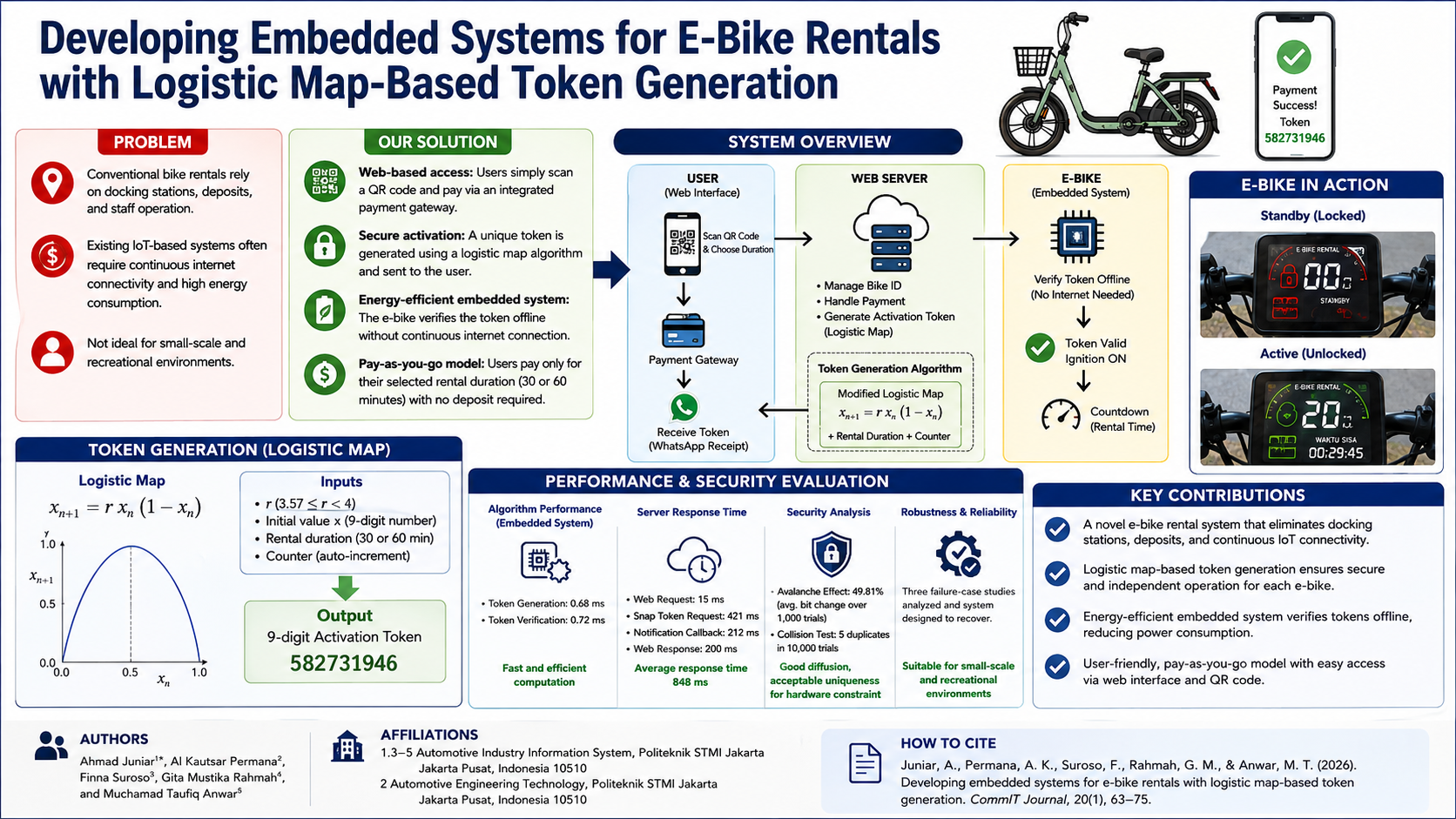
The research presents a novel electric bike rental system that operates efficiently without an internet connection. The system integrates a logistic map algorithm into an embedded microcontroller and a web-based rental information system. The logistic map has pseudo-random code generation properties, allowing identical activation tokens to be generated on both the server and the embedded system, enabling robust token validation on e-bike units. Users rent e-bikes by scanning a barcode on the e-bike unit. The barcode then directs the user to a web interface, where they can select the rental duration via a secure payment gateway. The rental system is pay-per-use, eliminating the need for deposits or account registration and enhancing user convenience. Once payment is verified, a message is sent containing the receipt details and an activation token that can be used on the e-bike. The obtained token generation and verification times are 0.68 ms and 0.72 ms, respectively. This test demonstrates the ability to generate tokens in real time without significant latency. However, this approach faces practical issues of token collisions and hardware limitations. Token collisions occur when a 9-digit token appears twice across five different ID tokens, with counters ranging from 1 to 10,000 for the same e-bike ID and rental duration. Rounding to significant digits causes this problem due to the microcontroller’s inherent limitations. However, these duplications occur at widely separated counters, making them difficult to exploit. This system effectively balances simplicity, security, and scalability for local e-bike sharing services.

References
[1] A. R. Al-Ali, R. Aburukba, A. H. Riaz, A. Al Nabulsi, D. Khan, S. Khan, and M. Amer, “IoT-based shared community transportation system using e-bikes,” in 2021 5th International Conference on Smart Grid and Smart Cities (ICSGSC). Tokyo, Japan: IEEE, June 18–20, 2021, pp. 61–65.
[2] D. Croce, D. Garlisi, F. Giuliano, A. L. Valvo, S. Mangione, and I. Tinnirello, “Performance of LoRa for bike-sharing systems,” in 2019 AEIT International Conference of Electrical and Electronic Technologies for Automotive (AEIT AUTOMOTIVE). Turin, Italy: IEEE, July 2–4, 2019, pp. 1–6.
[3] S. Hameed, N. Junejo, Faraz Jafri, D. Rashid, and F. Shoaib, “Rent-a-cycle (Smart bicycle sharing service-IoT based),” Journal of Robotics and Mechanical Engineering, 2021.
[4] J. G. Ochoa, J. F. Mendieta, F. Astudillo-Salinas, D. Ochoa-Correa, and V. I˜niguez-Mor´an, “An IoT-based measurement device for e-bike tracking performance analysis,” in 2024 IEEE Eighth Ecuador Technical Chapters Meeting (ETCM). Cuenca, Ecuador: IEEE, Oct. 15–18, 2024, pp. 1–6.
[5] J. Qian, M. Comin, and L. Pianura, “Data-driven smart bike-sharing system by implementing machine learning algorithms,” in 2018 Sixth International Conference on Enterprise Systems (ES). Limassol, Cyprus: IEEE, Oct. 1–2, 2018, pp. 50–55.
[6] X. Wu, J. Lin, Y. Yang, and J. Guo, “A digital decision approach for scheduling process planning of shared bikes under Internet of Things environment,” Applied Soft Computing, vol. 133, 2023.
[7] E. Collini, P. Nesi, and G. Pantaleo, “Deep learning for short-term prediction of available bikes on bike-sharing stations,” IEEE Access, vol. 9, pp. 124 337–124 347, 2021.
[8] L. Lin, Z. He, and S. Peeta, “Predicting stationlevel hourly demand in a large-scale bikesharing network: A graph convolutional neural network approach,” Transportation Research Part C: Emerging Technologies, vol. 97, pp. 258–276, 2018.
[9] A. M. Joy, A. Ravi, J. Roy, G. V. Karthikeyan, and T. P. Rajan, “IoT enabled electronic security & remote monitoring solution for electric bikes,” in 2022 IEEE International Power and Renewable Energy Conference (IPRECON). Kollam, India: IEEE, Dec. 16–18, 2022, pp. 1–6.
[10] S. J. S. Bakker, M. B. Ahmed, A. Djupdal, L. Natvig, H. Andersson, M. Jahre, and K. Fagerholt, “FOMOsim: An open-source simulator for rigorous analysis of micromobility planning problems,” Expert Systems with Applications, vol. 264, pp. 1–18, 2025.
[11] A. Audikana, E. Ravalet, V. Baranger, and V. Kaufmann, “Implementing bikesharing systems in small cities: Evidence from the Swiss experience,” Transport Policy, vol. 55, pp. 18–28, 2017.
[12] S. H. Strogatz, Nonlinear dynamics and chaos: With applications to physics, biology, chemistry, and engineering, 2nd ed. CRC Press, 2018.
[13] M. Francois, T. Grosges, D. Barchiesi, and R. Erra, “A new pseudo-random number generator based on two chaotic maps,” Informatica, vol. 24, no. 2, pp. 181–197, 2013.
[14] R. B. Naik and U. Singh, “A review on applications of chaotic maps in pseudo-random number generators and encryption,” Annals of Data Science, vol. 11, no. 1, pp. 25–50, 2024.
[15] S. Benaissi, N. Chikouche, and R. Hamza, “A novel image encryption algorithm based on hybrid chaotic maps using a key image,” Optik, vol. 272, 2023.
[16] H. A. Abdullah and H. N. Abdullah, “A new chaotic map for secure transmission,” TELKOMNIKA (Telecommunication Computing Electronics and Control), vol. 16, no. 3, pp. 1135–1142, 2018.
[17] M. Ardalani-Farsa and S. Zolfaghari, “Synergy of chaos theory and artificial neural networks in chaotic time series forecasting,” International Journal of Applied Management Science, vol. 3, no. 2, pp. 121–142, 2011.
[18] R. Barrio, A´ . Lozano, A. Mayora-Cebollero, C. Mayora-Cebollero, A. Miguel, A. Ortega, S. Serrano, and R. Vigara, “Deep learning for chaos detection,” Chaos: An Interdisciplinary Journal of Nonlinear Science, vol. 33, no. 7, 2023.
[19] S. C¸ ic¸ek, “Microcontroller-based random number generator implementation by using discrete chaotic maps,” Sakarya University Journal of Science, vol. 24, no. 5, pp. 832–844, 2020.
[20] B. Stoyanov and T. Ivanova, “CHAOSA: Chaotic map based random number generator on Arduino platform,” in AIP Conference Proceedings, vol. 2172, 2019.
[21] Izharuddin, O. Farooq, and M. Q. Rafiq, “Implementation of hardware efficient chaotic generators for signal security in portable systems,” in Proceedings of the Second International Conference on Information and Communication Technology for Competitive Strategies. Udaipur, India: Association for Computing Machinery, March 4–5, 2016, pp. 1–8.
[22] W. Stallings, Cryptography and network security: Principles and practice, 8th ed. Pearson, 2020. [23] J. Katz and Y. Lindell, Introduction to modern cryptography, 3rd ed. CRC Press, 2020.
[24] K. Luo, Y. Song, Z. Shi, Q. Yu, G. Wang, and Y. Shen, “A dynamic electric fence planning framework for dockless bike-sharing systems based on inventory prediction,” Computers & Industrial Engineering, vol. 198, 2024.
[25] K. Hosseini, T. P. Choudhari, A. Stefaniec, M. O’Mahony, and B. Caulfield, “E-bike to the future: Scalability, emission-saving, and ecoefficiency assessment of shared electric mobility hubs,” Transportation Research Part D: Transport and Environment, vol. 133, pp. 1–20, 2024.
[26] S. T. Jin and D. Z. Sui, “A comparative analysis of the spatial determinants of e-bike and e-scooter sharing link flows,” Journal of Transport Geography, vol. 119, pp. 1–15, 2024.
[27] M. C. M. Silva, D. Aloise, and S. D. Jena, “On the simultaneous computation of target inventories and intervals for bimodal bike-sharing systems,” Transportation Engineering, vol. 16, pp. 1–9, 2024.
[28] Q. Li, E. Zhang, D. Luca, and F. Fuerst, “The travel pattern difference in dockless micromobility: Shared e-bikes versus shared bikes,” Transportation research part D: Transport and Environment, vol. 130, pp. 1–18, 2024.

Downloads
Published
How to Cite
Issue
Section
License
Copyright (c) 2026 Ahmad Juniar, Al Kautsar Permana, Finna Suroso, Gita Mustika Rahmah, Muchamad Taufiq Anwar

This work is licensed under a Creative Commons Attribution-ShareAlike 4.0 International License.
Authors who publish with this journal agree to the following terms:
a. Authors retain copyright and grant the journal right of first publication with the work simultaneously licensed under a Creative Commons Attribution License - Share Alike that allows others to share the work with an acknowledgment of the work's authorship and initial publication in this journal.
b. Authors are able to enter into separate, additional contractual arrangements for the non-exclusive distribution of the journal's published version of the work (e.g., post it to an institutional repository or publish it in a book), with an acknowledgment of its initial publication in this journal.
c. Authors are permitted and encouraged to post their work online (e.g., in institutional repositories or on their website) prior to and during the submission process, as it can lead to productive exchanges, as well as earlier and greater citation of published work.
Â
USER RIGHTS
All articles published Open Access will be immediately and permanently free for everyone to read and download. We are continuously working with our author communities to select the best choice of license options, currently being defined for this journal as follows: Creative Commons Attribution-Share Alike (CC BY-SA)