An Adaptive DTN Routing Protocol Using a Q-Learning Framework for Archipelagic Emergency Networks
DOI:
https://doi.org/10.21512/commit.v20i1.13877Keywords:
Delay Tolerant Network (DTN), QLearning, Disaster Response, Maritime Networks, Adaptive RoutingAbstract
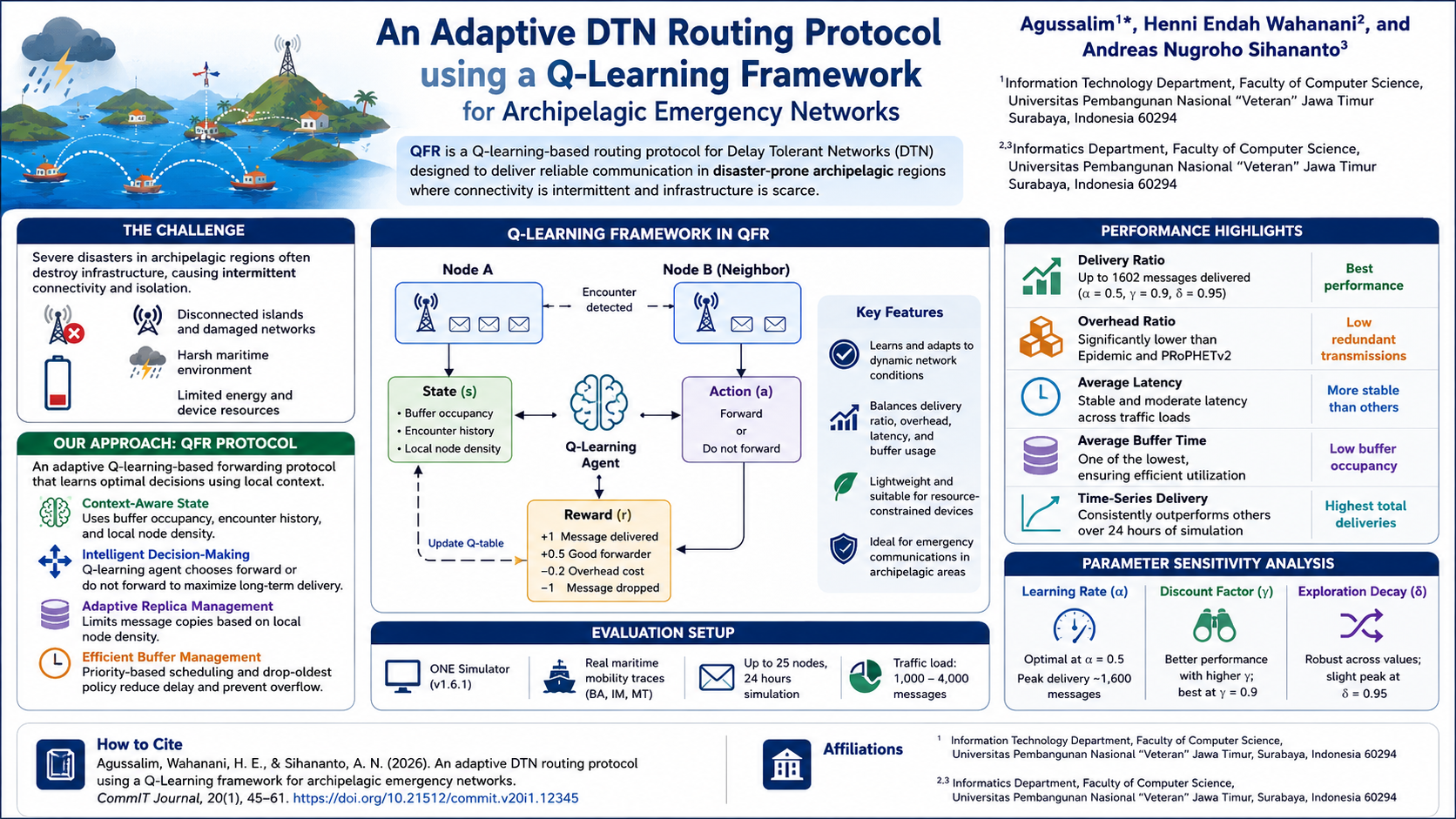
Natural disasters in archipelagic regions often disrupt communication networks, particularly in geographically isolated islands where terrestrial infrastructure is limited and highly vulnerable. Hence, adaptive, infrastructure-independent solutions are required to maintain connectivity during emergencies. The research proposes an adaptive routing protocol for Delay Tolerant Network (DTN), named Q-learning-based Forwarding Routing (QFR), designed to enhance data delivery performance in disaster scenarios characterized by intermittent connectivity and constrained resources. QFR employs a lightweight, tabular Q-learning framework to make intelligent forwarding decisions based on real-time state information, including buffer occupancy, encounter history, and local node density. The protocol further integrates adaptive replica control and prioritybased scheduling mechanisms to regulate congestion and optimize bandwidth and buffer utilization. Performance evaluation is conducted using the ONE Simulator with realistic maritime mobility traces derived from vessel movement patterns around Madura Island, Indonesia, representing inter-island emergency communication conditions. The results indicate that QFR consistently outperforms benchmark protocols such as Epidemic and PRoPHETv2, particularly in maintaining a high delivery ratio under heavy traffic loads while keeping routing overhead moderate and latency stable. Time-series analysis further demonstrates QFR’s ability to improve its performance over time as the agent learns. The key finding is that a lightweight, adaptive algorithm based on a tabular Q-learning framework provides a practical and effective solution for reliable communication in resource-constrained emergency networks, avoiding the computational complexity of deep reinforcement learning approaches.

References
[1] I. Desportes, W. Wicaksono, and M. Voss, “Disaster cultures—Indonesia and its tsunami warning system,” 2024. [Online]. Available: https://hal.science/hal-04829233v1/file/DisasterCultures Indonesia KFS WP32.pdf
[2] E. T. Paripurno, D. N. Yalesrie, A. A. Al-Kudus, Y. N. Maharani, A. R. B. Nugroho, N. E. Nugroho, J. Purwanta, G. A. Pratama, G. Mahojwala, and W. Putra, “The influence of geological conditions for the level of building damages a preliminary study on the impact of the Bawean Island earthquake, East Java, Indonesia,” vol. 1486, pp. 1–10, 2025.
[3] F. Muttaqy, A. D. Nugraha, N. T. Puspito, D. P. Sahara, Z. Zulfakriza, S. Rohadi, and P. Supendi, “Double-difference earthquake relocation using waveform cross-correlation in Central and East Java, Indonesia,” Geoscience Letters, vol. 10, no. 1, pp. 1–16, 2023.
[4] nPerf, “Telkomsel’s 3G/4G/5G coverage map in Indonesia.” [Online]. Available: https://www.nperf.com/en/map/ID/-/5119. Telkomsel/signal?ll=-7.069548170712799&lg=114.6361541748047&zoom=10
[5] A. F¨orster, J. Dede, A. K¨onsgen, K. Kuladinithi, V. Kuppusamy, A. Timm-Giel, A. Udugama, and A. Willig, “A beginner’s guide to infrastructureless networking concepts,” IET Networks, vol. 13, no. 1, pp. 66–110, 2024.
[6] E. Rosas, O. Andrade, and N. Hidalgo, “Effective communication for message prioritization in DTN for disaster scenarios,” Peer-to-Peer Networking and Applications, vol. 16, no. 1, pp. 368–382, 2023.
[7] S. Perumal, V. Raman, G. N. Samy, B. Shanmugam, K. Kisenasamy, and S. Ponnan, “Comprehensive literature review on Delay Tolerant Network (DTN) framework for improving the efficiency of internet connection in rural regions of Malaysia,” International Journal of System Assurance Engineering and Management, vol. 13, no. Suppl 1, pp. 764–777, 2022.
[8] M. Jes´us-Azabal, J. Berrocal-Olmeda, J. Garc´ıa-Alonso, and J. Gal´an-Jim´enez, “A self-sustainable DTN solution for isolation monitoring in remote areas,” in International Workshop on Gerontechnology. ´ Evora, Portugal: Springer, Oct. 5–6, 2020, pp. 57–68.
[9] E. Yaacoub, K. Abualsaud, T. Khattab, and A. Chehab, “Secure transmission of IoT mHealth patient monitoring data from remote areas using DTN,” IEEE Network, vol. 34, no. 5, pp. 226–231, 2020.
[10] G. Koukis, K. Safouri, and V. Tsaoussidis, “All about Delay-Tolerant Networking (DTN) contributions to Future Internet,” Future Internet, vol. 16, no. 4, pp. 1–21, 2024.
[11] S. H. Park, S. Cho, and J. R. Lee, “Energyefficient probabilistic routing algorithm for Internet of Things,” Journal of Applied Mathematics, vol. 2014, no. 1, pp. 1–7, 2014.
[12] A. Lohachab and A. Jangra, “Opportunistic Internet of Things (IoT): Demystifying the effective possibilities of opportunisitc networks towards IoT,” in 2019 6th International Conference on Signal Processing and Integrated Networks (SPIN). Noida, India: IEEE, March 7–8, 2019, pp. 1100–1105.
[13] L. Wu, S. Cao, Y. Chen, J. Cui, and Y. Chang, “An adaptive multiple spray-and-wait routing algorithm based on social circles in delay tolerant networks,” Computer Networks, vol. 189, 2021.
[14] Y. Yahara, A. Kato, M. Takai, and S. Ishihara, “On interactions between evacuation behavior and information dissemination via heterogeneous DTN,” Journal of Information Processing, vol. 30, pp. 120–129, 2022.
[15] H. Liang, Y. Shang, and S. Wang, “[retracted] study on DTN routing protocol of vehicle ad hoc network based on machine learning,” Wireless Communications and Mobile Computing, vol. 2021, 2021.
[16] S. Datta and S. K. Madria, “Prioritized content determination and dissemination using reinforcement learning in DTNs,” IEEE Transactions on Network Science and Engineering, vol. 9, no. 1, pp. 20–32, 2021.
[17] S. Bajpai and A. Chauhan, “Evolution of machine learning techniques for optimizing delay tolerant routing,” in 2022 4th International Conference on Advances in Computing, Communication Control and Networking (ICAC3N). Greater Noida, India: IEEE, Dec. 16–17, 2022, pp. 294–299.
[18] F. Y. Yesuf and M. Prathap, “CARL-DTN: Context adaptive reinforcement learning based routing algorithm in delay tolerant network,” 2021. [Online]. Available: https://arxiv.org/abs/2105.00544
[19] P. G. Buzzi, D. Selva, and M. S. Net, “Autonomous delay tolerant network management using reinforcement learning,” Journal of Aerospace Information Systems, vol. 18, no. 7, pp. 404–416, 2021.
[20] S. C. K. Tekouabou, Y. Maleh, and A. Nayyar, “Towards to intelligent routing for DTN protocols using machine learning techniques,” Simulation Modelling Practice and Theory, vol. 117, 2022.
[21] S. Liu, H. Shen, B. L. Smith, and V. Fessmann, “Machine learning based intelligent routing for VDTNs,” in 2023 32nd International Conference on Computer Communications and Networks (ICCCN). Honolulu, HI, USA: IEEE, July 24–27, 2023, pp. 1–10.
[22] L. Yang, J. A. Fraire, K. Zhao, R. Wang, W. Li, and H. Yang, “Optimizing deep-space DTN congestion control via deep reinforcement learning,” Computer Networks, vol. 255, 2024.
[23] M. A. Salam, A. F. M. S. Saif, P. H. Katroju, and R. Kassouf-Short, “A constructive analysis on machine learning integration in High Delay Tolerant Networking (HDTN),” in 2024 7th International Conference on Advanced Communication Technologies and Networking (CommNet). Rabat, Morocco: IEEE, Dec. 4–6, 2024, pp. 1–6.
[24] J. Koteich, N. Mitton, and R. Wolhuter, “Mobility context aware routing protocol in dtn,” in 2025 International Conference on Information Networking (ICOIN). Chiang Mai, Thailand: IEEE, Jan. 15–17, 2025, pp. 12–17.
[25] A. Ker¨anen, J. Ott, and T. K¨arkk¨ainen, “The ONE simulator for DTN protocol evaluation,” in Proceedings of the 2nd International Conference on Simulation Tools and Techniques. Rome, Italy: Association for Computing Machinery, March 2–6, 2009, pp. 1–10.
[26] Agussalim and M. Tsuru, “Spray and hop distance routing protocol in multiple-island DTN scenarios,” in Proceedings of the 11th International Conference on Future Internet Technologies. Nanjing, China: Association for Computing Machinery, June 15–17, 2016, pp. 49–55.
[27] J. H¨ochst, L. Baumg¨artner, F. Kuntke, A. Penning, A. Sterz, M. Sommer, and B. Freisleben, “Mobile device-to-device communication for crisis scenarios using low-cost LoRa modems,” in Disaster management and information technology: Professional response and recovery management in the age of disasters. Springer, 2023, pp. 235–268.

Downloads
Published
How to Cite
Issue
Section
License
Copyright (c) 2026 Agussalim, Henni Endah Wahanani, Andreas Nugroho Sihananto

This work is licensed under a Creative Commons Attribution-ShareAlike 4.0 International License.
Authors who publish with this journal agree to the following terms:
a. Authors retain copyright and grant the journal right of first publication with the work simultaneously licensed under a Creative Commons Attribution License - Share Alike that allows others to share the work with an acknowledgment of the work's authorship and initial publication in this journal.
b. Authors are able to enter into separate, additional contractual arrangements for the non-exclusive distribution of the journal's published version of the work (e.g., post it to an institutional repository or publish it in a book), with an acknowledgment of its initial publication in this journal.
c. Authors are permitted and encouraged to post their work online (e.g., in institutional repositories or on their website) prior to and during the submission process, as it can lead to productive exchanges, as well as earlier and greater citation of published work.
Â
USER RIGHTS
All articles published Open Access will be immediately and permanently free for everyone to read and download. We are continuously working with our author communities to select the best choice of license options, currently being defined for this journal as follows: Creative Commons Attribution-Share Alike (CC BY-SA)