Magnetic Resonance Imaging (MRI)-Based Breast Cancer Detection Using Graph Convolutional Network (GCN) with Advanced Texture Feature Extraction
DOI:
https://doi.org/10.21512/commit.v20i1.13806Keywords:
Breast Cancer, Gray-Level Co- Occurrence Matrix (GLCM), Graph Convolutional Network (GCN), t-Distributed Stochastic Neighbor Embedding (t-SNE), Dual-Tree Discrete Wavelet Transform (DTDWT)Abstract
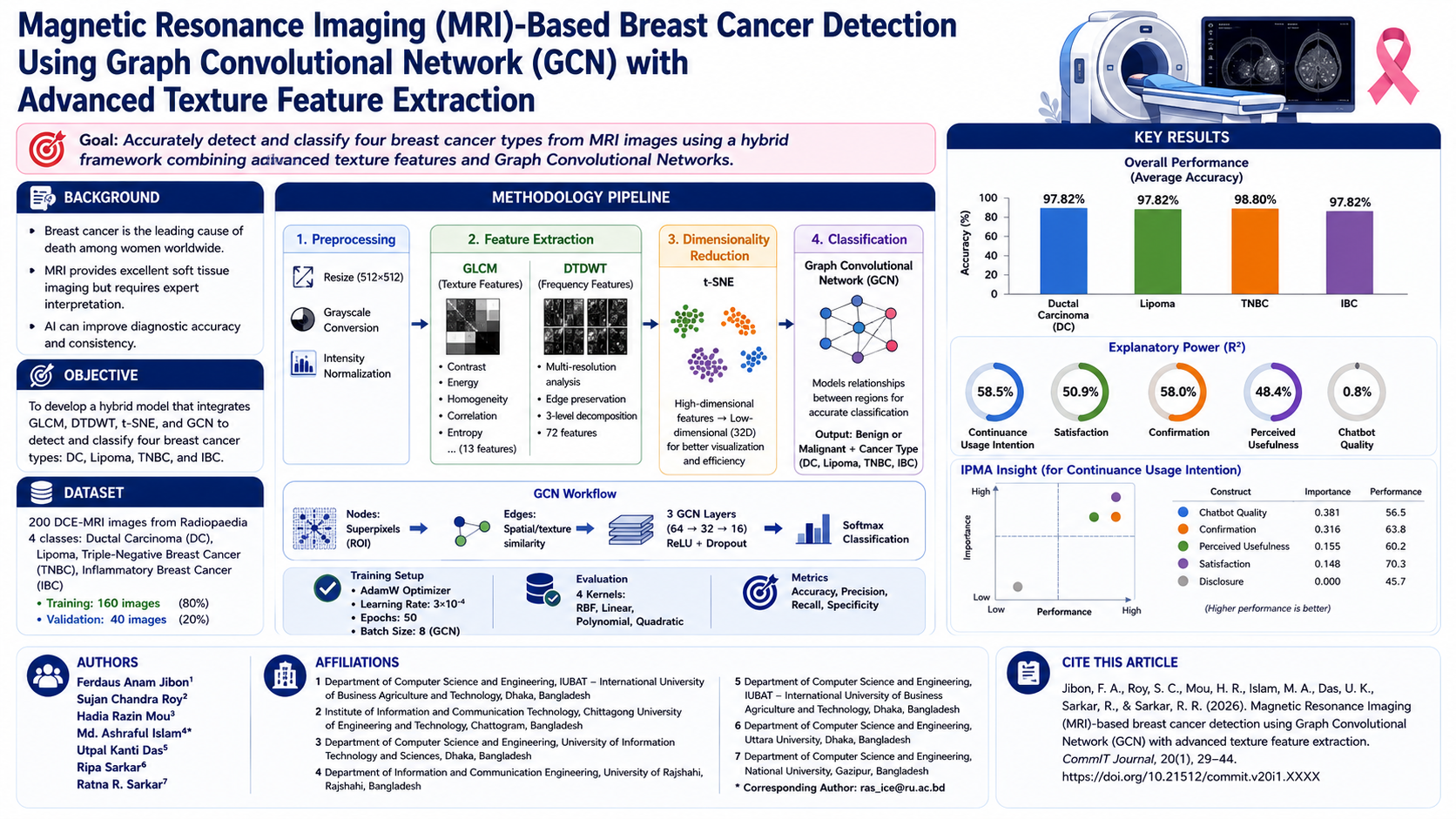
Breast cancer is the leading cause of death for women worldwide, and it is predicted to be an important factor in public health. Therefore, early and accurate detection is crucial to enhancing survival rates. Recently, Magnetic Resonance Imaging (MRI) has become a superior option to biopsies due to its exceptional soft tissue imaging capabilities, making it highly effective for detecting and monitoring breast cancer. However, it requires a competent radiologist to perform the procedure. The researchers introduce an approach for breast cancer detection and classification that employs Graph Convolutional Networks (GCNs) to distinguish breast MRI images. The combination of Dual-Tree Discrete Wavelet Transform (DTDWT) with GCNs enhances feature extraction, while the Gray-Level Co-Occurrence Matrix (GLCM) identifies texture patterns distinguishing normal, benign, and malignant tissues. The research also employs t-Distributed Stochastic Neighbor Embedding (t-SNE) for dimensionality reduction, improving pattern interpretation. This approach classifies the four breast cancer types using a dataset comprising 200 Dynamic Contrast-Enhanced (DCE)-MRI images from Radiopaedia, allocated as 160 training and 40 validation instances in categories including Ductal Carcinoma (DC), lipoma, Triple-Negative Breast Cancer (TNBC), and Inflammatory Breast Cancer (IBC). A comparative analysis confirms the validity of the approach, which is the first to address these four categories in MRI. The experimental results indicate significant improvements, achieving an accuracy of 0.9821 in classifying breast tumors as benign or malignant, thereby establishing a new diagnostic standard.

References
[1] T. M. Allweis, N. Hermann, R. Berenstein-Molho, and M. Guindy, “Personalized screening for breast cancer: Rationale, present practices, and future directions,” Annals of Surgical Oncology, vol. 28, no. 8, pp. 4306–4317, 2021.
[2] M. Arnold, E. Morgan, H. Rumgay, A. Mafra, D. Singh, M. Laversanne, J. Vignat, J. R. Gralow, F. Cardoso, S. Siesling, and I. Soerjomataram, “Current and future burden of breast cancer: Global statistics for 2020 and 2040,” The Breast, vol. 66, pp. 15–23, 2022.
[3] M. M. Srikantamurthy, V. P. S. Rallabandi, D. B. Dudekula, S. Natarajan, and J. Park, “Classification of benign and malignant subtypes of breast cancer histopathology imaging using hybrid CNN-LSTM based transfer learning,” BMC Medical Imaging, vol. 23, pp. 1–15, 2023.
[4] C. Xu, Z. Gu, J. Liu, X. Lin, C. Wang, J. Li, Y. Fu, X. Cheng, and Z. Zhuang, “Adenosquamous carcinoma of the breast: A populationbased study,” Breast Cancer, vol. 28, no. 4, pp. 848–858, 2021.
[5] H. M. T. Khushi, T. Masood, A. Jaffar, and S. Akram, “A novel approach to classify brain tumor with an effective transfer learning based deep learning model,” Brazilian Archives of Biology and Technology, vol. 67, pp. 1–18, 2024.
[6] S. S. Reddy, N. Pilli, P. Voosala, and S. R. Chigurupati, “A comparative study to predict breast cancer using machine learning techniques,” Indonesian Journal of Electrical Engineering and Computer Science (IJEECS), vol. 27, no. 1, pp. 171–180, 2022.
[7] F. A. Jibon, M. U. Khandaker, M. H. Miraz, H. Thakur, F. Rabby, N. Tamam, A. Sulieman, Y. S. Itas, and H. Osman, “Cancerous and noncancerous brain MRI classification method based on convolutional neural network and log-polar transformation,” Healthcare, vol. 10, no. 9, pp. 1–19, 2022.
[8] G. Holste, S. C. Partridge, H. Rahbar, D. Biswas, C. I. Lee, and A. M. Alessio, “End-to-end learning of fused image and non-image features for improved breast cancer classification from MRI,” in Proceedings of the IEEE/CVF International Conference on Computer Vision, Virtual, Oct. 11– 17, 2021, pp. 3294–3303.
[9] H. Chen, N. Wang, X. Du, K. Mei, Y. Zhou, and G. Cai, “Classification prediction of breast cancer based on machine learning,” Computational Intelligence and Neuroscience, vol. 2023, no. 1, pp. 1–9, 2023.
[10] S. Nanglia, M. Ahmad, F. A. Khan, and N. Z. Jhanjhi, “An enhanced predictive heterogeneous ensemble model for breast cancer prediction,” Biomedical Signal Processing and Control, vol. 72, 2022.
[11] M. J. Khan, A. K. Singh, R. Sultana, P. P. Singh, A. Khan, and S. Saxena, “Breast cancer: A comparative review for breast cancer detection using machine learning techniques,” Cell Biochemistry and Function, vol. 41, no. 8, pp. 996–1007, 2023.
[12] J. O. Afolayan, M. O. Adebiyi, M. O. Arowolo, C. Chakraborty, and A. A. Adebiyi, “Breast cancer detection using particle swarm optimization and decision tree machine learning technique,” in Intelligent healthcare: Infrastructure, algorithms and management. Springer, 2022, pp. 61–83.
[13] M. Darwich and M. Bayoumi, “An evaluation of the effectiveness of machine learning prediction models in assessing breast cancer risk,” Informatics in Medicine Unlocked, vol. 49, pp. 1–17, 2024.
[14] J. Wang, M. A. Khan, S. Wang, and Y. Zhang, “SNSVM: SqueezeNet-guided SVM for breast cancer diagnosis,” Computers, Materials & Continua, vol. 76, no. 2, pp. 2201–2216, 2023.
[15] R. Jalloul, C. H. Krishnappa, V. I. Agughasi, and R. Alkhatib, “Enhancing early breast cancer detection with infrared thermography: A comparative evaluation of deep learning and machine learning models,” Technologies, vol. 13, no. 1, pp. 1–31, 2024.
[16] B. S. Abunasser, M. R. J. Al-Hiealy, I. S. Zaqout, and S. S. Abu-Naser, “Convolution neural network for breast cancer detection and classification using deep learning,” Asian Pacific Journal of Cancer Prevention: APJCP, vol. 24, no. 2, pp. 531–544, 2023.
[17] S. M. Shaaban, M. Nawaz, Y. Said, and M. Barr, “An efficient breast cancer segmentation system based on deep learning techniques,” Engineering, Technology & Applied Science Research, vol. 13, no. 6, pp. 12 415–12 422, 2023.
[18] H. Li, D. Chen, W. H. Nailon, M. E. Davies, and D. I. Laurenson, “Dual convolutional neural networks for breast mass segmentation and diagnosis in mammography,” IEEE Transactions on Medical Imaging, vol. 41, no. 1, pp. 3–13, 2021.
[19] R. M. Munshi, L. Cascone, N. Alturki, O. Saidani, A. Alshardan, and M. Umer, “A novel approach for breast cancer detection using optimized ensemble learning framework and XAI,” Image and Vision Computing, vol. 142, 2024.
[20] H. Aljuaid, N. Alturki, N. Alsubaie, L. Cavallaro, and A. Liotta, “Computer-aided diagnosis for breast cancer classification using deep neural networks and transfer learning,” Computer Methods and Programs in Biomedicine, vol. 223, pp. 1–10, 2022.
[21] S. S. Chowa, S. Azam, S. Montaha, I. J. Payel, M. R. I. Bhuiyan, M. Z. Hasan, and M. Jonkman, “Graph neural network-based breast cancer diagnosis using ultrasound images with optimized graph construction integrating the medically significant features,” Journal of Cancer Research and Clinical Oncology, vol. 149, no. 20, pp. 18 039–18 064, 2023.
[22] S. A. Shanto, G. K. Paul, R. A. Mohon, S. Sarker, M. S. Mahir, and S. S. Haque, “Machine learning in healthcare: Breast cancer detection using graph convolutional network,” International Journal of Research and Innovation in Applied Science (IJRIAS), vol. 7, no. 8, pp. 78–86, 2022.
[23] Y. Cakmak, S. Safak, M. A. Bayram, and I. Pacal, “Comprehensive evaluation of machine learning and ANN models for breast cancer detection,” Computer and Decision Making: An International Journal, vol. 1, pp. 84–102, 2024.
[24] J. Chen, J. Ou, H. Zeng, and C. Cai, “A fast algorithm based on gray level co-occurrence matrix and Gabor feature for HEVC screen content coding,” Journal of Visual Communication and Image Representation, vol. 78, p. 103128, 2021.
[25] C. Chiappa, A. Bonetti, G. J. Jaber, V. De Berardinis, V. Bianchi, and F. Rovera, “Pure ductal carcinoma in situ of the breast: Analysis of 270 consecutive patients treated in a 9-year period,” Cancers, vol. 13, no. 3, pp. 1–16, 2021.
[26] G. M. Wilson, P. Dinh, N. Pathmanathan, and J. D. Graham, “Ductal carcinoma in situ: Molecular changes accompanying disease progression,” Journal of Mammary Gland Biology and Neoplasia, vol. 27, no. 1, pp. 101–131, 2022.
[27] L. Kolb, S. N. S. Yarrarapu, and J. A. Rosario-Collazo, “Lipoma,” 2023. [Online]. Available: https://www.ncbi.nlm.nih.gov/books/NBK507906
[28] R. A. Towner, R. Dissanayake, and M. Ahmed, “Clinical advances in triple negative breast cancer treatment: Focus on poly (l-lactide-coglycolide) nanoparticles,” The Journal of Pharmacology and Experimental Therapeutics, vol. 390, no. 1, pp. 53–64, 2024.
[29] D. Sood, C. Kaur, N. Kumar, R. Kumar, and G. Singh, “Triple-negative breast cancer: Challenges, advances, and promising therapeutic interventions,” Medical Oncology, vol. 42, p. 506, 2025.
[30] R. Salmanzadeh, K. Aghemo, B. Thatiparthi, S. A. Al-Shaikhli, A. Salmanzadeh, O. DeAngelo, D. Martin, S. Sukpraprut-Braaten, A. M. Salmanzadeh, and D. E. Martin, “A case of advanced bilateral inflammatory breast cancer: A radiological perspective,” Cureus, vol. 15, no. 1, pp. 1–7, 2023.
[31] M. Gour, S. Jain, and T. Sunil Kumar, “Residual learning based CNN for breast cancer histopatho-logical image classification,” International Journal of Imaging Systems and Technology, vol. 30, no. 3, pp. 621–635, 2020.
[32] J. Zheng, D. Lin, Z. Gao, S. Wang, M. He, and J. Fan, “Deep learning assisted efficient AdaBoost algorithm for breast cancer detection and early diagnosis,” IEEE Access, vol. 8, pp. 96 946–96 954, 2020.
[33] H. Rahman, T. F. Naik Bukht, R. Ahmad, A. Almadhor, and A. R. Javed, “Efficient breast cancer diagnosis from complex mammographic images using deep convolutional neural network,” Computational Intelligence and Neuroscience, vol. 2023, no. 1, pp. 1–11, 2023.

Downloads
Published
How to Cite
Issue
Section
License
Copyright (c) 2026 Ferdaus Anam Jibon, Sujan Chandra Roy, Hadia Razin Mou, Md. Ashraful Islam, Utpal Kanti Das, Ripa Sarkar, Ratna Rani Sarkar

This work is licensed under a Creative Commons Attribution-ShareAlike 4.0 International License.
Authors who publish with this journal agree to the following terms:
a. Authors retain copyright and grant the journal right of first publication with the work simultaneously licensed under a Creative Commons Attribution License - Share Alike that allows others to share the work with an acknowledgment of the work's authorship and initial publication in this journal.
b. Authors are able to enter into separate, additional contractual arrangements for the non-exclusive distribution of the journal's published version of the work (e.g., post it to an institutional repository or publish it in a book), with an acknowledgment of its initial publication in this journal.
c. Authors are permitted and encouraged to post their work online (e.g., in institutional repositories or on their website) prior to and during the submission process, as it can lead to productive exchanges, as well as earlier and greater citation of published work.
Â
USER RIGHTS
All articles published Open Access will be immediately and permanently free for everyone to read and download. We are continuously working with our author communities to select the best choice of license options, currently being defined for this journal as follows: Creative Commons Attribution-Share Alike (CC BY-SA)