Exploring Impulsive Buying Tendency in Preloved Goods with Mindful Consumption and Platform Trust
DOI:
https://doi.org/10.21512/bbr.v17i1.14285Keywords:
buying intentions, impulsive buying tendency, preloved goods, mindful consumption, platform trustAbstract
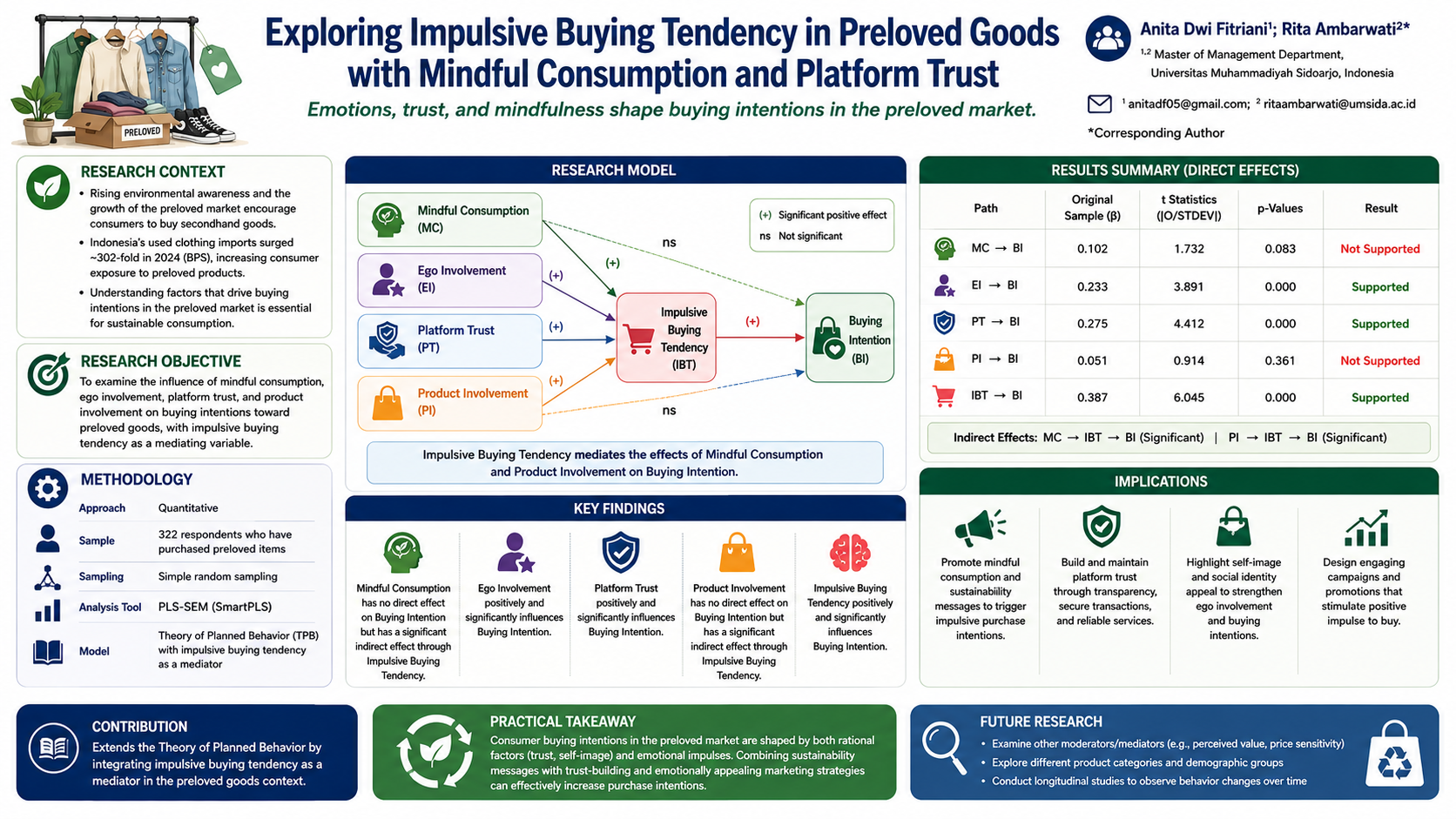
The research examined the influence of mindful consumption, ego involvement, platform trust, and product involvement on buying intentions toward preloved goods, with impulsive buying tendency as a mediating variable. The novelty of the research lay in extending the Theory of Planned Behavior (TPB) by integrating impulsive buying tendency to explain consumer behavior in the Indonesian preloved market, which remained underexplored. A quantitative approach was employed by distributing questionnaires to 322 respondents who had purchased preloved items. Samples were selected using a simple random sampling technique, ensuring that every consumer in the population had an equal chance of being included. Then, data were analyzed using Partial Least Squares-Structural Equation Modeling (PLS-SEM) to examine both direct and indirect relationships among variables. The results show that ego involvement and platform trust significantly and positively influence buying intentions, while mindful consumption and product involvement do not have a direct effect. However, both variables indirectly influence buying intentions through impulsive buying tendency, which serves as a significant mediator. These findings indicate that consumer decisions in the preloved market are shaped not only by rational considerations but also by emotional impulses and trust in sales platforms. Theoretically, the research enriches TPB by highlighting the impulsive buying tendency as a mediating construct in sustainable consumption. Practically, the results suggest that platform managers should strengthen consumer trust through transparency and secure transactions, while marketers can combine sustainability messages with emotional strategies to enhance buying intentions.

References
Al Mutanafisa, T., & Retnaningsih. (2021). The effect of sales promotion and knowledge on impulsive buying of online platform consumers. Journal of Consumer Sciences, 6(1), 77–91. https://doi.org/10.29244/jcs.6.1.77-91
Aldiaz, N., Tuti, M., & Shahril, A. M. (2021). Boosting customers’ impulse purchases through trust. JDM (Jurnal Dinamika Manajemen), 15(1), 160–174.
Amalita, R., & Rahma, T. I. F. (2022). Pengaruh kemudahan, kualitas produk, harga dan promosi terhadap keputusan pembelian di marketplace Facebook pada mahasiswa/i UINSU dengan structural equation modeling. JMBI UNSRAT (Jurnal Ilmiah Manajemen Bisnis dan Inovasi Universitas Sam Ratulangi), 9(2), 593–604.
Ambarwati, R., & Sari, D. K. (2024). Experiential marketing and Islamic branding: A new perspective on college decision in Islamic higher education. Journal of Islamic Marketing, 15(3), 745–776. https://doi.org/10.1108/JIMA-08-2022-0207
Arfia, M. (2022). Pengaruh fashion involvement terhadap impulse buying melalui positive emotion pada produk fashion Muslim di e-commerce. Youth & Islamic Economic Journal, 3(02), 19–30.
Asyhari, A., Pudjihastuti, S. H., Alfionita, V., & Othman, A. Y. (2024). Uncovering the power of consumer involvement: How perceived quality drives e-commerce behavior? Jurnal Aplikasi Manajemen, 22(3), 816–838. https://doi.org/10.21776/ub.jam.2024.022.03.14
Borusiak, B., Szymkowiak, A., Horska, E., Raszka, N., & Zelichowska, E. (2020). Towards building sustainable consumption: A study of second-hand buying intentions. Sustainability, 12(3), 1–15. https://doi.org/10.3390/su12030875
Chetioui, Y., & El Bouzidi, L. (2023). An investigation of the nexus between online impulsive buying and cognitive dissonance among Gen Z shoppers: Are female shoppers different? Young Consumers: Insight and Ideas for Responsible Marketers, 24(4), 406–426. https://doi.org/10.1108/YC-06-2022-1548
Deng, M., Yang, Y., & Sun, B. (2024). Research on the purchase intention of social commerce consumers in video streams: Dual pathways of affection and rationality. Behavioral Sciences, 14(9), 1–19. https://doi.org/10.3390/bs14090738
Febryaningrum, V., Buana, A. V., Rohman, A. F., Rochmah, A. N., Soraya, A., & Suparta, I. M. (2024). Penggunaan analisis Structural Equation Modelling (SEM) dengan PLS untuk menguji pengaruh variabel intervening terhadap hubungan variabel independen dan variabel dependen. Jurnal Ekonomi Manajemen dan Bisnis, 1(6), 258–266.
Finthariasari, M., Ekowati, S., & Krisna, R. (2020). Pengaruh kualitas produk, display layout, dan variasi produk terhadap kepuasan konsumen. Ekombis Review: Jurnal Ilmiah Ekonomi dan Bisnis, 8(2), 149–159. https://doi.org/10.37676/ekombis.v8i2.1081
Firmanza, M. H. D., & Artanti, Y. (2022). Online buying intentions of shopee consumers: The influence of celebrity endorsement, social media marketing, and brand image. Jurnal Manajemen Pemasaran, 16(2), 87–95.
Furqon, R. J., & Supriatna, U. (2025). Pengaruh perilaku konsumen dan minat beli terhadap keputusan pembelian pakaian bekas di Pasar Cimol Gedebage and Education (IJOSSE), 1(3), 905–916. https://doi.org/10.62567/ijosse.v1i3.1389
Harahap, L. K. (2020). Analisis SEM (Structural Equation Modelling) dengan SMARTPLS (Partial Least Square). https://fst.walisongo.ac.id/analisis-semstructural-equation-modelling-dengan-smartplspartial-least-square/
Hair, J., & Alamer, A. (2022). Partial Least Squares Structural Equation Modeling (PLS-SEM) in second language and education research: Guidelines using an applied example. Research Methods in Applied Linguistics, 1(3), 1–16. https://doi.org/10.1016/j.rmal.2022.100027
Iyer, G. R., Blut, M., Xiao, S. H., & Grewal, D. (2020). Impulse buying: A meta-analytic review. Journal of the Academy of Marketing Science, 48, 384–404. https://doi.org/10.1007/s11747-019-00670-w
Keating, D. M., & Fan, Q. (2024). Ambiguity undermines persuasive effectiveness: Ego involvement, motivated reasoning, and message ambiguity. International Journal of Communication, 18, 470–488.
Lăzăroiu, G., Neguriţă, O., Grecu, I., Grecu, G., & Mitran, P. C. (2020). Consumers’ decision-making process on social commerce platforms: Online trust, perceived risk, and purchase intentions. Frontiers in Psychology, 11, 1–7. https://doi.org/10.3389/fpsyg.2020.00890
Lesmana, T., & Setiadi, T. D. (2023). Peran mindfulness terhadap konsumsi mindful dimediasi keterlibatan konsumen pembelanja online. Jurnal RAP (Riset Aktual Psikologi), 14(2), 1–20. https://doi.org/10.24036/rapun.v14i2.122218
Li, B., Hu, M., Chen, X., & Lei, Y. (2021). The moderating role of anticipated regret and product involvement on online impulsive buying behavior. Frontiers in Psychology, 12, 1–10. https://doi.org/10.3389/fpsyg.2021.732459
Laili, R. N. N., Muhammad, Z. T., & Rahman, R. Y. (2023). Legal protection for parties in the sale of preloved goods in Indonesia. International Journal of Advanced Multidisciplinary Research and Studies, 3(3), 901–905.
Najib, M. F., Fauziah, T., Djatnika, T., Saefulloh, D., & Purnamasari, D. (2022). The impact of utilitarian and hedonic values on hijab buying intentions: Evidence from Indonesia. Journal of Marketing Innovation (JMI), 2(2), 154–168. https://doi.org/10.35313/jmi.v2i2.48
Nasution, M. I., Fahmi, M., Jufrizen, Muslih, & Prayogi, M. A. (2020). The quality of small and medium enterprises performance using the Structural Equation Model-Part Least Square (SEM-PLS). Journal of Physics: Conference Series, 1477, 1–7. https://doi.org/10.1088/1742-6596/1477/5/052052
Nawaz, S., Jiang, Y., Nawaz, M. Z., Manzoor, S. F., & Zhang, R. (2021). Mindful consumption, egoinvolvement, and social norms impact on buying SHC: Role of platform trust and impulsive buying tendency. SAGE Open, 11(4). https://doi.org/10.1177/21582440211056621
Ningsih, G., Karningsih, E., & Purwasih, R. (2024). Pengaruh digital marketing umkm makanan minuman terhadap kinerja pemasaran melalui inovasi produk di Kota Pangkalpinang (The influence of digital marketing for food and beverage msmes on marketing performance through product innovation in the City of Pangkalpinang). Jurnal Agribisnis dan Komunikasi Pertanian (Journal of Agribusiness and Agricultural Communication), 7(1), 68–77. https://doi.org/10.35941/jakp.7.1.2024.13817.68-77
Oesterreich, T. D., Anton, E., Hettler, F. M., & Teuteberg, F. (2025). What drives individuals’ trusting intention in digital platforms? An exploratory meta-analysis. Management Review Quarterly, 75, 3615–3667. https://doi.org/10.1007/s11301-024-00477-2
Olsen, S. O., Khoi, N. H., & Tuu, H. H. (2021). The “well-being” and “ill-being” of online impulsive and compulsive buying on life satisfaction: The role of self-esteem and harmony in life. Journal of Macromarketing, 42(1), 128–145. https://doi.org/10.1177/02761467211048751
Putri, K., & Fourqoniah, F. (2023). Pengaruh promosi dan shopping emotion serta pembelian impulsif terhadap keputusan pembelian merchandise NCT. Journal of Applied Business Administration, 7(1), 1–8. https://doi.org/10.30871/jaba.v7i1.5238
Rahmawati, Y., Pristiyono, & Gulo, A. (2024). Analisis motivasi konsumen dan impulsive buying dalam berbelanja online e-commerce Indonesia. Management Studies and Entrepreneurship Journal, 5(2), 5024–5039.
Rizkila, M., Sosianika, A., & Gunawan, A. I. (2021). Shopping lifestyle generasi millenial dalam trend preloved fashion. In Prosiding Industrial Research Workshop and National Seminar (Vol. 12, pp. 1054–1060).
Rocha, S., Fernández, X. M., Castro, Y. R., Ferreira, S., Teixeira, L., Campos, C., & Rocha, N. B. (2023). Exploring the associations between early maladaptive schemas and impulsive and compulsive buying tendencies. Frontiers in Psychiatry, 14, 1–10. https://doi.org/10.3389/fpsyt.2023.1157710
Sadida, N. Q. (2023). Pengaruh kesadaran lingkungan, pengetahuan, dan religiusitas terhadap niat membeli sustainable fashion pada mahasiswa: Dengan variabel moderasi nilai yang dirasakan [Doctoral dissertation, Universitas Islam Indonesia]. https://dspace.uii.ac.id/handle/123456789/46164
Salah, P., Asfahani, A. M., & AlRajhi, F. H. (2024). The effect of perceived value on intention to purchase pre-loved luxury fashion products. Sustainability, 16(23), 1–19. https://doi.org/10.3390/su162310426
Sari, N. K. A., & Prianthara, I. B. T. (2024). Pengaruh Sosial, materialisme, dan impulse buying terhadap niat membeli. Ekonomis: Journal of Economics and Business, 8(2), 1727–1733. https://doi.org/10.33087/ekonomis.v8i2.1628
Sarkar, A., Azim, J. A., Al Asif, A., Qian, L., & Peau, A. K. (2021). Structural equation modeling for indicators of sustainable agriculture: Prospective of a developing country’s agriculture. Land Use Policy, 109. https://doi.org/10.1016/j.landusepol.2021.105638
Sharifi Asadi Malafe, N., Gholipour Fereydoni, S., & Nabavi Chashmi, S. A. (2023). The impact of advertising values on impulsive and compulsive buying. Journal of Internet Commerce, 22(3), 349–394. https://doi.org/10.1080/15332861.2022.2057122
Sherif, M., & Cantril, H. (1947). The psychology of ego-involvements: Social attitudes and identifications. John Wiley & Sons, Inc. https://doi.org/10.1037/10840-000
Soleimani, M. (2022). Buyers’ trust and mistrust in e-commerce platforms: A synthesizing literature review. Information Systems and E-Business Management, 20, 57–78. https://doi.org/10.1007/s10257-021-00545-0
Turunen, L. L. M., & Gossen, M. (2024). From preloved to reloved: How second-hand clothing companies facilitate the transaction of used garments. Journal of Sustainability Research, 6(1), 1–22. https://doi.org/10.20900/jsr20240002
Wijaya, A., & Kinder, L. (2020). Pengaruh price bundling dan product bundling terhadap niat membeli yang dimoderasi oleh barang komplementaritas. Jurnal Manajemen, 17(1), 28–38. https://doi.org/10.25170/jm.v17i1.866
Wibisono, A. B., & Fachira, I. (2021). Factors influencing online impulsive buying behavior in Indonesia. MIMBAR : Jurnal Sosial dan Pembangunan, 37(1), 127–137. https://doi.org/10.29313/mimbar.v37i1.6926
Wirya, Y. H., & Syah, T. Y. R. (2022). Consumer product involvement, attitude and cognition towards ad, and perceived value concerning purchase intentions. JDM: Jurnal Dinamika Manajemen, 13(2), 173–184.
Zahid, N. M., Khan, J., & Tao, M. (2023). Exploring mindful consumption, ego involvement, and social norms influencing second-hand clothing purchase. Current Psychology, 42, 13960–13974. https://doi.org/10.1007/s12144-021-02657-9
Zhu, Y. Q., Amelina, D., & Yen, D. C. (2020). Celebrity endorsement and impulsive buying intentions in social commerce - The case of Instagram in Indonesia: Celebrity endorsement. Journal of Electronic Commerce in Organizations, 18(1), 1–17. https://doi.org/10.4018/JECO.2020010101
Downloads
Published
How to Cite
Issue
Section
License
Copyright (c) 2026 Anita Dwi Fitriani, Rita Ambarwati

This work is licensed under a Creative Commons Attribution-ShareAlike 4.0 International License.
Authors who publish with this journal agree to the following terms:
a. Authors retain copyright and grant the journal right of first publication with the work simultaneously licensed under a Creative Commons Attribution License - Share Alike that allows others to share the work with an acknowledgment of the work's authorship and initial publication in this journal.
b. Authors are able to enter into separate, additional contractual arrangements for the non-exclusive distribution of the journal's published version of the work (e.g., post it to an institutional repository or publish it in a book), with an acknowledgment of its initial publication in this journal.
c. Authors are permitted and encouraged to post their work online (e.g., in institutional repositories or on their website) prior to and during the submission process, as it can lead to productive exchanges, as well as earlier and greater citation of published work.
USER RIGHTS
All articles published Open Access will be immediately and permanently free for everyone to read and download. We are continuously working with our author communities to select the best choice of license options, currently being defined for this journal as follows: Creative Commons Attribution-Share Alike (CC BY-SA)