Antecedents and Effects of Job Satisfaction on Organizational Commitment and Turnover Intention
DOI:
https://doi.org/10.21512/bbr.v17i1.14032Keywords:
job satisfaction, organizational commitment, turnover intention, transformational leadership, organizational culture, organizational justiceAbstract
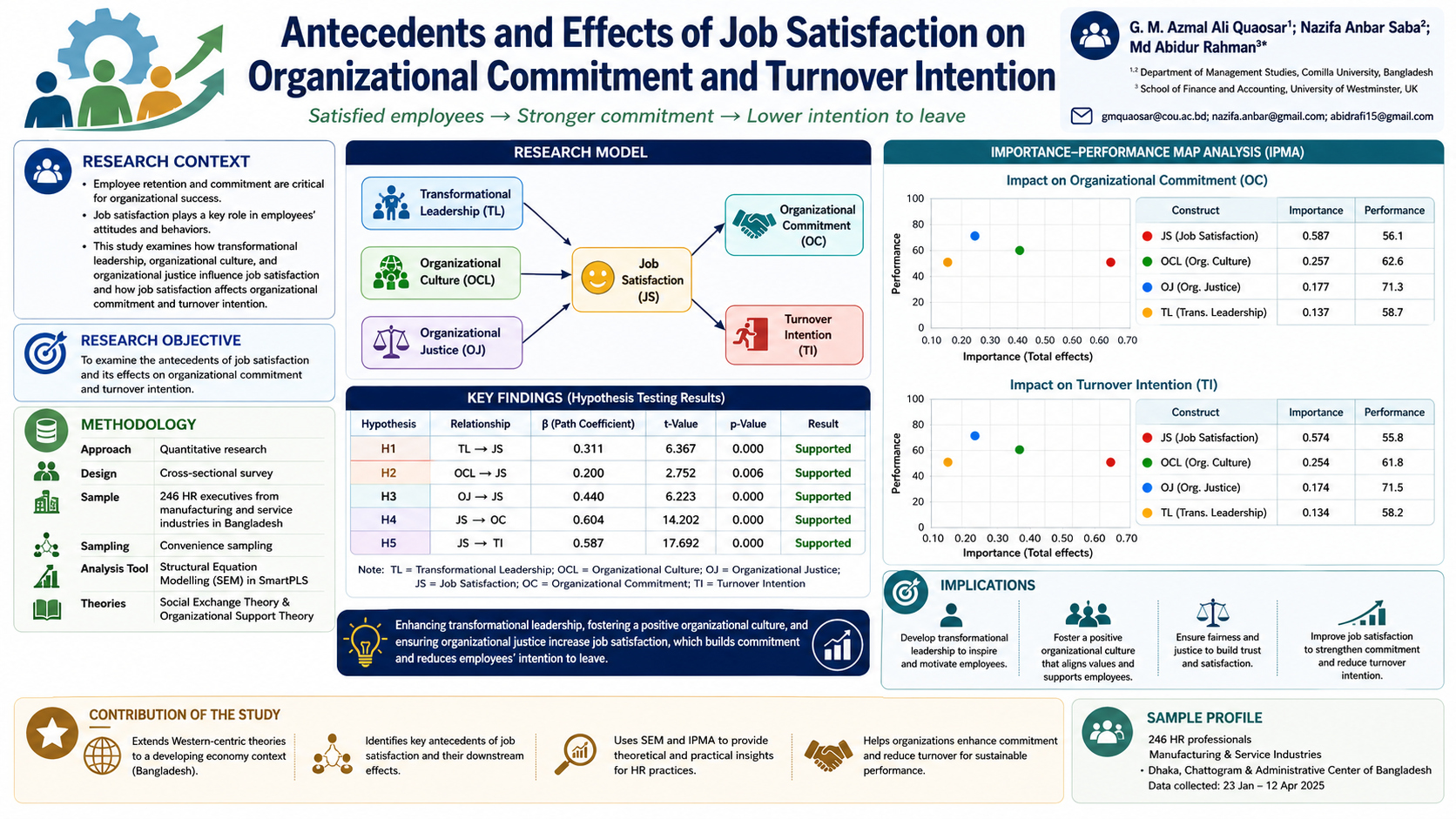
In today’s competitive organizational landscape, employee commitment and retention have emerged as critical determinants of core organizational success. The research explored the antecedents of job satisfaction and its subsequent impact on organizational commitment among the employees. Grounded in social exchange theory and organizational support theory, the research highlighted transformational leadership, organizational culture, and organizational justice as primary drivers that significantly influenced and contributed to employees’ job satisfaction. Using quantitative methods, data were collected from 246 Human Resources (HR) executives through a convenience sampling method from the manufacturing and service industries of Bangladesh and analyzed using Structural Equation Modelling (SEM) in SmartPLS. The findings reveal that transformational leadership, organizational culture, and organizational justice have a significant and positive influence on employees’ job satisfaction, and, conversely, job satisfaction affects employees’ organizational commitment. Moreover, the result shows that job satisfaction exerts a significant association with turnover intentions, indicating that increased job satisfaction diminishes the chances of employees’ intention to leave the organization. The research advances the understanding of how enhancing job satisfaction can serve as a strategic tool for cultivating long-term organizational commitment, extending Western-centric theories to a developing economy country like Bangladesh. The research helps to improve continuance commitment to the organization and reduce turnover. Moreover, by integrating key antecedents and using Importance-Performance Map Analysis (IPMA), it offers both theoretical and practical contributions for HR practices to reduce turnover and enhance commitment.

References
Abu-Alhaija, A. S. (2019). From epistemology to structural equation modeling: An essential guide in understanding the principles of research philosophy in selecting the appropriate methodology. Australian Journal of Basic and Applied Sciences, 13(9), 122–128. https://doi.org/10.22587/ajbas.2019.13.9.12
Aeknarajindawat, N., & Jermsittiparsert, K. (2020). Does organization justice influence the organization citizenship behavior, job satisfaction & organization outcomes? Systematic Reviews in Pharmacy, 11(1), 489–496.
Agistiawati, E., Asbari, M., Basuki, S., Yuwono, T., Chidir, G., Mustofa, Silitonga, N., Sutardi, D., & Novitasari, D. (2020). Exploring the impact of knowledge sharing and organizational culture on teacher innovation capability. International Journal of Science and Management Studies (IJSMS), 3(3), 62–77. https://doi.org/10.51386/25815946/ijsms-v3i3p107
Ahmad, M. R., & Raja, R. (2021). Employee job satisfaction and business performance: The mediating role of organizational commitment. Vision: The Journal of Business Perspective, 25(2), 168–179. https://doi.org/10.1177/0972262920985949
Alderfer, C. P. (1969). An empirical test of a new theory of human needs. Organizational Behavior and Human Performance, 4(2), 142–175. https://doi.org/10.1016/0030-5073(69)90004-X
Al-Douri, Z. (2020). Organizational justice and its impact on job satisfaction: Evidence from transportation industry. Management Science Letters, 10, 351–360. https://doi.org/10.5267/j.msl.2019.8.035
AlKahtani, N. S., Iqbal, S., Sohail, M., Sheraz, F., Jahan, S., Anwar, B., & Haider, S. A. (2021). Impact of employee empowerment on organizational commitment through job satisfaction in four and five stars hotel industry. Management Science Letters, 11, 813–822. https://doi.org/10.5267/j.msl.2020.10.022
Alkhadher, O., Beehr, T., & Meng, L. (2020). Individualismcollectivism and nation as moderators of the job satisfaction-organisational citizenship behaviour relationship in the United States, China, and Kuwait. Asian Journal of Social Psychology, 23(4), 469–482. https://doi.org/10.1111/ajsp.12414
Ashraf, M. A. (2020). Demographic factors, compensation, job satisfaction and organizational commitment in private university: An analysis using SEM. Journal of Global Responsibility, 11(4), 407–436. https://doi.org/10.1108/JGR-01-2020-0010
Azmy, A., & Sigalingging, H. (2025). Predictors of employee performance at electronic manufacturing company: Job satisfaction as mediation. Binus Business Review, 16(1), 39–56. https://doi.org/10.21512/bbr.v16i1.11954
Bacon, D. R., Sauer, P. L., & Young, M. (1995). Composite reliability in structural equations modeling. Educational and Psychological Measurement, 55(3), 394–406. https://doi.org/10.1177/0013164495055003003
Bashir, B., & Gani, A. (2020). Testing the effects of job satisfaction on organizational commitment. Journal of Management Development, 39(4), 525–542. https://doi.org/10.1108/JMD-07-2018-0210
Bass, B., & Avolio, B. (2000). Technical report, leader form, rater form, and scoring key of MLQ from 5x-short. Mind Garden, Inc.
Bernarto, I., Bachtiar, D., Sudibjo, N., Suryawan, I. N., Purwanto, A., & Asbari, M. (2020). Effect of transformational leadership, perceived organizational support, job satisfaction toward life satisfaction: Evidences from Indonesian teachers. International Journal of Advanced Science and Technology, 29(3), 5495–5503.
Bharadwaj, S., Khan, N. A., & Yameen, M. (2022). Unbundling employer branding, job satisfaction, organizational identification and employee retention: A sequential mediation analysis. Asia-Pacific Journal of Business Administration, 14(3), 309–334. https://doi.org/10.1108/APJBA-08-2020-0279
Chavadi, C. A., Sirothiya, M., & R., M. V. (2021). Mediating role of job satisfaction on turnover intentions and job mismatch among millennial employees in Bengaluru. Business Perspectives and Research, 10(1), 79–100. https://doi.org/10.1177/2278533721994712
Chen, X., Al Mamun, A., Hussain, W. M. H. W., Jingzu, G., Yang, Q., & Al Shami, S. S. A. (2023). Envisaging the job satisfaction and turnover intention among the young workforce: Evidence from an emerging economy. PLOS ONE, 18(6), 1–21. https://doi.org/10.1371/journal.pone.0287284
Cherif, F. (2020). The role of human resource management practices and employee job satisfaction in predicting organizational commitment in Saudi Arabian banking sector. International Journal of Sociology and Social Policy, 40(7-8), 529–541. https://doi.org/10.1108/IJSSP-10-2019-0216
Chi, H., Vu, T. V., Nguyen, H. V., & Truong, T. H. (2023). How financial and non–financial rewards moderate the relationships between transformational leadership, job satisfaction, and job performance. Cogent Business & Management, 10(1), 1–18. https://doi.org/10.1080/23311975.2023.2173850
Choi, S. L., Goh, C. F., Adam, M. B. H., & Tan, O. K. (2016). Transformational leadership, empowerment, and job satisfaction: The mediating role of employee empowerment. Human Resources for Health, 14, 1–14. https://doi.org/10.1186/s12960-016-0171-2
Clark, R. A., Hartline, M. D., & Jones, K. C. (2008). The effects of leadership style on hotel employees’ commitment to service quality. Cornell Hospitality Quarterly, 50(2), 209–231. https://doi.org/10.1177/1938965508315371
Cohen, J. (1992). Statistical power analysis. Current Directions in Psychological Science, 1(3), 98–101. https://doi.org/10.1111/1467-8721.ep10768783
Dahleez, K., & Aboramadan, M. (2025). Servant leadership and job satisfaction in higher education: The mediating roles of organizational justice and organizational trust. International Journal of Leadership in Education, 28(4), 853–874. https://doi.org/10.1080/13603124.2022.2052753
Dodanwala, T. C., Santoso, D. S., & Yukongdi, V. (2023). Examining work role stressors, job satisfaction, job stress, and turnover intention of Sri Lanka’s construction industry. International Journal of Construction Management, 23(15), 2583–2592. https://doi.org/10.1080/15623599.2022.2080931
Dung, L. T., & Hai, P. V. (2020). The effects of transformational leadership and job satisfaction on commitment to organisational change: A threecomponent model extension approach. The South East Asian Journal of Management, 14(1), 106–123. https://doi.org/10.21002/seam.v14i1.11585
Eisenberger, R., Shoss, M. K., Karagonlar, G., Gonzalez‐Morales, M. G., Wickham, R. E., & Buffardi, L. C. (2014). The supervisor POS–LMX–subordinate POS chain: Moderation by reciprocation wariness and supervisor’s organizational embodiment. Journal of Organizational Behavior, 35(5), 635–656. https://doi.org/10.1002/job.1877
Eryılmaz, M. E., Kara, E., Aydoğan, E., Bektaş, O., & Erdur, D. A. (2016). Quality management in the Turkish higher education institutions: Preliminary findings. Procedia Social and Behavioral Sciences, 229, 60–69. https://doi.org/10.1016/j.sbspro.2016.07.114
Escortell, R., Baquero, A., & Delgado, B. (2020). The impact of transformational leadership on the job satisfaction of internal employees and outsourced workers. Cogent Business & Management, 7(1), 1–15. https://doi.org/10.1080/23311975.2020.1837460
Georgescu, I., Bocean, C. G., Vărzaru, A. A., Rotea, C. C., Mangra, M. G., & Mangra, G. I. (2024). Enhancing organizational resilience: The transformative influence of strategic human resource management practices and organizational culture. Sustainability, 16(10), 1–21. https://doi.org/10.3390/su16104315
Ghaderi, Z., Tabatabaei, F., Khoshkam, M., & Shahabi Sorman Abadi, R. (2023). Exploring the role of perceived organizational justice and organizational commitment as predictors of job satisfaction among employees in the hospitality industry. International Journal of Hospitality & Tourism Administration, 24(3), 415–444. https://doi.org/10.1080/15256480.2021.1988882
Gomes, J. F., & Marques, T. M. (2022). The influence of organisational justice on work engagement, organisational commitment, and job satisfaction: A comprehensive study. Journal of General Management, 50(2), 138–149. https://doi.org/10.1177/03063070221140726
Gudergan, S. P., Ringle, C. M., Wende, S., & Will, A. (2008). Confirmatory tetrad analysis in PLS path modeling. Journal of Business Research, 61(12), 1238–1249. https://doi.org/10.1016/j.jbusres.2008.01.012
Hair, J. F., Hult, G. T. M., Ringle, C. M., Sarstedt, M., Danks, N. P., & Ray, S. (2021). An introduction to structural equation modeling. In J. F. Hair, G. T. M. Hult, C. M. Ringle, M. Sarstedt, N. P. Danks, & S. Ray (Eds.), Partial Least Squares Structural Equation Modeling (PLS-SEM) using R (pp. 1–29). Springer. https://doi.org/10.1007/978-3-030-80519-7_1
Hair, J. F., Jr., Ringle, C. M., & Sarstedt, M. (2013). Partial least squares structural equation modeling: Rigorous applications, better results and higher acceptance. Long Range Planning, 46(1–2), 1–12. https://doi.org/10.1016/j.lrp.2013.01.001
Hair, J., Hollingsworth, C. L., Randolph, A. B., & Chong, A. Y. L. (2017). An updated and expanded assessment of PLS-SEM in information systems research. Industrial Management & Data Systems, 117(3), 442–458. https://doi.org/10.1108/IMDS-04-2016-0130
Hakami, A., Almutairi, H., Al Otaibi, R., Al Otaibi, T., & Al Battal, A. (2020). The relationship between nurses job satisfaction and organizational commitment. Health Science Journal, 14(1), 1–5.
Handayani, R. (2020). The effect of human capital on batik SMEs innovation: The mediating role of adaptive creativity. Binus Business Review, 11(2), 105–113. https://doi.org/10.21512/bbr.v11i2.6178
Henseler, J., Ringle, C. M., & Sarstedt, M. (2012). Chapter 12: Using partial least squares path modeling in advertising research: Basic concepts and recent issues. In S. Okazaki (Ed.), Handbook of research on international advertising. Edward Elgar Publishing Limited. https://doi.org/10.4337/9781781001042.00023
Huning, T. M., Hurt, K. J., & Frieder, R. E. (2020). The effect of servant leadership, perceived organizational support, job satisfaction and job embeddedness on turnover intentions: An empirical investigation. Evidence-Based HRM: A Global Forum for Empirical Scholarship, 8(2), 177–194. https://doi.org/10.1108/EBHRM-06-2019-0049
Huynh, T. N., & Hua, N. T. A. (2020). The relationship between task-oriented leadership style, psychological capital, job satisfaction and organizational commitment: Evidence from Vietnamese small and medium-sized enterprises. Journal of Advances in Management Research, 17(4), 583–604. https://doi.org/10.1108/JAMR-03-2020-0036
Irwan, A., Mahfudnurnajamuddin, Nujum, S., & Mangkona, S. (2020). The effect of leadership style, work motivation and organizational culture on employee performance mediated by job satisfaction. International Journal of Multicultural and Multireligious Understanding, 7(8), 642–657. https://doi.org/10.18415/ijmmu.v7i8.2007
Islam, K. A., Bari, M. F., Al-Kharusi, S., Bhuiyan, A. B., & Faisal-E-Alam, M. (2023). Impact of transformational leadership, human capital, and job satisfaction on organizational performance in the manufacturing industry. Problems and Perspectives in Management, 21(3), 382–392. https://doi.org/10.21511/ppm.21(3).2023.31
Jena, L., & Nayak, U. (2023). Organizational career development and retention of millennial employees: Role of job satisfaction, organizational engagement and employee empowerment. International Journal of Organization Theory & Behavior, 26(1-2), 115–131. https://doi.org/10.1108/IJOTB-08-2022-0159
Jigjiddorj, S., Zanabazar, A., Jambal, T., & Semjid, B. (2021). Relationship between organizational culture, employee satisfaction and organizational commitment. In SHS Web of Conferences. https://doi.org/10.1051/shsconf/20219002004
Khaola, P., & Rambe, P. (2021). The effects of transformational leadership on organisational citizenship behaviour: The role of organisational justice and affective commitment. Management Research Review, 44(3), 381–398. https://doi.org/10.1108/MRR-07-2019-0323
Kock, N. (2015). Common method bias in PLS-SEM: A full collinearity assessment approach. International Journal of e-Collaboration, 11(4), 1–10. https://doi.org/10.4018/ijec.2015100101
Lambert, E. G., Tewksbury, R., Otu, S. E., & Elechi, O. O. (2020). The association of organizational justice with job satisfaction and organizational commitment among Nigerian correctional staff. International Journal of Offender Therapy and Comparative Criminology, 65(2–3), 180–204. https://doi.org/10.1177/0306624X20946926
Lin, C. Y., & Huang, C. K. (2021). Employee turnover intentions and job performance from a planned change: The effects of an organizational learning culture and job satisfaction. International Journal of Manpower, 42(3), 409–423. https://doi.org/10.1108/IJM-08-2018-0281
Lin, C. Y., Huang, C. K., Li, H. X., Chang, T. W., & Hsu, Y. C. (2021). Will they stay or leave? Interplay of organizational learning culture and workplace mindfulness on job satisfaction and turnover intentions. Public Personnel Management, 51(1), 24–47. https://doi.org/10.1177/0091026021991581
Maryati, S., Panjaitan, N. K., & Sukmawati, A. (2022). Do organizational culture and human resources management practices decrease turnover intention in microfinance company? Binus Business Review, 13(2), 147–157. https://doi.org/10.21512/bbr.v13i2.8012
Meyer, J. P., & Allen, N. J. (1991). A three-component conceptualization of organizational commitment. Human Resource Management Review, 1(1), 61–89. https://doi.org/10.1016/1053-4822(91)90011-z
Mon, M. D., I., T. W., & Sentoso, A. (2025). Role of polychronicity in job performance and turnover intention mediated by job satisfaction and work engagement. Binus Business Review, 16(1), 57–69. https://doi.org/10.21512/bbr.v16i1.11974
Moorman, R. H. (1991). Relationship between organizational justice and organizational citizenship behaviors: Do fairness perceptions influence employee citizenship? Journal of Applied Psychology, 76(6), 845–855.
Muhtar, M. H. I., & Wahyuni, S. (2023). The mediating role of job satisfaction and organizational commitment in influencing entrepreneurial orientation, compensation structure, organizational culture on employee performance. European Journal of Business and Management Research, 8(3), 348–352. https://doi.org/10.24018/ejbmr.2023.8.3.1993
Murtiningsih, R. S. (2020). The impact of compensation, training &development, and organizational culture on job satisfaction and employee retention. Indonesian Management and Accounting Research, 19(1), 33–50. https://doi.org/10.25105/imar.v19i1.6969
Mwesigwa, R., Tusiime, I., & Ssekiziyivu, B. (2020). Leadership styles, job satisfaction and organizational commitment among academic staff in public universities. Journal of Management Development, 39(2), 253–268. https://doi.org/10.1108/JMD-02-2018-0055
Nguon, V. (2022). Effect of transformational leadership on job satisfaction, innovative behavior, and work performance: A conceptual review. International Journal of Business and Management, 17(12), 75–89. https://doi.org/10.5539/ijbm.v17n12p75
Nurhayati, M., Haningsih, L., & Awaliyah, S. (2020). Job satisfaction and turnover intention: Moderation of organizational trust and organizational justice. KINERJA, 24(2), 126–139. https://doi.org/10.24002/kinerja.v24i2.2419
Nurjanah, S., Pebianti, V., & Handaru, A. W. (2020). The influence of transformational leadership, job satisfaction, and organizational commitments on Organizational Citizenship Behavior (OCB) in the inspectorate general of the Ministry of Education and Culture. Cogent Business & Management, 7(1), 1–12. https://doi.org/10.1080/23311975.2020.1793521
Peterson, D. K., & Xing, Y. (2007). Correlates and predictors to organizational commitment in China. Journal of Asia Business Studies, 1(2), 27–36. https://doi.org/10.1108/15587890780001293
Purwanto, A. (2020). The impacts of leadership and organizational culture on performance in indonesian public health: The mediating effects of innovative work behavior. International Journal of Control and Automation, 13(2), 216–227.
Purwanto, A., Asbari, M., & Pramono, R. (2021, December 20). Implementation of analysis of talent management in family business. SSRN. https://doi.org/10.2139/ssrn.3986602
Quaosar, G. M. A. A., Saba, N. A., & Rahman, M. A. (2024). What matters in the adoption of human resource information systems: An empirical study of developing country. International Journal of Academic Research in Business and Social Sciences, 14(11), 3236–3250. https://doi.org/10.6007/IJARBSS/v14-i11/23651
Rahman, S. M. (2020). Relationship between job satisfaction and turnover intention: Evidence from Bangladesh. Asian Business Review, 10(2), 99–108. https://doi.org/10.18034/abr.v10i2.470
Sari, Y., Sudarno, Nyoto, & Suyono. (2022). Improving employee satisfaction and performance through motivation, organizational culture, and employee competency in Pekanbaru City Health Office. Journal of Applied Business and Technology, 3(1), 1–16. https://doi.org/10.35145/jabt.v3i1.84
Sarstedt, M., Ringle, C. M., & Hair, J. F. (2022). Partial least squares structural equation modeling. In C. Homburg, M. Klarmann, & A. Vomberg (Eds.), Handbook of market research (pp. 587–632). Springer International Publishing. https://doi.org/10.1007/978-3-319-57413-4_15
Sekaran, U., & Bougie, R. (2016). Research methods for business: A skill building approach. Wiley.
Sembiring, N., Nimran, U., Astuti, E. S., & Utami, H. N. (2020). The effects of emotional intelligence and organizational justice on job satisfaction, caring climate, and criminal investigation officers’ performance. International Journal of Organizational Analysis, 28(5), 1113–1130. https://doi.org/10.1108/IJOA-10-2019-1908
Shahriari, M., Riahi, M. T., Azizan, O., & Rasti-Barzoki, M. (2023). The effect of green organizational culture on organizational commitment: The mediating role of job satisfaction. Journal of Human Behavior in the Social Environment, 33(2), 180–197. https://doi.org/10.1080/10911359.2022.2029789
Shimamura, M., Fukutake, M., Namba, M., & Ogino, T. (2021). The relationship among factors of organizational justice, organizational citizenship behavior, job satisfaction, and ease of work among Japanese nurses. Applied Nursing Research, 61. https://doi.org/10.1016/j.apnr.2021.151479
Silitonga, N., Novitasari, D., Sutardi, D., Sopa, A., Asbari, M., Yulia, Y., Supono, J., & Fauji, A. (2020). The relationship of transformational leadership, organisational justice and organisational commitment: A mediation effect of job satisfaction. Journal of Critical Reviews, 7, 89–108.
Soelton, M. (2020). The implication of job satisfaction that influence workers to practice Organizational Citizenship Behavior (OCB) in the work place. Archives of Business Research, 8(5), 33–48. https://doi.org/10.14738/abr.85.8139
Viseu, J., Pinto, P., Borralha, S., & De Jesus, S. N. (2020). Role of individual and organizational variables as predictors of job satisfaction among hotel employees. Tourism and Hospitality Research, 20(4), 466–480. https://doi.org/10.1177/1467358420924065
Wahjoedi, T. (2021). The effect of organizational culture on employee performance mediated by job satisfaction and work motivation: Evident from SMEs in Indonesia. Management Science Letters, 11, 2053–2060. https://doi.org/10.5267/j.msl.2021.3.004
Wang, X., Li, C., Chen, Y., Zheng, C., Zhang, F., Huang, Y., & Birch, S. (2022). Relationships between job satisfaction, organizational commitment, burnout and job performance of healthcare professionals in a district-level health care system of Shenzhen, China. Frontiers in Psychology, 13, 1–10. https://doi.org/10.3389/fpsyg.2022.992258
Weiss, D. J., Dawis, R. V., & England, G. W. (1967). Manual for the Minnesota satisfaction questionnaire. Minnesota Studies in Vocational Rehabilitation, 22.
Zahednezhad, H., Hoseini, M. A., Ebadi, A., Afshar, P. F., & Gheshlagh, R. G. (2021). Investigating the relationship between organizational justice, job satisfaction, and intention to leave the nursing profession: A cross-sectional study. Journal of Advanced Nursing, 77(4), 1741–1750. https://doi.org/10.1111/jan.14717
Zheng, J., Feng, S., Feng, Y., Wang, L., Gao, R., & Xue, B. (2024). Relationship between burnout and turnover intention among nurses: A network analysis. BMC Nursing, 23, 1–10. https://doi.org/10.1186/s12912-024-02624-2
Downloads
Published
How to Cite
Issue
Section
License
Copyright (c) 2026 G. M. Azmal Ali Quaosar, Nazifa Anbar Saba, Md Abidur Rahman

This work is licensed under a Creative Commons Attribution-ShareAlike 4.0 International License.
Authors who publish with this journal agree to the following terms:
a. Authors retain copyright and grant the journal right of first publication with the work simultaneously licensed under a Creative Commons Attribution License - Share Alike that allows others to share the work with an acknowledgment of the work's authorship and initial publication in this journal.
b. Authors are able to enter into separate, additional contractual arrangements for the non-exclusive distribution of the journal's published version of the work (e.g., post it to an institutional repository or publish it in a book), with an acknowledgment of its initial publication in this journal.
c. Authors are permitted and encouraged to post their work online (e.g., in institutional repositories or on their website) prior to and during the submission process, as it can lead to productive exchanges, as well as earlier and greater citation of published work.
USER RIGHTS
All articles published Open Access will be immediately and permanently free for everyone to read and download. We are continuously working with our author communities to select the best choice of license options, currently being defined for this journal as follows: Creative Commons Attribution-Share Alike (CC BY-SA)