Dynamic Interactions Between Financial Development and Current Account Sustainability in African Economies
DOI:
https://doi.org/10.21512/bbr.v17i1.13640Keywords:
financial development, current account sustainability, money supply, stock market development, banking sector development, Generalized Method of Moments (GMM)Abstract
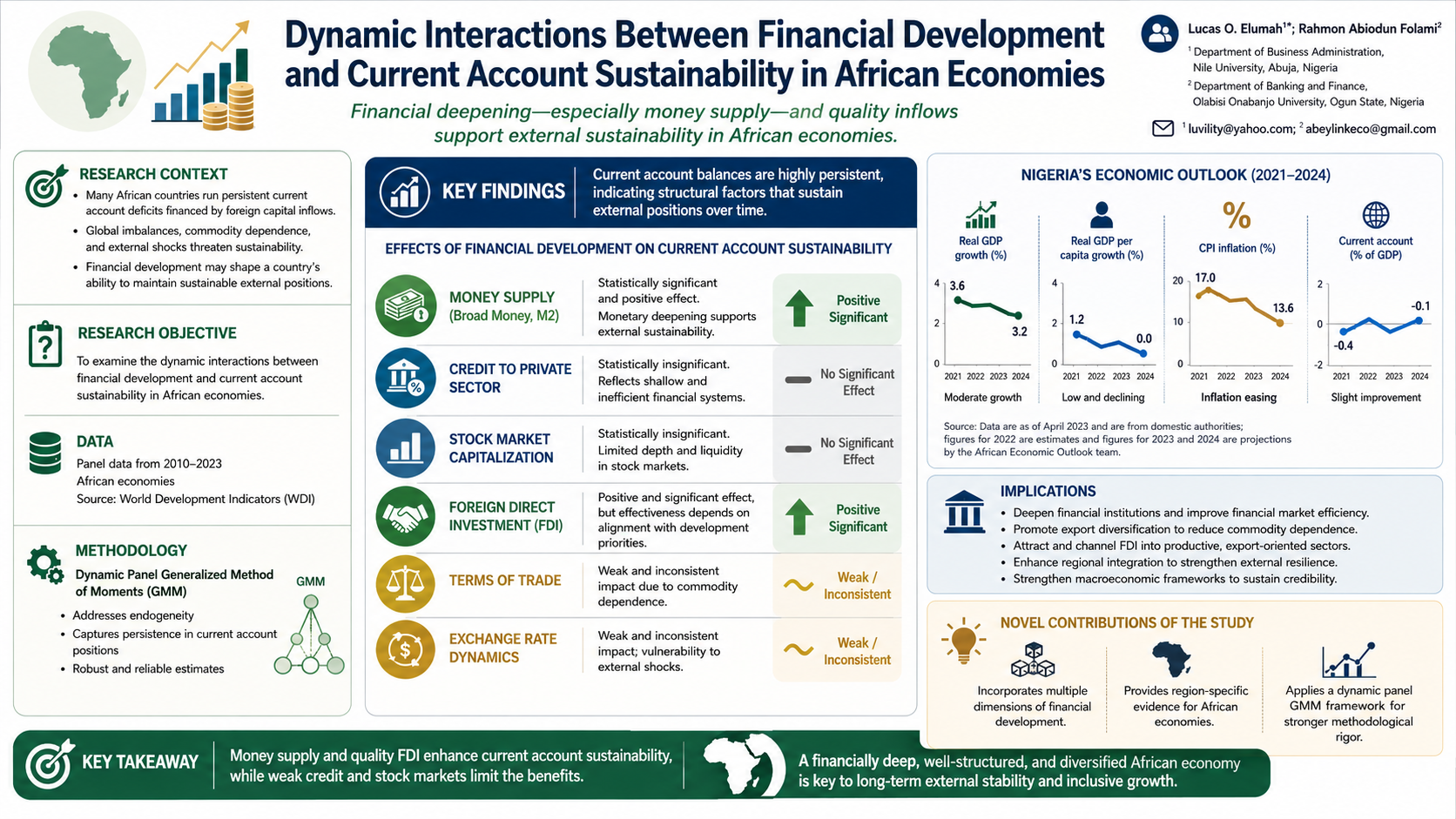
The research examined financial development and current account sustainability in African economies using panel data from 2010 to 2023 from the World Development Indicators (WDI). Unlike previous studies that focused narrowly on single indicators or on other regions, this research adopted a multidimensional approach by analyzing credit to the private sector, broad money supply, stock market capitalization, Foreign Direct Investment (FDI), and terms of trade and exchange rate dynamics. To address endogeneity and capture the persistence of current account positions, the researchers employed a dynamic panel Generalized Method of Moments (GMM) framework, ensuring robust and reliable results. The findings reveal strong persistence in current account balances, suggesting structural factors that maintain external positions over time. Among financial development variables, money supply has a statistically significant and positive effect, indicating that monetary deepening supports external sustainability. In contrast, credit to the private sector and stock market capitalization are statistically insignificant, reflecting shallow and inefficient financial systems across much of Africa. FDI exerts a positive influence, but its effectiveness depends on alignment with national development priorities. Terms of trade and exchange rate changes show weak and inconsistent impacts, underlining the region’s vulnerability to commodity dependence and external shocks. The research contributes novelty in three respects: incorporating multiple dimensions of financial development, providing region-specific evidence for African economies, and applying a dynamic panel GMM framework to strengthen methodological rigor. The results highlight the need to deepen financial institutions, promote export diversification, and enhance regional integration to improve external resilience and long-term macroeconomic stability.

References
Abille, A. B., & Meçik, O. (2024). Macro-determinants of current account balance performance in selected African countries. Journal of Social and Economic Development, 26, 1083–1102. https://doi.org/10.1007/s40847-023-00298-1
African Development Bank Group. (2023). African economic outlook 2023 – Mobilizing private sector financing for climate and green growth in Africa. https://www.afdb.org/sites/default/files/documents/publications/afdb23-01_aeo_main_english_0602.pdf
African Development Bank Group. (n.d.). Nigeria economic outlook. https://www.afdb.org/en/countries-westafrica-nigeria/nigeria-economic-outlook
Ahulu, H., MacCarthy, J., & Muda, P. (2021). Financial stability and economic growth nexus: Evidence from Sub‑Saharan Africa using panel data. International Journal of Economics and Financial Issues, 11(4), 11–18. https://doi.org/10.32479/ijefi.11407
Akonnor, K. T. (2024). The effect of Foreign Direct Investment (FDI) on the Current Account Balance (CAB) of selected West Africa countries. African Journal of Business and Economic Research, 19(4).
Ali, A., & Audi, M. (2023). Analyzing the impact of foreign capital inflows on the current account balance in developing economies: A panel data approach. Journal of Applied Economic Sciences, XVIII(2(80)), 92–107. https://doi.org/10.57017/jaes.v18.2(80).04
Altayligil, Y. B., & Çetrez, M. (2020). Macroeconomic, institutional and financial determinants of current account balances: A panel data assessment. Journal of Economic Structures, 9, 1–23. https://doi.org/10.1186/s40008-020-00225-1
Badia, M. M., Medas, P. A., Gupta, P., & Xiang, Y. (2020, January). Debt is not free. IMF Working Papers. https://www.imf.org/-/media/Files/Publications/WP/2020/English/wpiea2020001-print-pdf.ashx
Badibanga, T. M. (2022). Capital markets’ development: Are African countries lagging? In Monetary and financial systems in Africa: Integration and economic performance (pp. 283–314). Springer International Publishing.
Bah, M., Atangana, H. O., Kpognon, K. D., & Ouattara, S. (2023). Current account and institutional quality in Sub-Saharan Africa: An empirical investigation. Journal of the Knowledge Economy, 14, 4466–4488. https://doi.org/10.1007/s13132-022-01057-z
Bawuah, I. (2024). Bank stability and economic growth in Sub-Saharan Africa: trade-offs or opportunities? And how do institutions and bank capital affect this trade-off? Cogent Economics & Finance, 12(1),1–23. https://doi.org/10.1080/23322039.2024.2381695
Beirne, J., Renzhi, N., & Volz, U. (2020, July 21). Persistent current account imbalances: Are they good or bad for regional and global growth? SSRN. https://doi.org/10.2139/ssrn.3544629
Boachie, M. K., Ruzima, M., & Immurana, M. (2020). The concurrent effect of financial development and trade openness on private investment in India. South Asian Journal of Macroeconomics and Public Finance, 9(2), 190–220. https://doi.org/10.1177/2277978720906049
Borio, C., & Disyatat, P. (2015, October). Capital flows and the current account: Taking financing (more) seriously. Bank for International Settlement. https://www.bis.org/publ/work525.pdf
Bousnina, R., & Gabsi, F. B. (2022). Current account balance and financial development in MENA countries: The role of institutions. Comparative Economic Studies, 64(1), 109–142.
Bousnina, R., Redzepagic, S., & Gabsi, F. B. (2021). Sustainability of current account balances in MENA countries: Threshold cointegration approach. Economic Change and Restructuring, 54, 241–264. https://doi.org/10.1007/s10644-020-09278-5
Camarero, M., Carrion-i-Silvestre, J.L., & Tamarit, C. (2025). Current account determinants in a globalized world. Empirical Economics, 68, 1497–1527. https://doi.org/10.1007/s00181-024-02686-w
Cuestas, J. C., & Monfort, M. (2021). Current account sustainability in Central and Eastern Europe: Structural change and crisis. Empirica, 48, 141–153 https://doi.org/10.1007/s10663-020-09473-7
Demirguc-Kunt, A., Klapper, L., Singer, D., & Ansar, S. (2022). The Global Findex Database 2021: Financial inclusion, digital payments, and resilience in the age of COVID-19. World Bank Group. https://documents1.worldbank.
org/curated/en/099818107072234182/pdf/IDU06a834fe908933040670a6560f44e3f4d35b7.pdf
Ergano, T. Y., & Rao, S. P. (2025). Exploring the economic effects of financial development across Sub‑Saharan African nations. YMER Digital, 24(1), 279–296.
Faruq, A. T. M. O., & Chowdhury, M. A. R. (2025, March 9). Financial markets and ESG: How big data is transforming sustainable investing in developing countries. arXiv. https://doi.org/10.48550/arXiv.2503.06696
Habiba, U., & Xinbang, C. (2022). An investigation of the dynamic relationships between financial development, renewable energy use, and CO₂ emissions. Sage Open, 12(4), 1–21. https://doi.org/10.1177/21582440221134794
Husted, S. (1992). The emerging U.S. current account deficit in the 1980s: A cointegration analysis. The Review of Economics and Statistics, 74(1), 159–166. https://doi.org/10.2307/2109554
Ilo, B. M., Elumah, L. O., & Yinusa, O. G. (2018). Financial intermediaries and capital market development in Nigeria. Studies in Business and Economics, 21(1), 69–82
International Monetary Fund. African Dept. (2024a, May 9). Nigeria: 2024 article IV consultation-press release; staff report; staff statement; and statement by the executive director for Nigeria. IMF eLibrary. https://www.elibrary.imf.org/view/journals/002/2024/102/article-A001-en.xml
International Monetary Fund. African Dept. (2024b, February 9). Nigeria: Post-financing assessment discussions-press release; and staff report. IMF eLibrary. https://www.elibrary.imf.org/view/journals/002/2024/049/article-A001-en.xml
López-Villavicencio, A., & Mignon, V. (2021). Does backward participation in global value chains affect countries’ current account position? Review of World Economics, 157, 65–86. https://doi.org/10.1007/s10290-020-00390-2
Manjengwa, E., Dunga, S. H., Mncayi-Makhanya, P., & Makhalima, J. (2025). ESG performance and economic growth in BRICS countries: A dynamic ARDL panel approach. Sustainability, 17(14), 1–25. https://doi.org/10.3390/su17146334
Meniago, C., Mazorodze, B. T., & Mah, G. (2025). Linking financial development and economic growth: Do we have new evidence of the role of institutions in CFA countries? Cogent Economics & Finance, 13(1), 1–20. https://doi.org/10.1080/23322039.2025.2460067
Mlambo, C. (2024). Financial development and economic growth: Evidence from low-income nations in the SADC region. International Journal of Financial Studies, 12(3), 1–16. https://doi.org/10.3390/ijfs12030062
Moyo, C., Le Roux, P. (2020). Financial liberalisation, financial development and financial crises in SADC countries. Journal of Financial Economic Policy, 12(4), 477–494. https://doi.org/10.1108/JFEP-07-2018-0102
Nathaniel, E. T., & Biyi Oyeyemi, O. (2024). An analysis of the determinants of current account in Nigeria (1981-2022). IIARD International Journal of Economics and Business Management, 10(5), 1–12, https://doi.org/10.56201/ijebm.v10.no4.2024.pg1.12
National Bureau of Statistics. (2023, November). Nigerian gross domestic product report (Q3 2023). https://nigerianstat.gov.ng/elibrary/read/1241415
Ndzama, N. F. (2025). Examining the sustainability of current account deficits using a probability approach. Society and Economy, 47(2), 199–214. https://doi.org/10.1556/204.2024.00019
Nieminen, M. (2022). Cross-country variation in patience, persistent current account imbalances and the external wealth of nations. Journal of International Money and Finance, 121, 1–17. https://doi.org/10.1016/j.jimonfin.2021.102517
Nigerian Upstream Petroleum Regulatory Commission (NUPRC). (2023). Crude oil and condensate production - 2023. https://www.nuprc.gov.ng/wp-content/uploads/2024/02/JAN-TO-DEC-2023-PRODUCTION.pdf
Ohiomu, S., & Oligbi, B. O. (2020). The influence of financial sector development and financial deepening on economic growth: Empirical evidence from Nigeria. IOSR Journal of Economics and Finance (IOSR-JEF), 11(1), 58–67.
Olayiwola, A. S. (2022). Dynamic relationship between financial sector development and inclusive growth in Sub-Saharan African countries. African Journal of Economic Review, 10(2), 101–119.
Organisation for Economic Co-operation and Development (OECD). (2021, January 19). Africa’s development dynamics 2021: Digital transformation for quality jobs. https://www.oecd.org/en/publications/africa-sdevelopment-dynamics-2021_0a5c9314-en.html
Osisanwo, B. G., Oyelade, A. O., & Ajayi, F. O. (2024). Determinants of current account in Nigeria. African Journal of Economic Review, 12(3), 120–133.
Oyadeyi, O., & Akinbobola, T. (2022). Financial development and the current account in Nigeria. IOSR Journal of Economics and Finance, 13(2), 65–74.
Pagliari, M.S., & Hannan, S. A. (2024). The volatility of capital flows in emerging markets: Measures and determinants. Journal of International Money and Finance, 145. https://doi.org/10.1016/j.jimonfin.2024.103095
Poulakis, T., & Kyrkilis, D. (2024). A non-linear approach to current account sustainability—The cases of Germany, China, and the USA. Journal of Risk and Financial Management, 17(12), 1–18. https://doi.org/10.3390/jrfm17120565
Safdar, F., Javid, A. Y., & Sheraz, M. (2021). Macroeconomic and institutional drivers of current account in developing Asian countries. Studies of Applied Economics, 40(1), 1–14. https://doi.org/10.25115/eea.v40i1.5273
Sivrikaya, A., & Kurul, Z. (2020). Sustainability of current account surpluses: Evidence from European countries. Prague Economic Papers, 29(4), 481-501. https://doi.org/10.18267/j.pep.733
Terrones, M., & Tol, R. S. J. (2022, November 15). Relevance of financial development and fiscal stability in dealing with disasters in Emerging Economies. arXiv. https://arxiv.org/abs/2211.08078
Trehan, B., & Walsh, C. E. (1991). Testing intertemporal budget constraints: Theory and applications to U. S. federal budget and current account deficits. Journal of Money, Credit and Banking, 23(2), 206–223. https://doi.org/10.2307/1992777
Ullah, S., Niu, B., & Meo, M. S. (2025). Advancing sustainability in China by uncovering the role of eco-innovation, sustainable urbanization and financial development: Evidence from novel wavelet approaches. International Journal of Sustainable Development & World Ecology, 32(1), 110–125. https://doi.org/10.1080/13504509.2024.2412153
Yessymkhanova, Z., Khamitova, D., Bakytgul, U., & Azretbergenova, G. Ž. (2025). The relationship between current account deficit, economic growth and oil prices in developing countries. International Journal of Energy Economics and Policy, 15(2), 292–297.
Zulfiqar, B., Alwakid, W. N., Hanif, M., & Manzoor, M. (2024). Dynamics of access to finance, financial development and sustainable economic development in developing economies. The Business and Management Review, 15(3), 1–12. https://doi. org/10.24052/BMR/V15NU03/ART-01
Downloads
Published
How to Cite
Issue
Section
License
Copyright (c) 2026 Elumah Lucas, Rahmon Abiodun Folami

This work is licensed under a Creative Commons Attribution-ShareAlike 4.0 International License.
Authors who publish with this journal agree to the following terms:
a. Authors retain copyright and grant the journal right of first publication with the work simultaneously licensed under a Creative Commons Attribution License - Share Alike that allows others to share the work with an acknowledgment of the work's authorship and initial publication in this journal.
b. Authors are able to enter into separate, additional contractual arrangements for the non-exclusive distribution of the journal's published version of the work (e.g., post it to an institutional repository or publish it in a book), with an acknowledgment of its initial publication in this journal.
c. Authors are permitted and encouraged to post their work online (e.g., in institutional repositories or on their website) prior to and during the submission process, as it can lead to productive exchanges, as well as earlier and greater citation of published work.
USER RIGHTS
All articles published Open Access will be immediately and permanently free for everyone to read and download. We are continuously working with our author communities to select the best choice of license options, currently being defined for this journal as follows: Creative Commons Attribution-Share Alike (CC BY-SA)