Applying the Theory of Planned Behavior to Cyberloafing: Drivers and Performance Consequences in an Indonesia’s Cement Company
DOI:
https://doi.org/10.21512/bbr.v17i1.12910Keywords:
Theory of Planned Behavior (TPB), cyberloafing, performance, perceived behavioral control, subjective normAbstract
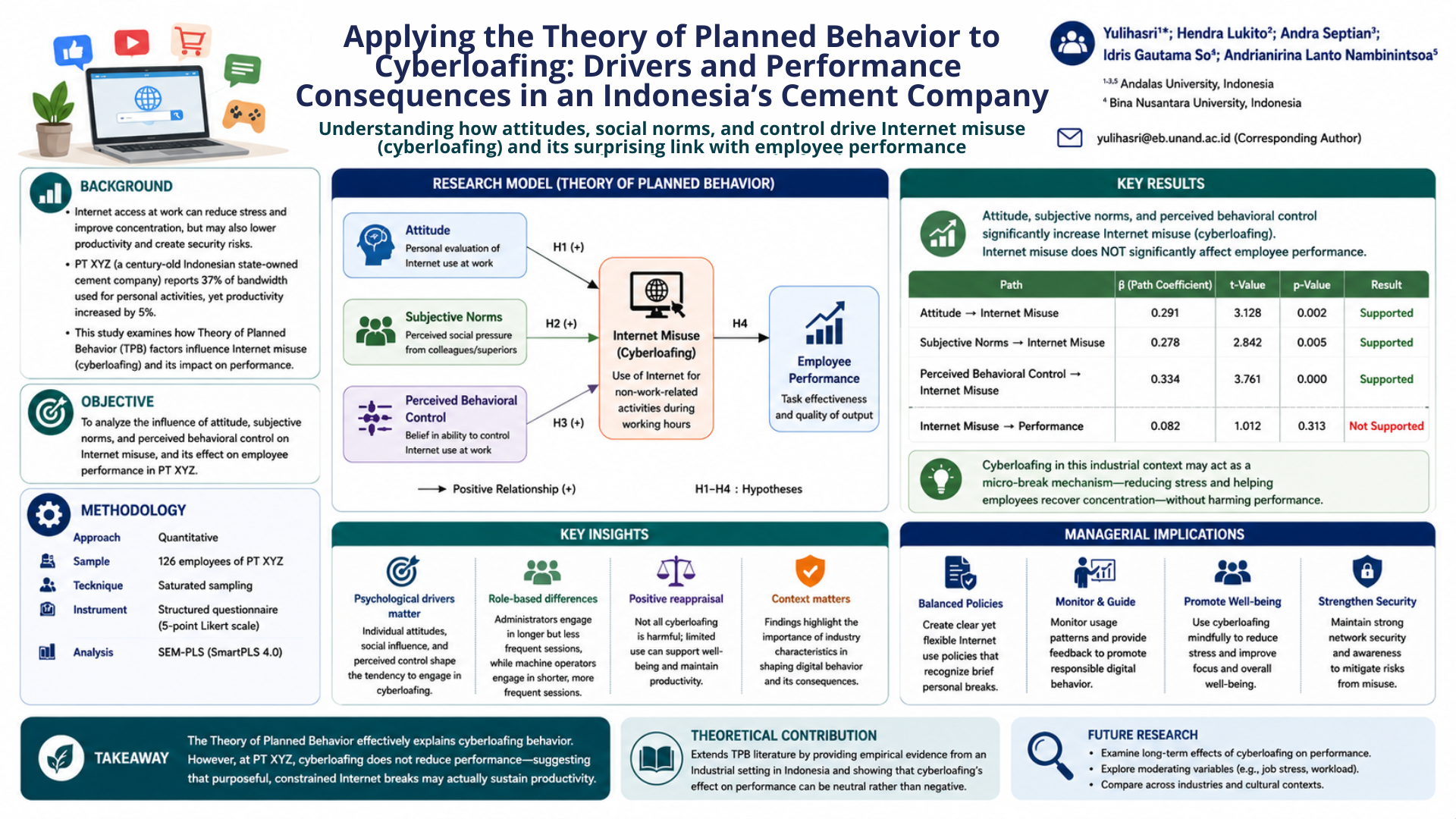
The research investigated how the Theory of Planned Behavior (TPB) factors, attitudes, subjective norms, and perceived behavioral control influenced cyberloafing among employees at PT XYZ, and how such behavior subsequently related to employee performance. While prior literature often assumed that cyberloafing reduced productivity, the research challenged that perspective by examining its potential as a form of workplace microbreak. Data were collected from 126 employees using a structured questionnaire on a five-point Likert scale and analyzed through Structural Equation Modeling (SEM) with SmartPLS 4.0. The findings reveal three main results. First, all TPB constructs significantly predict higher levels of cyberloafing, underscoring the role of psychological and social factors in shaping Internet use at work. Second, patterns of cyberloafing differ across organizational roles, with administrators engaging more frequently than operators. Third, contrary to conventional assumptions, cyberloafing shows no significant negative effect on overall work performance. These results suggest that, in this industrial context, limited cyberloafing may operate as a mechanism for stress relief and concentration recovery rather than as a drain on productivity. By providing empirical evidence from an Indonesian state-owned enterprise, the researchers contribute to a more nuanced understanding of cyberloafing, highlighting its cultural and organizational dimensions and questioning its universally negative portrayal.

References
Ajzen, I. (2020). The theory of planned behavior: Frequently asked questions. Human Behavior and Emerging Technologies, 2, 314–324. https://doi.org/10.1002/hbe2.195
Akram, H., Abdelrady, A. H., Al-Adwan, A. S., & Ramzan, M. (2022). Teachers’ perceptions of technology integration in teaching-learning practices: A systematic review. Frontiers in Psychology, 13, 1–9. https://doi.org/10.3389/fpsyg.2022.920317
Askarov, R. (2025, February 1). Internet usage policy. Monitask. https://www.monitask.com/en/forms/internet-usage-policy
Askew, K., Buckner, J. E., Taing, M. U., Ilie, A., Bauer, J. A., & Coovert, M. D. (2019). Erratum to “Explaining cyberloafing: The role of the theory of planned behavior” [Computers in Human Behavior 36C 510–519]. Computers in Human Behavior, 90. https://doi.org/10.1016/j.chb.2018.09.019
Asogwa, O. S., & Nosike, C. J. (2024). The impact of strike action on productivity : An analysis. Nigerian Journal of Arts and Humanities (NJAH), 4(1), 1–11.
Bonny-Noach, H., Gold, D., & Caduri, A. (2025). Applying the theory of planned behavior to predict online addiction treatment intention. Journal of Addictive Diseases, 43(1), 24–31. https://doi.org/10.1080/10550887.2023.2230834
Bosnjak, M., Ajzen, I., & Schmidt, P. (2020). The theory of planned behavior: Selected recent advances and applications. Europe’s Journal of Psychology, 16(3), 352–356. https://doi.org/10.5964/ejop.v16i3.3107
Cristello, J. V., Litt, D. M., Sutherland, M. T., & Trucco, E. M. (2024). Subjective norms as a mediator between exposure to online alcohol and marijuana content and offline use among adolescents. Drug and Alcohol Review, 43(1), 111–121. https://doi.org/10.1111/dar.13620
Environmental Management Authority. (n.d.). Environmental policies. https://www.ema.co.tt/emalegal/ema-policies/
Fei, Z. (2023). The impact of cyberloafing: A literature review and future prospects. Journal of Education, Humanities and Social Sciences, 24, 904–911. https://doi.org/10.54097/ez4hda76
Hair, J., & Alamer, A. (2022). Partial Least Squares Structural Equation Modeling (PLS-SEM) in second language and education research: Guidelines using an applied example. Research Methods in Applied Linguistics, 1(3), 1–16. https://doi.org/10.1016/j.rmal.2022.100027
Hardiani, S., Guanting, Chodidjah, & Kumar, A. M. (2022). Perilaku cyberloafing: Perspektif faktor individual dan organisasi di Dinas Pendidikan dan Kebudayaan Kota Malang. Business Management Research, 1(1), 12–22. https://doi.org/10.26905/bismar.v1i1.7331
Hurriyati, D., & Marlinda, I. (2023). The relationship between job stress and cyberloafing behavior in administrative and HR employees of Sunan Rubber Palembang Ltd. Endless: International Journal of Future Studies, 6(1), 239–256.
Jiao, J., & Cao, X. (2024). Research on designers’ behavioral intention toward artificial intelligence-aided design: Integrating the theory of planned behavior and the technology acceptance model. Frontiers in Psychology, 15, 1–13. https://doi.org/10.3389/fpsyg.2024.1450717
Jiaxuan, L., Zhenyan, L., Jiewang, C., & Yue, W. (2025). Privacy paradox stems from overconfidence: A study of users’ privacy disclosure in online knowledge communities. Behaviour & Information Technology, 44(13), 3194–3211. https://doi.org/10.1080/0144929X.2024.2438789
Koay, K. Y., & Lai, C. H. Y. (2023). Workplace ostracism and cyberloafing: A social cognitive perspective. Management Research Review, 46(12), 1769–1782. https://doi.org/10.1108/MRR-07-2022-0490
Kosasih, Diwyarthi, N. D. M. S., & Rezeki, F. (2023). The influence of the work environment and career development on employee productivity mediated by job satisfaction. e-Jurnal Apresiasi Ekonomi, 11(2), 367–377.
Lee, J. A., Lee, S. Y., Ryoo, Y., Kim, W., & Sung, Y. (2022). The psychological consequences of envying influencers on Instagram. Cyberpsychology, Behavior, and Social Networking, 25(11), 703–708. https://doi.org/10.1089/cyber.2022.0001
Liberman, B., Seidman, G., McKenna, K. Y., & Buffardi, L. E. (2011). Employee job attitudes and organizational characteristics as predictors of cyberloafing. Computers in Human behavior, 27(6), 2192–2199. https://doi.org/10.1016/j.chb.2011.06.015
Lim, V. K. G., & Chen, D. J. Q. (2012). Cyberloafing at the workplace: Gain or drain on work? Behaviour & Information Technology, 31(4), 343–353. https://doi.org/10.1080/01449290903353054
Margaret, F., & Sidharta, H. (2023). Integrating planned behavior and technology acceptance models: A study of GoFood after COVID-19. Journal The Winners, 24(2), 97–105. https://doi.org/10.21512/tw.v24i2.10847
Masur, P. K., Bazarova, N. N., & DiFranzo, D. (2023). The impact of what others do, approve of, and expect you to do: An in-depth analysis of social norms and selfdisclosure on social media. Social Media + Society, 9(1). https://doi.org/10.1177/20563051231156401
Mehdy, A. K. M. N., Ekstrand, M. D., Knijnenburg, B. P., & Mehrpouyan, H. (2021). Privacy as a planned behavior: Effects of situational factors on privacy perceptions and plans. In UMAP ‘21 - Proceedings of the 29th ACM Conference on User Modeling, Adaptation and Personalization (pp. 169–178). https://doi.org/10.1145/3450613.3456829
Mehrabioun, M. (2024). A multi-theoretical view on social media continuance intention: Combining theory of planned behavior, expectation-confirmation model and consumption values. Digital Business, 4(1), 1–21. https://doi.org/10.1016/j.digbus.2023.100070
Meng, C., Quancai, L., Kunjie, C., Yanyu, X., Wencai, L., & Yiwei, X. (2024). Low self-control, perceived social support and internet gaming addiction: Findings from an ethnicity minority region in China. Frontiers in Psychiatry, 15, 1–15. https://doi.org/10.3389/fpsyt.2024.1458626
Moffan, M. D. B., & Handoyo, S. (2020). Pengaruh stres kerja terhadap cyberloafing dengan kepuasan kerja sebagai variabel moderator pada karyawan di Surabaya. Analitika: Jurnal Magister Psikologi UMA, 12(1), 64–72. https://doi.org/10.31289/analitika.v12i1.3401
Mohammed, Y., Warkentin, M., Nehme, A., & Beshah, T. (2025). Testing a comprehensive model of employee IS misuse in a developing economy context. Journal of Knowledge Management, 29(6), 1974–2017. https://doi.org/10.1108/JKM-09-2024-1049
Murthy, T., Bluemn, T., Gupta, A. K., Reimer, M., Rao, S., Pillai, M. M., & Minella, A. C. (2018). Cyclindependent kinase 1 (CDK1) and CDK2 have opposing roles in regulating interactions of splicing factor 3B1 with chromatin. Journal of Biological Chemistry, 293(26), 10220–10234. https://doi.org/10.1074/jbc.RA118.001654
Nilsson, K. H., Matilla-Santander, N., Lee, M. K., Brulin, E., Bodin, T., & Håkansta, C. (2025). Algorithmic management and occupational health: A comparative case study of organizational practices in logistics. Safety Science, 187, 1–13. https://doi.org/10.1016/j.ssci.2025.106863
Ngowella, G. D., Loua, L. R., & Suharmono. (2022). A review on cyberloafing: The effects of social platforms on work performance. Asia Pasific Fraud Journal, 7(1), 27–39. https://doi.org/10.21532/apfjournal.v7i1.249
Novianti, K. R., & Roz, K. (2023). Cyberloafing behavior: The determinant factors related to work stress and workload in the banking sector. Jurnal Aplikasi Bisnis dan Manajemen, 9(2), 378–385. https://doi.org/10.17358/jabm.9.2.378
Plath, C., & Christiansen, T. (2023). Scrolling for success? The impact of social media microbreaks on perceived work productivity and psychological detachment from work [Thesis, Linnaeus University].
Rizky, R., Lestari, E. P., & Wihadanto, A. (2024). Cyberloafing mechanism: The impact of workload, self-control, and job stress on civil servant performance. Jurnal EKBIS, 25(1).
Safdeni, H. F., Wolor, C. W., & Marsofiyati. (2025). Analysis of cyberloafing behavior restriction strategies at Company X. International Student Conference on Business, Education, Economics, Accounting, and Management (ISC-BEAM), 3(1), 1424–1435. https://doi.org/10.21009/ISC-BEAM.013.107
Safrilsyah, S., Silvani, E. O., & Nova, V. (2024). Work ethic and cyberloafing in state civil apparatus at the office of the Ministry of Religion, Banda Aceh City. In Proceedings Ar-Raniry International Conference on Psychology (Vol. 1, No. 1, pp. 278–290).
Sao, R., Chandak, S., Patel, B., & Bhadade, P. (2022). Cyberloafing: Effects on employee job performance and behavior. International Journal of Recent Technology and Engineering (IJRTE), 8(5), 1509–1515. https://doi.org/10.35940/ijrte.E4832.018520
Twenge, J., & Blanchflower, D. G. (2025, February). Declining life satisfaction and happiness among young adults in six English-speaking countries. National Bureau of Economic Research. https://www.nber.org/papers/w33490
Vischer, J. C. (2007). The effects of the physical environment on job performance: Towards a theoretical model of workspace stress. Stress and Health, 23(3), 175–184. https://doi.org/10.1002/smi.1134
Wright, M. F., & Wachs, S. (2020). Adolescents’ cyber victimization: The influence of technologies, gender, and gender stereotype traits. International Journal of Environmental Research and Public Health, 17(4), 1–11. https://doi.org/10.3390/ijerph17041293
Wolgast, M., Adler, H., & Wolgast, S. N. (2025). Motives for social media use in adults: Associations with platform-specific use, psychological distress, and problematic engagement. Journal of Social Media Research, 2(3), 179–194. https://doi.org/10.29329/jsomer.45
Wu, J., Mei, W., Ugrin, J., Liu, L., & Wang, F. (2021). Curvilinear performance effects of social cyberloafing out of class: The mediating role as a recovery experience. Information Technology & People, 34(2), 581–598. https://doi.org/10.1108/ITP-03-2019-0105
Xie, Y., Wu, J., Zhang, C., & Zhu, L. (2022). Cumulative childhood trauma and cybervictimization among Chinese college students: Internet addiction as a mediator and roommate relationships as a moderator. Frontiers in Psychology, 13, 1–14. https://doi.org/10.3389/fpsyg.2022.791291
Yeoman, I. S. (2024). Editorial: Is theory of planned behaviour a good predictor of the future? Journal of Tourism Futures, 10(2), 162–164. https://doi.org/10.1108/JTF-06-2024-304
Zhu, C., Huang, S., Evans, R., & Zhang, W. (2021). Cyberbullying among adolescents and children: A comprehensive review of the global situation, risk factors, and preventive measures. Frontiers in Public Health, 9, 1–12. https://doi.org/10.3389/fpubh.2021.634909
Zubairi, A. A., Saravanan, S., Ali, F. D. A., Masrom, N. W., Suhaimi, P. F. M., & Idris, R. (2024). Digital drift: Unraveling impact of cyberloafing on job performance among service workers in the Klang Valley. International Journal of Academic Research in Progressive Education and Development, 13(3), 3340–3352. https://doi.org/10.6007/ijarped/ v13-i3/22629
Downloads
Published
How to Cite
Issue
Section
License
Copyright (c) 2026 Yulihasri, Hendra Lukito, Andra Septian, Idris Gautama So, Andrianirina Lanto Nambinintsoa

This work is licensed under a Creative Commons Attribution-ShareAlike 4.0 International License.
Authors who publish with this journal agree to the following terms:
a. Authors retain copyright and grant the journal right of first publication with the work simultaneously licensed under a Creative Commons Attribution License - Share Alike that allows others to share the work with an acknowledgment of the work's authorship and initial publication in this journal.
b. Authors are able to enter into separate, additional contractual arrangements for the non-exclusive distribution of the journal's published version of the work (e.g., post it to an institutional repository or publish it in a book), with an acknowledgment of its initial publication in this journal.
c. Authors are permitted and encouraged to post their work online (e.g., in institutional repositories or on their website) prior to and during the submission process, as it can lead to productive exchanges, as well as earlier and greater citation of published work.
USER RIGHTS
All articles published Open Access will be immediately and permanently free for everyone to read and download. We are continuously working with our author communities to select the best choice of license options, currently being defined for this journal as follows: Creative Commons Attribution-Share Alike (CC BY-SA)