Internal Mobility Influence on Qualitative Assurance Outcomes as Enhancement of Employee Skills and Competencies
DOI:
https://doi.org/10.21512/bbr.v17i1.12039Keywords:
internal mobility, qualitative assurance outcomes, employee skills, employee competenciesAbstract
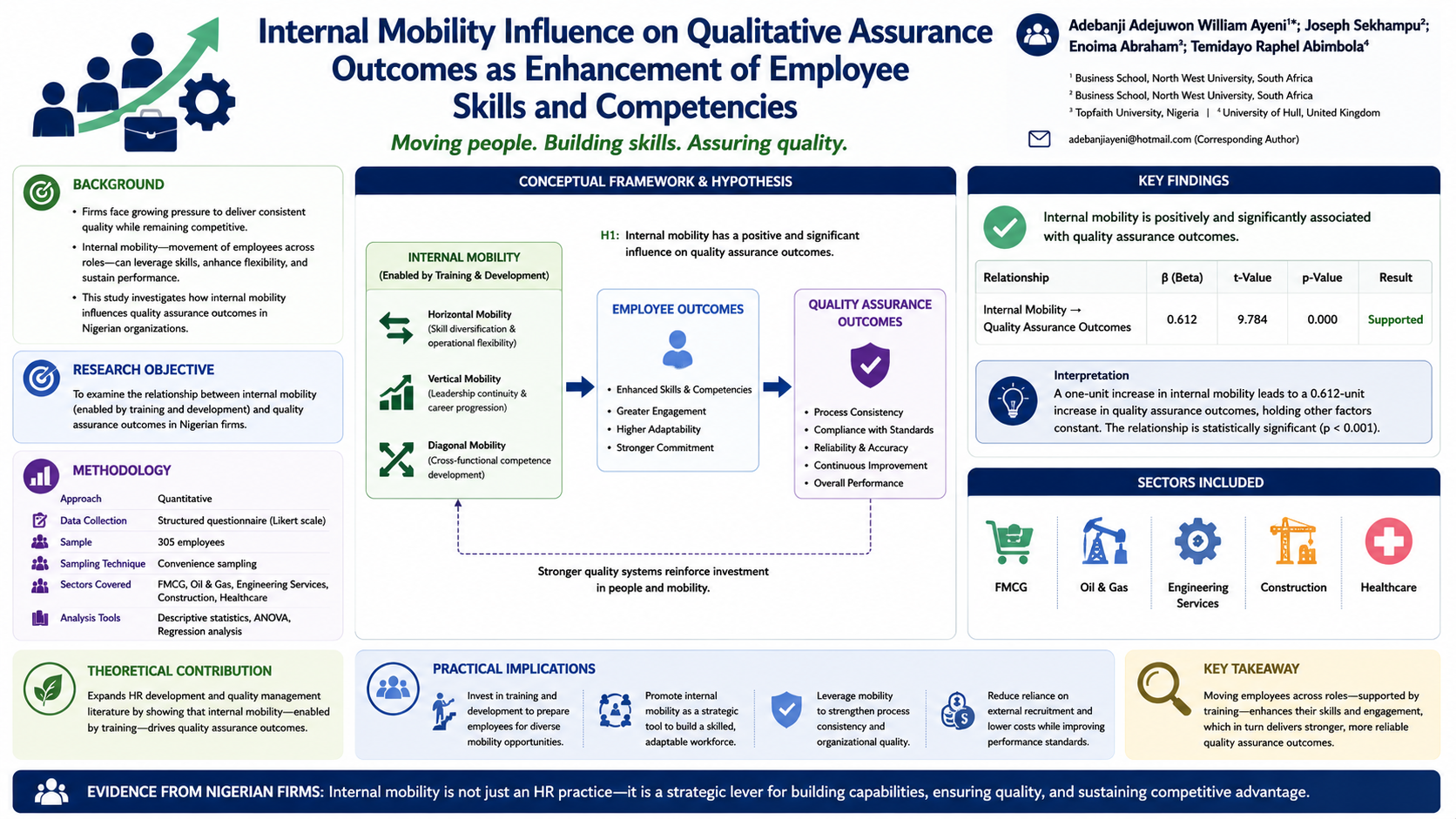
The research examined the correlation between internal mobility and quality assurance outcomes in Nigerian firms. It analyzed survey data from 305 employees in the Fast-Moving Consumer Goods (FMCG), oil and gas, engineering services, construction, and healthcare sectors to determine if structured internal mobility procedures enhanced quality assurance. Data were gathered via a standardized questionnaire and analyzed using descriptive statistics, ANOVA, and regression to examine patterns and identify statistically significant relationships. The findings demonstrate a positive, significant correlation between internal mobility and quality assurance outcomes, suggesting that employee movement across roles and functions enhances competency utilization, reinforces process consistency, and fosters compliance with organizational performance standards. Furthermore, internal mobility serves as a strategy for maintaining quality across corporate processes by systematically enabling people to apply their talents and expertise in diverse contexts. The research can experimentally illustrate the path of internal mobility as a quality-relevant organizational behavior by expanding the scope of human resource development and quality management research beyond its conventional emphasis on training efficacy. Moreover, by presenting evidence from an underrepresented emerging market environment, these findings enhance theoretical comprehension of how talent migration may bolster resilient organizational quality systems. The research highlights the strategic importance of internal mobility as a substitute for external recruitment, providing organizations with a cost-efficient method to uphold performance standards, improve workforce adaptability, and ensure quality assurance in dynamic and competitive operational settings.

References
Abubakir, H., & Alshaboul, Y. (2023). Unravelling EFL teachers’ mastery of TPACK: Technological pedagogical and content knowledge in writing classes. Heliyon, 9(6), 1–11. https://doi.org/10.1016/j.heliyon.2023.e17348
Al-Hakimi, M. A., Al-Swidi, A. K., Gelaidan, H. M., & Mohammed, A. (2022). The influence of green manufacturing practices on the corporate sustainable performance of SMEs under the effect of green organizational culture: A moderated mediation analysis. Journal of Cleaner Production, 376. https://doi.org/10.1016/j.jclepro.2022.134346
Anas, A. L., Salifu, M., & Abdulai, M. (2023). Reflections on migratory and mobility patterns and labour market security of Ghanaian youth amidst the Covid-19 crisis. Social Sciences & Humanities Open, 7(1), 1–8. https://doi.org/10.1016/j.ssaho.2023.100420
Anderson, S. W., & Widener, S. K. (2006). Doing quantitative field research in management accounting. In C. S. Chapman, A. G. Hopwood, & M. D. Shields (Eds.), Handbooks of management accounting research (1st ed., pp. 319–341). Elsevier. https://doi.org/10.1016/S1751-3243(06)01012-1
Antonietti, C., Cattaneo, A., & Amenduni, F. (2022). Can teachers’ digital competence influence technology acceptance in vocational education? Computers in Human Behavior, 132, 1–9. https://doi.org/10.1016/j.chb.2022.107266
Archakova, A. (2013). Service quality and customer satisfaction. Case study: Company X. Semantic Scholar. https://www.semanticscholar.org/paper/Service-Qualityand-Customer-Satisfaction.Case-X-Archakova/b9b2930dd1c472fcfd505ee9d5a645d0120851cb
Assefa, D. Z., Liao, C. T., & Misganaw, B. A. (2022). Unpacking the negative impact of initial informality on innovation: The mediating roles of investments in R&D and employee training. Technovation, 114. https://doi.org/10.1016/j.technovation.2022.102455
Baird, N., Martin, L. J., & Benson, A. J. (2020). A dynamic view of coach transformational leadership: How leadership perceptions relate to task cohesion and team potency. Psychology of Sport and Exercise, 51. https://doi.org/10.1016/j.psychsport.2020.101789
Bell, R., & Warren, V. (2023). Illuminating a methodological pathway for doctor of business administration researchers: Utilizing case studies and mixed methods for applied research. Social Sciences & Humanities Open, 7(1), 1–8. https://doi.org/10.1016/j.ssaho.2022.100391
Bisschoff, C., & Joubert, W. (2020). Brand loyalty towards online accommodation booking platforms. Innovative Marketing, 16(2), 1–14. https://doi.org/10.21511/im.16(2).2020.01
Bisschoff, C., Cader Asvat, R. A. C., & Botha, C. (2022). Measuring the performance of a private higher education institution in South Africa. International Journal of Management Practice, 15(6), 771–798. https://doi.org/10.1504/ijmp.2022.126530
Boubker, O. (2024). Does religion raise entrepreneurial intention and behavior of Muslim university students? An extension of Ajzen’s Theory of Planned Behavior (TPB). The International Journal of Management Education, 22(3). https://doi.org/10.1016/j.ijme.2024.101030
Braun, V., & Clarke, V. (2012). Thematic analysis. In H. Cooper, P. M. Camic, D. L. Long, A. T. Panter, D. Rindskopf, & K. J. Sher (Eds.), APA handbook of research methods in psychology, Vol. 2. Research designs: Quantitative, qualitative, neuropsychological, and biological (pp. 57–71). American Psychological Association. https://doi.org/10.1037/13620-004
Britrián, P., Buil, I., Catalán, S., & Merli, D. (2024). Gamification in workforce training: Improving employees’ self-efficacy and information security and data protection behaviours. Journal of Business Research, 179, 1–19. https://doi.org/10.1016/j.jbusres.2024.114685
Chakrabarti, R., & Henneberg, S. C. (2023). Base of the Pyramid entrepreneurship through silent design and effectuation. Journal of Business Research, 158. https://doi.org/10.1016/j.jbusres.2022.113633
Christofi, M., Ηadjielias, E., Hughes, M., & Plakoyiannaki, E. (2024). Advancing research methodologies in management: Revisiting debates, setting new grounds for pluralism. British Journal of Management, 35(1), 24–35. https://doi.org/10.1111/1467-8551.12791
Cochran, W. G. (1977). Sampling techniques (3rd ed.). John Wiley & Sons, Inc.
Coolen, P., Van Den Heuvel, S., Van De Voorde, K., & Paauwe, J. (2023). Understanding the adoption and institutionalization of workforce analytics: A systematic literature review and research agenda. Human Resource Management Review, 33(4), 1–24. https://doi.org/10.1016/j.hrmr.2023.100985
Copley, P., Douthett, E., & Zhang, S. (2021). Venture capitalists and assurance services on initial public offerings. Journal of Business Research, 131, 278–286. https://doi.org/10.1016/j.jbusres.2021.04.011
Del Val Núñez, M. T., De Lucas Ancillo, A., Gavrila, S. G., & Gandía, J. A. G. (2024). Technological transformation in HRM through knowledge and training: Innovative business decision making. Technological Forecasting and Social Change, 200, 1–16. https://doi.org/10.1016/j.techfore.2023.123168
Demerouti, E. (2023). Effective employee strategies for remote working: An online self-training intervention. Journal of Vocational Behavior, 142, 1–17. https://doi.org/10.1016/j.jvb.2023.103857
Du, Y., & Kim, P. H. (2021). One size does not fit all: Strategy configurations, complex environments, and new venture performance in emerging economies. Journal of Business Research, 124, 272–285. https://doi.org/10.1016/j.jbusres.2020.11.059
Dutta, D., Mishra, S. K., & Budhwar, P. (2022). Ethics in competency models: A framework towards developing ethical behaviour in organisations. IIMB Management Review, 34(3), 208–227. https://doi.org/10.1016/j.iimb.2022.10.002
Flynn, D. (n.d.). Student guide to SPSS. https://doczz.net/doc/5069888/student-guide-to-spss?
Gage, A. D., Gotsadze, T., Seid, E., Mutasa, R., & Friedman, J. (2022). The influence of continuous quality improvement on healthcare quality: A mixed-methods study from Zimbabwe. Social Science & Medicine, 298. https://doi.org/10.1016/j.socscimed.2022.114831
García-Carrión, B., Muñoz-Leiva, F., Del Barrio-García, S., & Porcu, L. (2024). The effect of online message congruence, destination-positioning, and emojis on users’ cognitive effort and affective evaluation. Journal of Destination Marketing & Management, 31. https://doi.org/10.1016/j.jdmm.2023.100842
Gkinko, L., & Elbanna, A. (2023). Designing trust: The formation of employees’ trust in conversational AI in the digital workplace. Journal of Business Research, 158, 1–10. https://doi.org/10.1016/j.jbusres.2023.113707
Harrison, R. L., Reilly, T. M., & Creswell, J. W. (2020). Methodological rigor in mixed methods: An application in management studies. Journal of Mixed Methods Research, 14(4), 473–495. https://doi.org/10.1177/1558689819900585
Hijrah, L., Hudayah, S., & Aransyah, M. F. (2023). Investigating the quality of online advertisements on Instagram: An experimental design. Quality -Access to Success, 24(193), 109–117. https://doi.org/10.47750/QAS/24.193.13
Hou, T., Luo, X., Ke, D., & Cheng, X. (2022). Exploring different appraisals in deviant sharing behaviors: A mixed-methods study. Journal of Business Research, 139, 496–509. https://doi.org/10.1016/j.jbusres.2021.09.066
Hughes, D., Hernandez, F. R., Miller, P., Warner, S., Babicky, M., Visser, B., Alseidi, A., & AHPBA SWOT Taskforce. (2022). The job market for HPB surgeons: Leadership perspectives on surgeon skillsets, training pathways, and hiring. HPB, 24(12), 2072–2081. https://doi.org/10.1016/j.hpb.2022.09.017
Isiani, M. C., Isiani, L. A., Obi-Ani, N. A., Isiani, A., Obi-Ani, P., & Isiani, O. J. (2024). The City of Boys: An ethnographic survey into the experiences of apprentices and urbanization of Onitsha City, Nigeria. Cities, 149. https://doi.org/10.1016/j.cities.2024.105003
Kim, M., & Park, M. J. (2023). Absorptive capacity in entrepreneurial education: Rethinking the Kolb’s experiential learning theory. The International Journal of Management Education, 21(3). https://doi.org/10.1016/j.ijme.2023.100873
Klassman, K., Malvaso, C., Delfabbro, P., Moulds, L., & Young, J. (2024). A rapid evidence assessment of barriers and strategies in service engagement when working with young people with complex needs. Children and Youth Services Review, 156, 1–14. https://doi.org/10.1016/j.childyouth.2023.107292
Kozachek, A. (2015). The Bologna professional training degrees in Europe and Russia: Analysis and systematization. Procedia - Social and Behavioral Sciences, 214, 235–242. https://doi.org/10.1016/j.sbspro.2015.11.671
Kushwaha, R. S., Mishra, S. K., Srivastava, A., & Tiwari, P. (2024). Research methodology. Noble Science Press. https://doi.org/10.52458/9788197357176.nsp.2024.tb
Liu, P. C. Y., Zhu, F., & Wang, J. (2024). The apple doesn’t fall far from the tree: Parenting styles and its effects on family business succession intentions. Journal of Business Research, 172. https://doi.org/10.1016/j.jbusres.2023.114429
Long, T., & Cooke, F. L. (2023). Advancing the field of employee assistance programs research and practice: A systematic review of quantitative studies and future research agenda. Human Resource Management Review, 33(2), 1–16. https://doi.org/10.1016/j.hrmr.2022.100941
Lynch, H. F., Eriksen, W., & Clapp, J. T. (2022). “We measure what we can measure”: Struggles in defining and evaluating institutional review board quality. Social Science & Medicine, 292. https://doi.org/10.1016/j.socscimed.2021.114614
Lyria, R. K., Namusonge, G. S., & Karanja, K. (2017). The effect of talent attraction on organizational performance of firms listed in the Nairobi Securities Exchange. Journal of Human Resource and Leadership, 1(3), 18–30. https://doi.org/10.47604/jhrl.217
Morris, M. W., Savani, K., Mor, S., & Cho, J. (2014). When in Rome: Intercultural learning and implications for training. Research in Organizational Behavior, 34, 189–215. https://doi.org/10.1016/j.riob.2014.09.003
Naughton, E., Moran, R., Kharub, M., Sa, J. C., & McDermott, O. (2024). A structured model for continuous improvement methodology deployment and sustainment: A case study. Heliyon, 10(21), 1–13. https://doi.org/10.1016/j.heliyon.2024.e40034
Nieuważny, J., Masui, F., Ptaszynski, M., Rzepka, R., & Nowakowski, K. (2020). How religion and morality correlate in age of Society 5.0: Statistical analysis of emotional and moral associations with Buddhist religious terms appearing on Japanese blogs. Cognitive Systems Research, 59, 329–344. https://doi.org/10.1016/j.cogsys.2019.09.026
O’Neill, B., Stapleton, L., & Carew, P. (2023). Can action research methods help address the digital social sustainability gap?: An evaluation and refinement of the ENRICHER methodology using PAR. IFACPapersOnLine, 56(2), 8994–8999. https://doi.org/10.1016/j.ifacol.2023.10.127
Orlandi, L. B., Veglianti, E., Zardini, A., & Rossignoli, C. (2024). Enhancing employees’ remote work experience: Exploring the role of organizational job resources. Technological Forecasting and Social Change, 199, 1–10. https://doi.org/10.1016/j.techfore.2023.123075
Paraschi, E. P., Georgopoulos, A., & Papanikou, M. (2022). Safety and security implications of crisisdriven austerity HRM practices in commercial aviation: A structural equation modelling approach. Safety Science, 147. https://doi.org/10.1016/j.ssci.2021.105570
Pennings, J. M., & Wezel, F. C. (2007). Human capital, inter-firm mobility and organizational evolution. Edward Elgar Publishing.
Peter, A., Adeniji, A., Oladele, K., Sajuyigbe, A., Peter, F., & Inegbedion, H. (2022). Role demand management among academic staff in selected Nigerian university: The eustress perspective. Journal of Management Information and Decision Sciences, 25(1), 1–16.
Rössig, S. A., Schmidt, C. V. H., Schrewentigges, L., & Strese, S. (2025). Is it contagious? The effect of fear of failure on employee satisfaction. Journal of Business Research, 188, 1–15. https://doi.org/10.1016/j.jbusres.2024.115059
Sage. (2017). Data collection. http://methods.sagepub.com/project-planner/data-collection
Sahranavard, S. A., Oney, E., & Aghaei, I. (2024). Consumer’s e-lifestyle and repurchase intention in online food ordering services: Exploring the role of e-WOM and habit. Technological Forecasting and Social Change, 208. https://doi.org/10.1016/j.techfore.2024.123647
Salleh, K. M., Sulaiman, N. L., Mohamad, M. M., & Sern, L. C. (2015). Academia and practitioner perspectives on competencies required for technical and vocational education students in Malaysia: A comparison with the ASTD WLP competency model. Procedia -Social and Behavioral Sciences, 186, 20–27. https://doi.org/10.1016/j.sbspro.2015.04.110
Sorensen, A. (2021). Facilitating value: How organizations deploy resources in social media-based brand communities. Journal of Business Research, 136, 678–694. https://doi.org/10.1016/j.jbusres.2021.07.058
Su, L., Yang, X., & Huang, Y. (2022). How do tourism goal disclosure motivations drive Chinese tourists’ goal-directed behaviors? The influences of feedback valence, affective rumination, and emotional engagement. Tourism Management, 90, 1–14. https://doi.org/10.1016/j.tourman.2021.104483
Ulatowska, R., Wainio, E., & Pierzchała, M. (2023). Digital transformation in HRM of the modern business service sector in Finland and Poland. Journal of Organizational Change Management, 36(7), 1180–1192. https://doi.org/10.1108/JOCM-11-2022-0339
Vijayasingham, L., Jogulu, U., & Allotey, P. (2020). Chronic illness and sustainable careers: How individuals with multiple sclerosis negotiate work transitions in a middle-income country. Social Science & Medicine, 245. https://doi.org/10.1016/j.socscimed.2019.112699
Wang, D., Luo, X., Hua, Y., & Benitez, J. (2023). Customers’ help-seeking propensity and decisions in brands’ self-built live streaming E-Commerce: A mixedmethods and fsQCA investigation from a dualprocess perspective. Journal of Business Research, 156. https://doi.org/10.1016/j.jbusres.2022.113540
Wengang, Z., Fenglian, W., & Feng, X. (2023). Motivating servant process for employee organizational citizenship behavior towards the environment: A goal setting perspective of integrating person-organization fit model. Journal of Cleaner Production, 387. https://doi.org/10.1016/j.jclepro.2023.135932
Yao, Q., Baker, L. T., & Lohrke, F. T. (2022). Building and sustaining trust in remote work by platformdependent entrepreneurs on digital labor platforms: Toward an integrative framework. Journal of Business Research, 149, 327–339. https://doi. org/10.1016/j.jbusres.2022.05.046
Downloads
Published
How to Cite
Issue
Section
License
Copyright (c) 2026 Adebanji Adejuwon William Ayeni, Joseph Sekhampu, Enoima Abraham, Temidayo Raphael Abimbola

This work is licensed under a Creative Commons Attribution-ShareAlike 4.0 International License.
Authors who publish with this journal agree to the following terms:
a. Authors retain copyright and grant the journal right of first publication with the work simultaneously licensed under a Creative Commons Attribution License - Share Alike that allows others to share the work with an acknowledgment of the work's authorship and initial publication in this journal.
b. Authors are able to enter into separate, additional contractual arrangements for the non-exclusive distribution of the journal's published version of the work (e.g., post it to an institutional repository or publish it in a book), with an acknowledgment of its initial publication in this journal.
c. Authors are permitted and encouraged to post their work online (e.g., in institutional repositories or on their website) prior to and during the submission process, as it can lead to productive exchanges, as well as earlier and greater citation of published work.
USER RIGHTS
All articles published Open Access will be immediately and permanently free for everyone to read and download. We are continuously working with our author communities to select the best choice of license options, currently being defined for this journal as follows: Creative Commons Attribution-Share Alike (CC BY-SA)