Hybrid Ant Colony Optimization and Deep Neural Network Model for 5G-IoT Optimization
DOI:
https://doi.org/10.21512/commit.v20i1.13195Keywords:
Internet of Things (IoT), Ant Colony Optimization (ACO), Deep Neural Network (DNN), Wireless NetworksAbstract
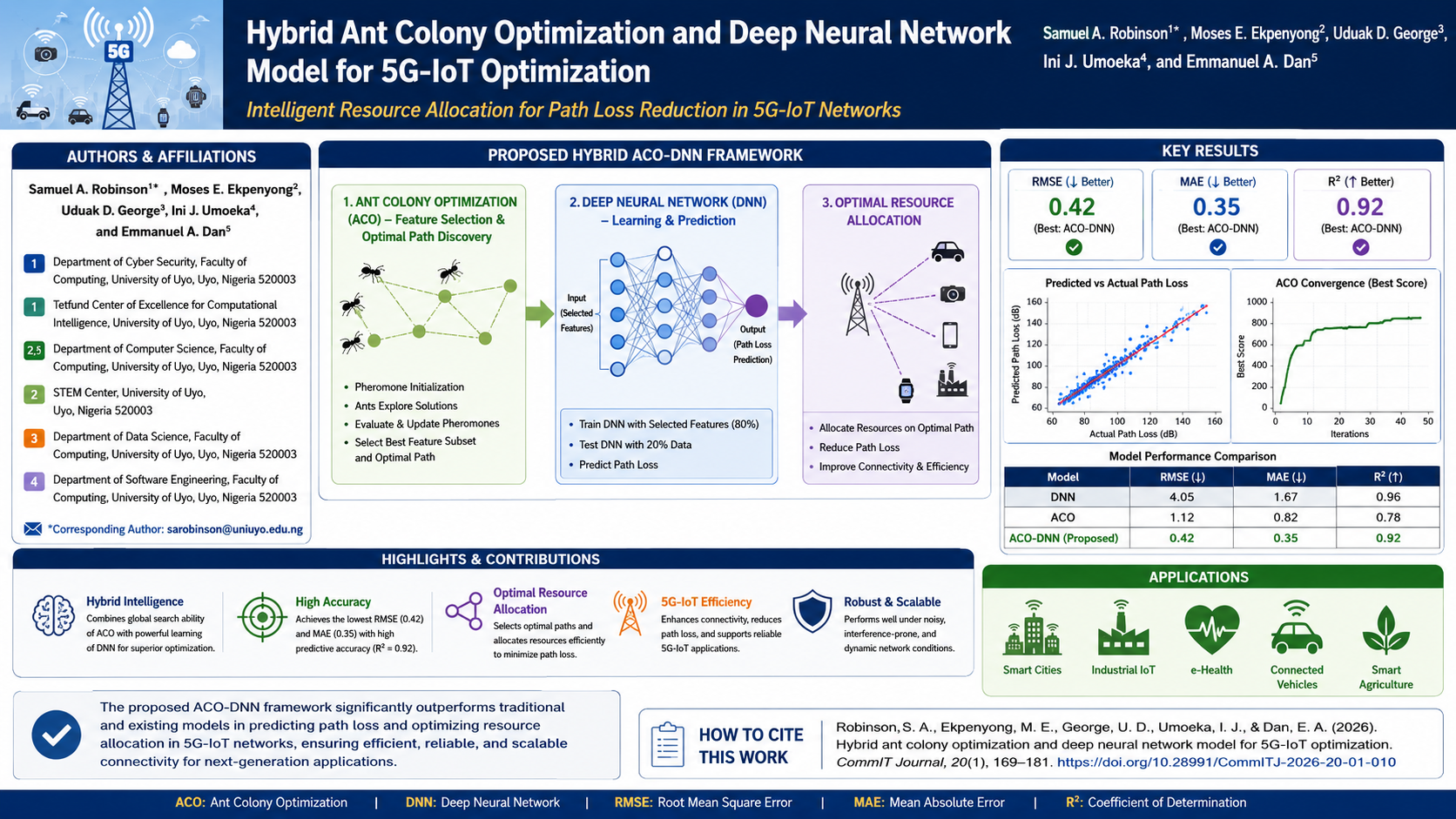
The research aims to develop a hybrid Ant Colony Optimization (ACO)-Deep Neural Network (DNN) for efficient resource allocation and the minimization of path loss in an Internet of Things (IoT)-driven 5G network. IoT-driven data are collected from the Zenodo repository, containing datasets with noisy information. The data are preprocessed using Exploratory Data Analysis (EDA) to remove outliers and missing values. The processed data are split into an 80-20% set. The training set (80%) is utilized for the ACO and DNN models, while the testing set (20%) evaluates the system’s performance. ACO is used for feature selection and identification of suitable features for learning and prediction, which feed into the DNN model for learning and prediction. The model is then evaluated with Root Mean Square Error (RMSE), Mean Absolute Error (MAE), and root square (R2) value to determine the optimal path for resource allocation and reducing signal loss in 5G networks. In the results, the ACO-DNN-based model outperforms the others with the lowest RMSE (0.42) and MAE (0.35). It shows high accuracy and minimal error in optimizing path loss. The ACO-DNN-based model also achieves effective resource allocation with an R2 of 0.92 and low error rates. The results underscore the efficiency of the hybridized ACO-DNN-based model for resource allocation while minimizing the path loss in the transmission link.

References
[1] P. Zuo, G. Sun, Z. Li, C. Guo, S. Li, and Z. Wei, “Toward secure transmission in fog Internet of Things using intelligent resource allocation,” IEEE Sensors Journal, vol. 23, no. 11, pp. 12 263–12 273, 2023.
[2] B. Pourghebleh, V. Hayyolalam, and A. Aghaei Anvigh, “Service discovery in the Internet of Things: Review of current trends and research challenges,” Wireless Networks, vol. 26, no. 7, pp. 5371–5391, 2020.
[3] M. A. Raza, M. Abolhasan, J. Lipman, N. Shariati, W. Ni, and A. Jamalipour, “Statistical learning-based adaptive network access for the industrial Internet of Things,” IEEE Internet of Things Journal, vol. 10, no. 14, pp. 12 219–12 233, 2023.
[4] X. Liu and X. Zhang, “NOMA-based resource allocation for cluster-based cognitive industrial Internet of Things,” IEEE Transactions on Industrial Informatics, vol. 16, no. 8, pp. 5379–5388, 2019.
[5] B. Pourghebleh, K. Wakil, and N. J. Navimipour, “A comprehensive study on the trust management techniques in the Internet of Things,” IEEE Internet of Things Journal, vol. 6, no. 6, pp. 9326–9337, 2019.
[6] H. Sun, X. Chen, Q. Shi, M. Hong, X. Fu, and N. D. Sidiropoulos, “Learning to optimize: Training deep neural networks for wireless resource management,” in 2017 IEEE 18th International Workshop on Signal Processing Advances in Wireless Communications (SPAWC). Sapporo, Japan: IEEE, July 3–6, 2017, pp. 1–6.
[7] P. Atanasov and Z. Kiss’ ovski, “Optimization of path loss models based on signal level measurements in 4G LTE network in Sofia,” Bulgarian Journal of Physics, vol. 44, no. 2, pp. 145–154, 2017.
[8] Y. A. Zakaria, E. K. Hamad, A. S. Abd Elhamid, and K. M. El-Khatib, “Performance evaluation of channel modeling and path loss measurements for wireless communication systems in urban and rural territories,” MEJ-Mansoura Engineering Journal, vol. 47, no. 1, pp. 1–11, 2022.
[9] M. Sharara, “Resource allocation in future radio access networks,” Ph.D. dissertation, Universit´e Paris-Saclay, 2023.
[10] S. Robinson and A. Imianvan, “Intelligent path loss prediction for IoT connectivity in 5G networks using hybrid machine learning techniques,” in 2024 International Conference on Science, Engineering and Business for Driving Sustainable Development Goals (SEB4SDG). Omu-Aran, Nigeria: IEEE, April 2–4, 2024, pp. 1–8.
[11] J. Isabona, S. A. Akinwumi, T. E. Arijaje, O. Ituabhor, and A. L. Imoize, “Parameter estimation of cellular communication systems models in computational MATLAB environment: A systematic solver-based numerical optimization approaches,” International Journal of Computer Network and Information Security (IJCNIS), vol. 16, no. 3, pp. 70–83, 2024.
[12] S. Islam, A. Mahmud, J. Uddin, and P. Podder, “An analytical analysis of path loss models for mobile cellular wireless communications,” International Journal on Cybernetics & Informatics, vol. 9, pp. 1–10, 2020.
[13] M. M. Yahaya, Y. Surajo, and A. H. Rawayau, “An enhanced resource allocation scheme for long term evolution advanced network,” Fudma Journal of Sciences, vol. 7, no. 3, pp. 7–12, 2023.
[14] J. Han, J. Pei, and H. Tong, Data mining: Concepts and techniques. Morgan kaufmann, 2022.
[15] H. Huang, S. Guo, G. Gui, Z. Yang, J. Zhang, H. Sari, and F. Adachi, “Deep learning for physical-layer 5G wireless techniques: Opportunities, challenges and solutions,” IEEE Wireless Communications, vol. 27, no. 1, pp. 214–222, 2019.
[16] M. M. I. Khan and G. Nencioni, “Resource allocation in networking and computing systems: A security and dependability perspective,” IEEE Access, vol. 11, pp. 89 433–89 454, 2023.
[17] A. Banchs, G. De Veciana, V. Sciancalepore, and X. Costa-Perez, “Resource allocation for network slicing in mobile networks,” IEEE Access, vol. 8, pp. 214 696–214 706, 2020.
[18] U. C. G¨ulmez, “Secure and energy-efficient resource allocation in network slicing,” Master’s thesis, Middle East Technical University (Turkey), 2022.
[19] R. V. Pamba, R. Bhandari, A. Asha, R. Neware, and A. S. Bist, “Novel deep learning approach to support optimal resource allocation in 5G environment,” Journal of Mobile Multimedia, vol. 19, no. 3, pp. 739–763, 2023.
[20] M. Alnatoor, M. Omari, and M. Kaddi, “Path loss models for cellular mobile networks using artificial intelligence technologies in different environments,” Applied Sciences, vol. 12, no. 24, pp. 1–23, 2022.
[21] A. Imianvan and S. Robinson, “Optimizing 5G IoT connectivity for path loss reduction through ant colony optimization and support vector regression,” in 2024 International Conference on Science, Engineering and Business for Driving Sustainable Development Goals (SEB4SDG). Omu-Aran, Nigeria: IEEE, April 2–4, 2024, pp. 1–10.
[22] S. A. Robinson, A. A. Imianvan, E. C. Igodan, E. A. Dan, K. U. Joseph, and L. A. Dickson, “Machine learning approach for path loss prediction in urban drive 5G network environments,” International Journal of Microwave & Optical Technology, vol. 20, no. 4, pp. 380–388, 2025.
[23] N. M. N. Pham and V. S. Le, “Applying ant colony system algorithm in multi-objective resource allocation for virtual services,” Journal of Information and Telecommunication, vol. 1, no. 4, pp. 319–333, 2017.
[24] M. Manavi, Y. Zhang, and G. Chen, “Resource allocation in cloud computing using genetic algorithm and neural network,” in 2023 IEEE 8th International Conference on Smart Cloud (Smart-Cloud). Tokyo, Japan: IEEE, Sep. 16–18, 2023, pp. 25–32.
Downloads
Published
How to Cite
Issue
Section
License
Copyright (c) 2026 Samuel A. Robinson, Moses E. Ekpenyong, Uduak D. George, Ini J. Umoeka, Emmanuel A. Dan

This work is licensed under a Creative Commons Attribution-ShareAlike 4.0 International License.
Authors who publish with this journal agree to the following terms:
a. Authors retain copyright and grant the journal right of first publication with the work simultaneously licensed under a Creative Commons Attribution License - Share Alike that allows others to share the work with an acknowledgment of the work's authorship and initial publication in this journal.
b. Authors are able to enter into separate, additional contractual arrangements for the non-exclusive distribution of the journal's published version of the work (e.g., post it to an institutional repository or publish it in a book), with an acknowledgment of its initial publication in this journal.
c. Authors are permitted and encouraged to post their work online (e.g., in institutional repositories or on their website) prior to and during the submission process, as it can lead to productive exchanges, as well as earlier and greater citation of published work.
Â
USER RIGHTS
All articles published Open Access will be immediately and permanently free for everyone to read and download. We are continuously working with our author communities to select the best choice of license options, currently being defined for this journal as follows: Creative Commons Attribution-Share Alike (CC BY-SA)