Fanfiction as ‘Textual Poaching’: Reconfiguring Fanfiction in Literary Production and Participatory Culture
DOI:
https://doi.org/10.21512/lc.v20i1.14048Keywords:
fanfiction, literary canon, participatory culture, textual poaching, valuesAbstract
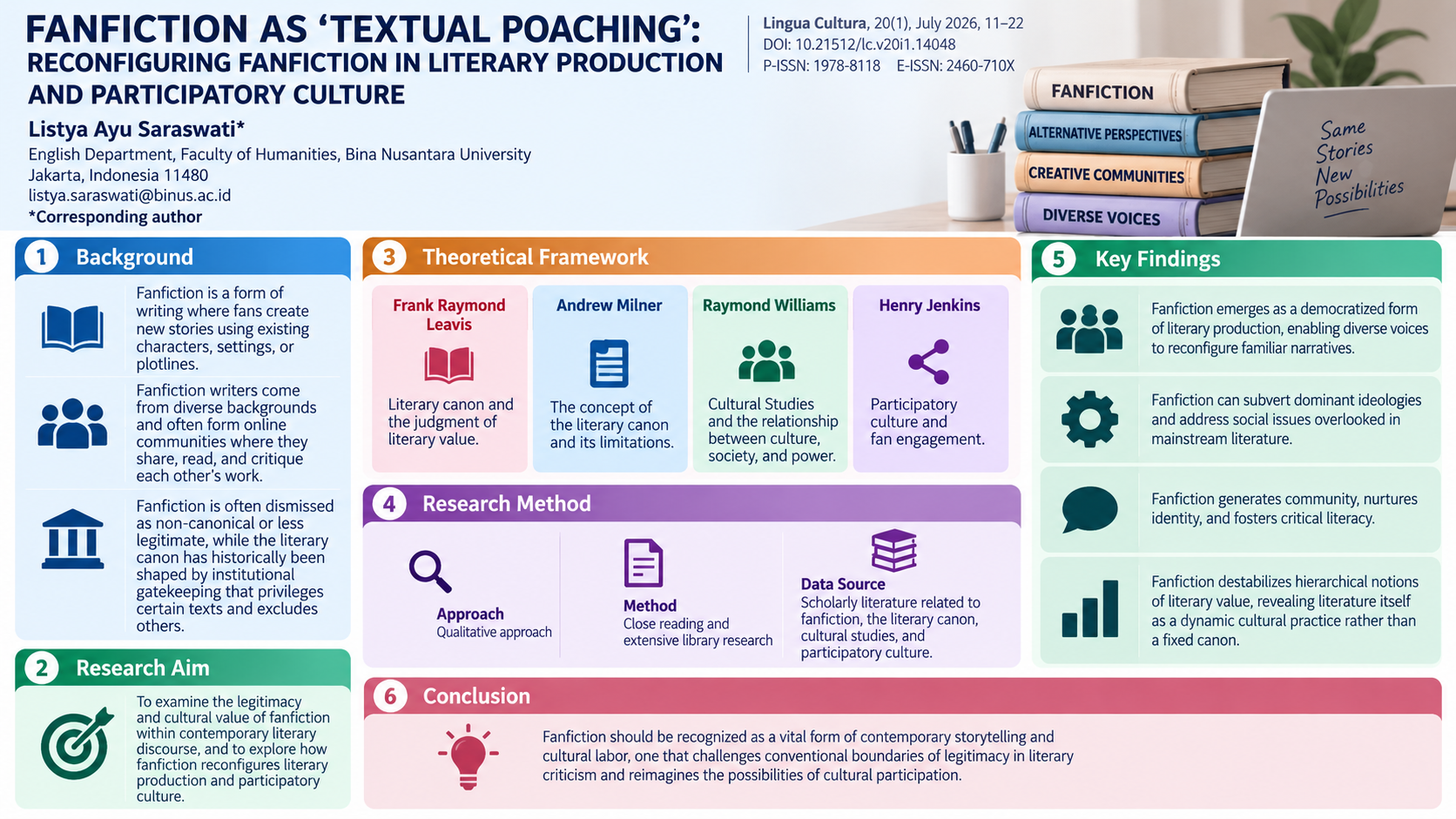
This philosophicaly reflective paper examines the legitimacy and cultural value of fanfiction within contemporary literary discourse, questioning its position in relation to the established literary canon. Beginning with an exploration of the practices of reading and writing fanfiction as forms of ‘labor’ within fandom, the study acknowledges the skepticism and dismissal that often surround its worth. These practices open broader inquiries into how value, legitimacy, and participation are determined in literature. Drawing on Frank Raymond Leavis and Andrew Milner’s theories of the literary canon, Raymond Williams’s Cultural Studies, and Henry Jenkins’s concept of participatory culture, the paper reflects on the historical role of institutional gatekeeping in canon literature, where certain texts were privileged as morally and culturally superior while others were excluded. In contrast, fanfiction emerges as a democratized form of literary production, enabling diverse voices to reconfigure familiar narratives, subvert dominant ideologies, and address social issues overlooked in mainstream literature. Through a qualitative approach that combines close reading and extensive library research, this paper highlights fanfiction’s intertextual and transformative qualities, emphasizing its capacity to generate community, nurture identity, and foster critical literacy. Rather than dismissing fanfiction as marginal or derivative, the analysis demonstrates how it destabilizes hierarchical notions of literary value, revealing literature itself as a dynamic cultural practice rather than a fixed canon. This study argues for recognizing fanfiction as a vital form of contemporary storytelling and cultural labor, one that challenges conventional boundaries of legitimacy in literary criticism and reimagines the possibilities of cultural participation.

References
Adawadkar, N., & Chutia, U. (2025). Between fandom and copyright: Navigating the maze of fanfiction commercialization. Journal of Intellectual Property Rights, 30(4), 455-465. https://doi.org/10.56042/jipr.v30i4.9484
Al-lawama, W. M. (2024). The evolution of modern literary criticism from structuralism to postmodernism: A case study of Edward Said and his critique of orientalism in literature. Theory and Practice in Language Studies, 14(10), 3268-3276. https://doi.org/10.17507/tpls.1410.30
Altun, M. (2023). Literature and social change: Exploring the transformative power of words. International Journal of Social Sciences & Educational Studies, 10(3), 387-391. https://doi.org/10.23918/ijsses.v10i3p386
Bollini, L., & Guida, F. E. (2024). Rewriting the canon: A literature review of graphic design history books to promote a gender-balanced education. ICERI 2024 Proceedings, 680-688. https://doi.org/10.21125/iceri.2024.0269
Brottrager, J., Doat, J., Häußler, J., & Weitin, T. (2023). Character shifts in Harry Potter fanfiction. Zeitschrift Für Literaturwissenschaft Und Linguistik, 53(3), 623-654. https://doi.org/10.1007/s41244-023-00310-5
Carvalho, A. M. (2024). “Keep on reading this crazy story”: About impoliteness and fanfiction in the digital environment [Master’s dissertation, Universidade Federal de Minas Gerais]. UFMG Institutional Repository. https://hdl.handle.net/1843/78392
Cheng, R., & Frens, J. (2022). Feedback exchange and online affinity: A case study of online fanfiction writers. Proceedings of the ACM on Human-Computer Interaction, 6(CSCW2), 1-29. https://doi.org/10.1145/3555127
Ciampa, K., & Reisboard, D. (2021). Books like me: An investigation of urban elementary teachers’ journey toward more culturally relevant pedagogy. Journal for Multicultural Education, 15(1), 1-19. https://doi.org/10.1108/JME-09-2019-0069
Duggan, J. (2022). Transformative readings: Harry Potter fanfiction, trans/queer reader response, and J. K. Rowling. Children’s Literature in Education, 53(2), 147-168. https://doi.org/10.1007/s10583-021-09446-9
Dunham, H., Oti, O. A., & Lawton, A. (2025). Examining critical consciousness within culturally sustaining literacy pedagogies: A systematic review of the literature. Literacy Research: Theory, Method, and Practice, 74(1), 257-279. https://doi.org/10.1177/23813377251358198
Ferran, Í. V. (2023). The transformative power of literary perspectives. Journal of Aesthetic Education, 57(3), 12-30. https://doi.org/10.5406/15437809.57.3.02
Furs, V. (2025). What’s wrong with participatory culture? Topos, 1(1) 153-176. https://doi.org/10.61095/815-0047-2025-1-153-176
Ghosh, S., & Aragon, C. (2024). Leveraging community support and platform affordances on a path to more active participation: A study of online fanfiction communities. Transformative Works and Cultures, 42. https://doi.org/10.3983/twc.2024.2477
Ghosh, S., Froelich, N., & Aragon, C. (2023, July). “I love you, my dear friend”: Analyzing the role of emotions in the building of friendships in online fanfiction communities [Conference paper]. International Conference on Human–Computer Interaction (HCII 2023), Copenhagen, Denmark. https://doi.org/10.1007/978-3-031-35927-9_32
Gonzalez-Vidal, T. (2024). Navigating linguacultures through fanfiction: Unveiling opportunities and challenges in the Chilean EFL school context. Computer Assisted Language Learning, 39(1-26), 89-114. https://doi.org/10.1080/09588221.2024.2366466
Grant, K. (2025). “Canon” and “fanon” in the danny phantom/detective comics (DC) comics crossover fandom: Expanding authorship and authority in transformative fan works. Computers and Composition, 76. https://doi.org/10.1016/j.compcom.2025.102937
Gregor, I. (1985). F. R. Leavis and “The great tradition.” The Sewanee Review, 93(3), 434–446.
Haas, L., & Tussey, J. (2023). Empowering minds: Multimodal literacies, fanfiction, and inclusive education. STEM Journal, 24(4), 28-40. https://doi.org/10.16875/stem.2023.24.4.28
Hylland, O. M., Berge, O. K., & Haugsevje, Å. D. (2025). On digital cultural value: What does research tell us? Cultural Trends, 1-19. https://doi.org/10.1080/09548963.2025.2495757
Jenkins, H. (2012). Textual Poachers. Routledge. https://doi.org/10.4324/9780203114339
Jenkins, H., Ford, S., & Green, J. (2013). Spreadable media: creating value and meaning in a networked culture. New York University Press.
Jiang, Q., & Doherty, S. (2024). A corpus-based study on the English-Chinese swearwords produced by amateur (fansubbing) and professional (prosubbing) subtitling. Perspectives, 1-27. https://doi.org/10.1080/0907676X.2024.2328755
Kang, B. (2024). Capturing differences in character representations between communities: An initial study with fandom. Computers and Society ArXiv Cornell University. https://doi.org/10.48550/arXiv.2409.11170
Khaeriyah, K., & Natsir, N. (2024). Social dynamics the role of social media in shaping collective identity. Momentum Matrix: International Journal of Communication, Tourism, and Social Economic Trends, 1(4), 56-66. https://doi.org/10.62951/momat.v1i4.121
Kidd, K. (2023). We need diverse fanfiction studies: On shipping fanfiction and CYA literature. Children’s Literature Association Quarterly, 48(1), 4-21. https://doi.org/10.1353/chq.2023.a905623
Kiefer, K., & Fernback, J. (2024). Sexual poachers: An analysis of where fandom, sex education, and marginalized sexualities collide. (Publication No. 31491053) [Master’s Thesis, Temple University] ProQuest Dissertations and Theses.
Kustritz, A. (2025). The politics of the digital transition: Lessons from slash fanfiction communities at the turn of the millennium. Internet Histories, 9(1-2), 69-85. https://doi.org/10.1080/24701475.2024.2442884
Leerssen, J. (2024). Culture in a moving rearview mirror: A historical meta-analysis of canonicity. International Journal of Documentary Heritage, 1(1), 8-8. https://doi.org/10.71278/IJODH.2024.1.1.8
Linsley, M. (2024). Life after canon: Dramione fanfiction’s literary reconstruction in Harry Potter fandom. Jamie Cassels Undergraduate Research Awards (JCURA). https://dspace.library.uvic.ca/items/0a395200-4826-4b5b-8f74-f5e77101155d
Llewellyn, A. (2022). “A space where queer is normalized”: The online world and fanfictions as heterotopias for WLW. Journal of Homosexuality, 69(13), 2348-2369. https://doi.org/10.1080/00918369.2021.1940012
Lüders, A., Dinkelberg, A., & Quayle, M. (2022). Becoming “us” in digital spaces: How online users creatively and strategically exploit social media affordances to build up social identity. Acta Psychologica, 228. https://doi.org/10.1016/j.actpsy.2022.103643
Magnifico, A. M., & Jones, K. (2025). Theorizing fanfiction: The importance of remixed social genres composed on the internet. Computers and Composition, 75. https://doi.org/10.1016/j.compcom.2025.102916
Mannard, E. (2023). Playful pluralities: Exploring play and playful literacies across ages, spaces and places. English Teaching: Practice & Critique, 22(2), 137-149. https://doi.org/10.1108/ETPC-09-2022-0126
Martin, A. D., & Spencer, T. (2020). Children’s literature, culturally responsive teaching, and teacher identity: An action research inquiry in teacher education. Action in Teacher Education, 42(4), 387-404. https://doi.org/10.1080/01626620.2019.1710728
Matlas, K. (2024). “Feedback means the world to me”: Constructing proximity in canon compliant fanfiction. Miscelánea: A Journal of English and American Studies, 70, 41-65. https://doi.org/10.26754/ojs_misc/mj.202410256
Milner, A. (1996). Literature, culture, and society. NYU Press.
Milner, A. (2004). Literature, culture and the canon. In Literature, Culture and Society (2nd Ed., pp. 1–26). Routledge.
Mißler, H. (2022). Chick lit and the new domesticity. In P. O’Donnell, S. J. Burn & L. Larkin (Eds.), The Encyclopedia of Contemporary American Fiction 1980–2020 (pp. 1-9). Wiley. https://doi.org/10.1002/9781119431732.ecaf0153
Moore, L. (2024). Fanfiction today: An analysis of publishing trends on Archive of Our Own. SLIS Connecting, 12(1). https://doi.org/10.18785/slis.1201.10
Oliveira, T., Nada, C., & Magalhães, A. (2025). Navigating an academic career in marketized universities: Mapping the international literature. Review of Educational Research, 95(2), 255-292. https://doi.org/10.3102/00346543231226336
Oulton, H. (2024). Harry Potter and the social construct. Does gender-swap fanfiction show us that we need to re-consider gender within children’s literature? Children’s Literature in Education, 55(3), 465-482. https://doi.org/10.1007/s10583-022-09518-4
Pilati, F., Tartari, M., Houssard, A., & Sacco, P. L. (2025). From fandoms to heritage. Understanding fanfiction forums as digital heritage communities. Convergence: The International Journal of Research into New Media Technologies, 31(4), 1383-1400. https://doi.org/10.1177/13548565241302245
Piva, H. C. (2022). An overview of fan production and participatory culture in the digital age. Hortus Semioticus, 9, 89-102.
Polák, M. (2025). Exploring literary genres in classical Greek and Latin literature: An analytical overview. American Journal of Philological Sciences, 5(3), 1-7.
Reed, E., & Johnson, B. (2023). Overview of cultural capital theory’s current impact and potential utility in academic libraries. The Journal of Academic Librarianship, 49(6). https://doi.org/10.1016/j.acalib.2023.102782
Richardson, D. E. (1999). Review: Scrutinizing F. R. Leavis: At the present time. The Sewanee Review, 107(1), 100-109.
Risch, J. (2023). Not just lustful literature: Self-liberation through fanfiction. Rhetorikos Blog. https://rhetorikos.blog.fordham.edu/?p=1712
Sajjad, M., Rahman, A., & Shoaib, A. (2025). Un-writing the canon: Feminist erasures and revisions in historical fiction. Journal of Social Signs Review, 3(4), 186-199.
Salcedo González, C. (2025). Female fantasies and romantic retellings of the myth of persephone: A case study in Greek mythology-based fanfiction. International Journal of the Classical Tradition. https://doi.org/10.1007/s12138-025-00710-7
Santa María, L., Aliagas, C., & Rutten, K. (2022). Youth’s literary socialisation practices online: A systematic review of research. Learning, Culture and Social Interaction, 34. https://doi.org/10.1016/j.lcsi.2022.100628
Sapuridis, E., & Alberto, M. K. (2022). Self-insert fanfiction as digital technology of the self. Humanities, 11(3), 1-31, 68. https://doi.org/10.3390/h11030068
Saputri, K. P. W., & Lammertz, S. (2024). Exploring the BTS ARMY fandom: A comprehensive review. LATTE: A Journal of Language, Culture, and Technology, 1(1), 31-38. https://doi.org/10.24002/lj.v2i1.8990
Sari, R. A., Salsabila, A., Alinda, Y., & Nurhaliza, A. A. (2025). Textual poaching dalam industri budaya k-pop oleh penggemar sebagai prosumer. Ganaya: Jurnal Ilmu Sosial Dan Humaniora, 8(3), 292-302. https://doi.org/10.37329/ganaya.v8i3.4557
Sezen, T. (2023). Books bleeding out of the screen: Engaging with imaginary books on screen through replicas. Participations: Journal of Audience and Reception Studies, 19(3), 286-294.
Sharapkova, A. (2024). Challenging the Arthurian myth in fanfiction: Rethinking gender and leadership. 3L The Southeast Asian Journal of English Language Studies, 30(3), 145-161. https://doi.org/10.17576/3L-2024-3003-11
Silberstein-Bamford, F. (2024). “Thank god for tags”—fanfiction as a reading paradigm. New Review of Hypermedia and Multimedia, 30(1-2), 129-147. https://doi.org/10.1080/13614568.2024.2369508
Southern, D. E. (2024). Redressing a gap in higher education and whiteness literature: conceptualizing the pervasiveness of whiteness in higher education organizations. Review of Educational Research, 95(6). https://doi.org/10.3102/00346543241287234
Span, M. (2022). Caring for the self. A case-study on sociocultural aspects of reading chick lit. Journal of Popular Romance Studies, 11, 1-18. https://doi.org/10.70138/LDBY6121
Stanko, D., & Kolegaeva, I. (2024). The educational potential of fanfiction: analysis of a derivative text. Revista Amazonia Investiga, 13(80), 204-214. https://doi.org/10.34069/AI/2024.80.08.17
Stecher, G. (2023). #MeToo and literary studies: Reading, writing, and teaching about sexual violence and rape culture. Feminist Pedagogy, 5(3).
Stevenson, J. (2025). The poorer the author, the better their art: How for-profit fanfiction can be fair use. SSRN Electronic Journal, 74(5), 1403-1475. https://doi.org/10.2139/ssrn.5325850
Subin, A., & Joseph, J. A. (2024). Rewriting narratives, reimagining communities: Fanfiction as a beacon of social connection in the digital era. ISHAL PAITHRKAM, 39, 61-78.
Sutrisno, S. (2023). Changes in media consumption patterns and their implications for people’s cultural identity. Technology and Society Perspectives (TACIT), 1(1), 18-25. https://doi.org/10.61100/tacit.v1i1.31
Wahyuni, L., Jia, C., Wahyuni, S., Mujianto, G., Vinahari, D. K., & Melati, I. K. (2024). The role of literature in shaping cultural identity and social consciousness in contemporary education. KEMBARA: Jurnal Keilmuan Bahasa, Sastra, Dan Pengajarannya, 10(2), 789-803. https://doi.org/10.22219/kembara.v10i2.37110
Wang, K., & Webb, M. (2024). Seeking best practice: A systematic review of literature on Chinese music teaching and learning in Western classroom contexts. International Journal of Music Education, 42(3), 442-460. https://doi.org/10.1177/02557614231175988
Wang, R. (2024). Censorship and creative communities: Fragility and change of fanfiction writing in China. Qualitative Sociology, 47(4), 667-689. https://doi.org/10.1007/s11133-024-09567-9
Williams, K. (2022). Voices of the establishment or of cultural subversion? The Western canon in the curriculum. Journal of Philosophy of Education, 55(4-5), 864-877. https://doi.org/10.1111/1467-9752.12588
Wilson, A. (2021). Fanfiction and premodern literature: Methods and definitions. Transformative Works and Cultures, 36. https://doi.org/10.3983/twc.2021.2037
Yang, X., & Pianzola, F. (2025). Fans reconstruct heroes: Modeling fictional characters in participatory culture. Semantic Web.
Yodovich, N. (2022). Reconciling feminism and fandom. In N. Yodovich (Ed.), Women Negotiating Feminism and Science Fiction Fandom: The Case of the “Good” Fan (pp. 141-169). Springer International Publishing. https://doi.org/10.1007/978-3-031-04079-5_6
Downloads
Published
How to Cite
Issue
Section
License
Copyright (c) 2026 Listya Ayu Saraswati

This work is licensed under a Creative Commons Attribution-ShareAlike 4.0 International License.
Authors who publish with this journal agree to the following terms:
a. Authors retain copyright and grant the journal right of first publication with the work simultaneously licensed under a Creative Commons Attribution License - Share Alike that allows others to share the work with an acknowledgment of the work's authorship and initial publication in this journal.
b. Authors are able to enter into separate, additional contractual arrangements for the non-exclusive distribution of the journal's published version of the work (e.g., post it to an institutional repository or publish it in a book), with an acknowledgment of its initial publication in this journal.
c. Authors are permitted and encouraged to post their work online (e.g., in institutional repositories or on their website) prior to and during the submission process, as it can lead to productive exchanges, as well as earlier and greater citation of published work.
USER RIGHTS
All articles published Open Access will be immediately and permanently free for everyone to read and download. We are continuously working with our author communities to select the best choice of license options, currently being defined for this journal as follows: Creative Commons Attribution-Share Alike (CC BY-SA)