Explainable Machine Learning Models SHAP-based for Feature Importance Affecting Stunting Prevalence
DOI:
https://doi.org/10.21512/comtech.v17i1.13732Keywords:
feature importance, logistic regression, explanaible machine learning, SHAPE value, stunting prevalenceAbstract
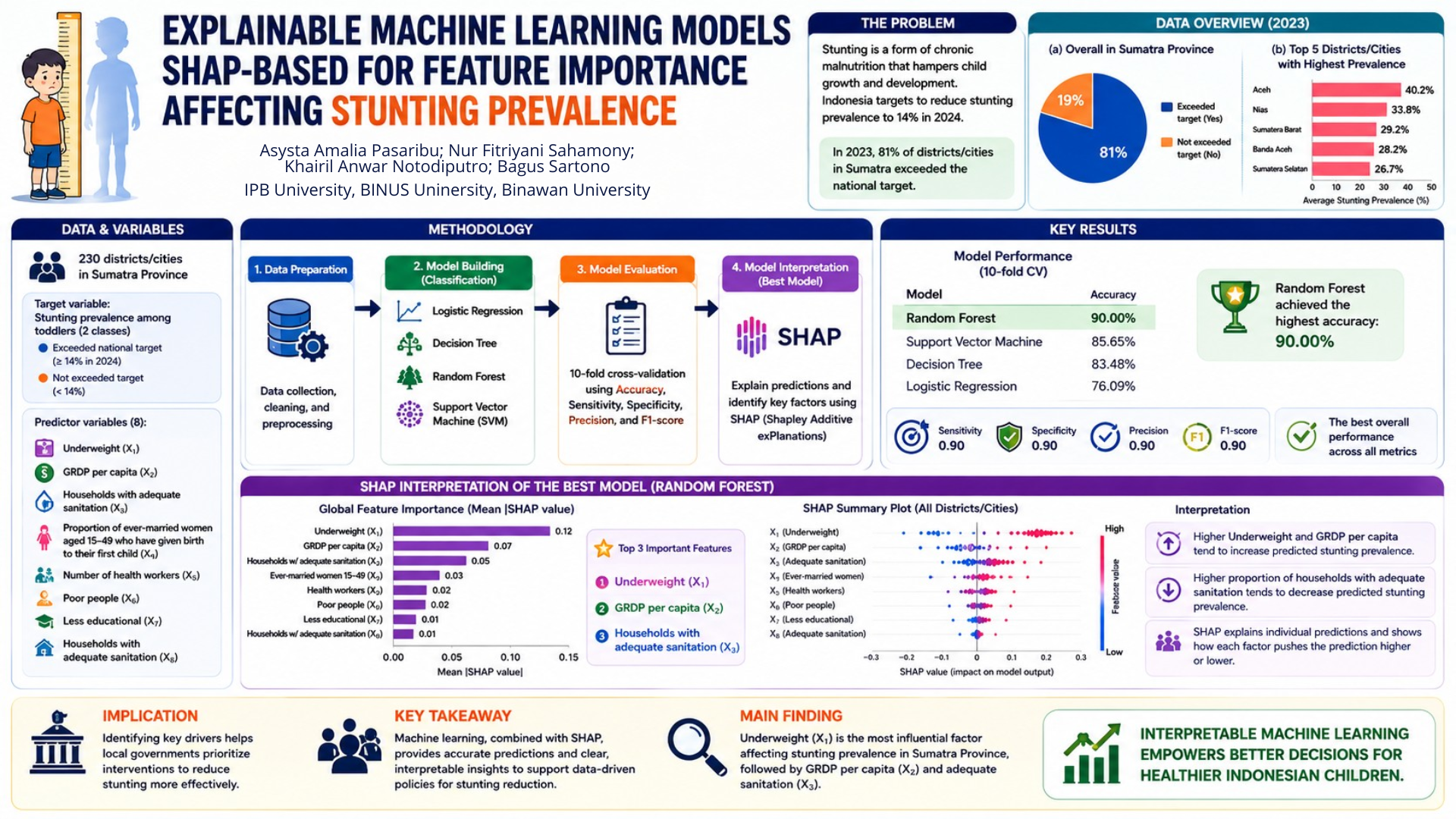
Stunting is a form of chronic nutritional deficiency in toddlers and remains a major public health concern due to its impact on child growth and development. Efforts to reduce its prevalence continue to be strengthened in Indonesia, particularly in Sumatra Province. This study aims to evaluate the accuracy of a logistic regression model and three machine learning models—decision tree, random forest, and Support Vector Machine (SVM)—in classifying stunting prevalence. The response variable is the prevalence of stunting among toddlers and is categorized into two classes: exceeding the national target and not exceeding it, based on the 2024 national threshold. Although classification models can provide accurate predictions, they often lack interpretability. Therefore, this study applies the Shapley Additive exPlanations (SHAP) method to the best-performing machine learning model to identify the key factors influencing stunting. The use of Shapley values is justified through the uniqueness theorem, which establishes it as the only attribution method that satisfies desirable fairness properties. SHAP values explain the model by referencing both the trained model and the underlying data. The results show that the random forest model achieves the highest accuracy (90.00%) and outperforms the other models. SHAP analysis reveals that Underweight is the most influential predictor contributing to stunting prevalence in Sumatra Province. These findings highlight the importance of machine learning interpretability in supporting policy decisions to reduce stunting.

References
Arsenault, P.-D., Wang, S., & Patenaude, J.M. (2025). A survey of explainable artificial intelligence (XAI) in financial time series forecasting. ACM Computing Surveys, 57(10), 1–37. https://doi.org/10.1145/3729531
Asgedom, Y. S., Seifu, B. L., Mare, K. U., Asmare, Z. A., Asebe, H. A., Kase, B. F., Shibeshi, A. H., Tebeje, T. M., Sabo, K. G., & Fente, B. M. (2024). Levels of stunting associated factors among under-five children in Ethiopia: A multi-level ordinal logistic regression analysis. Plos One, 19(1), e0296451. https://doi.org/10.1371/journal.pone.0296451
Ashari, R., Basyir, V., Afriwardi, A., Mayetti, M., Yusrawati, Y., & Desmawati, D. (2023). Factors related to stunting incidence in toddlers aged 24-59 months in the working area of Kambang Community Health Center, Pesisir Selatan District. Contagion: Scientific Periodical Journal of Public Health and Coastal Health, 5(2), 530–549.
Asmare, A. A., Tegegne, A. S., Belay, D. B., & Agmas, Y. A. (2025). Coexisting predictors for undernutrition indices among under-five children in West Africa: Application of a multilevel multivariate ordinal logistic regression model. BMC Nutrition, 11(1), 112. https://doi.org/10.1186/s40795-025-01099-x
Fadmi, F. R., Mulyani, S., Justin, W. O. S., & Riza, Y. (2025). Logistic regression analysis of risk factors for stunting among toddlers aged 24-59 months in Southeast Sulawesi, Indonesia. Health Dynamics, 2(2), 85–91. https://doi.org/10.33846/hd20206
Fahrani, D., Putri, A. E., & Pramana, S. (2025). Combining survey and satellite data for spatial analysis of the prevalence of stunting in java in 2021. In AIP Conference Proceedings (Vol. 3302, No. 1, P.050005). https://doi.org/10.1063/5.0262277
Falah, A. N., Andriyana, Y., Jaya, I., Tantular, B., & Maryadi, E. (2025). Expanded spatial Durbin model for analyzing stunting prevalence in Java Island. Commun. Math. Biol. Neurosci., 2025, Article-ID. https://doi.org/10.28919/cmbn/9217
Fedyk, M., & Ray, M. (2023). How to leverage machine learning interpretability and explainability to generate hypotheses in cognitive psychology. In Proceedings of the Annual Meeting of the Cognitive Science Society (Vol. 45, No. 45)
Girma, B., Sasahu, L. D., & Rahman, A. (2025). Spatial distribution of stunting among breast feeding children in Sub-Sahara Africa. PLoS One, 20(6), e0325812. https://doi.org/10.1371/journal.pone.0325812
Henninger, M., Debelak, R., Rothacher, Y., & Strobl, C. (2023). Interpretable machine learning for psychological research: Opportunities and pitfalls. Psychological Methods. https://doi.org/10.1037/met0000560
Houssein, E. H., Gamal, A. M., Younis, E. M., & Mohamed, E. (2025). Explainable artificial intelligence for medical imaging systems using deep learning: A comprehensive review. Cluster Computing, 28(7), 469. https://doi.org/10.1007/s10586-025-05281-5
Juniarti, N., Alsharaydeh, E., Sari, C. W. M., Yani, D. I., & Hutton, A. (2025). Determinant factors influencing stunting prevention behaviors among working mothers in West Java Province, Indonesia: A crosssectional study. BMC Public Health, 25(1), 2719. https://doi.org/10.1186/s12889-025-24078-0
Kassie, G. A., & Asgedom, Y. S. (2025). Childhood stunting severity level and associated factors among underfive children in Tanzania: A multi-level ordinal logistic regression analysis using 2022 Tanzanian demographic and health survey. BMC Pediatrics, 25(1), 129. https://doi.org/10.1186/s12887-025-05490-2
Mohsin, M. T., & Nasim, N. B. (2025). Explaining the unexplainable: A systematic review of explainable AI in finance. arXiv Preprint arXiv:2503.05966. https://doi.org/10.48550/arXiv.2503.05966
Muhaimin, A., Ekacitta, P. C., & Ardiani, A. E. (2025). Spatial autocorrelation analysis of East Java stunting prevalence cases in 2023. Journal of Advances in Information and Industrial Technology, 7(1), 83–94. https://doi.org/10.52435/jaiit.v7i1.689
Purnamasari, I., Widiyati, F., & Sahli, M. (2022). Analisis faktor yang mempengaruhi kejadian stunting pada balita. Jurnal Penelitian Dan Pengabdian Kepada Masyarakat UNSIQ, 9(1), 48–56. https://doi.org/10.32699/ppkm.v9i1.2342
Rehman, A., Lin, J. C., & Heldal, I. (2025). Enhancing psychologists’ understanding through explainable deep learning framework for ADHD diagnosis. Expert Systems, 42(2), e13788. https://doi.org/10.1111/exsy.13788
Rifada, M., Chamidah, N., Ningrum, R. A., & Muniroh, L. (2023). Stunting determinants among toddlers in Probolinggo district of Indonesia using parametric and nonparametric ordinal logistic regression models. Commun. Math. Biol. Neurosci., 2023, Article-ID. https://doi.org/10.28919/cmbn/6690
Shah, T., Shekokar, K., Barve, A., & Khandare, P. (2024). An analytical review: Explainable AI for decision making in finance using machine learning. In 2024 Parul International Concerence of Engineering and Technology (PICET (pp. 1-5). IEEE. 10.1109/PICET60765.2024.10716075
Shifa, N., Saleh, M., Akbari, Y., & Al Maadeed, S. (2025). A review of explainable AI techniques and their evaluation in mammography for breast cancer screening. Clinical Imaging, 123, 110492. https://doi.org/10.1016/j.clinimag.2025.110492
Sun, X., Liu, C., Wang, J., & Li, J. (2020). Assessing the extreme risk spillovers of international commodities on maritime markets: A GARCH-Copula-CoVaR approach. International Review of Financial Analysis, 68, 101453. https://doi.org/10.1016/j.irfa.2020.101453
Uban, A.-S., Chulvi, B., & Rosso, P. (2022). Explainability of depression detection on social media: From deep learning models to psychological interpretations and multimodality. In Early Detection of Mental Health Disorders by Social Media Monitoring: The First Five Years of the eRisk Project (pp. 289–320). Springer. https://doi.org/10.1007/978-3-031-04431-1_13
Ullah, N., Guzmán-Aroca, F., Martínez-Álvarez, F., De Falco, I., & Sannino, G. (2025). A novel explainable AI framework for medical image classification integrating statistical, visual, and rule-basedmethods. Medical Image Analysis, 103665. https://doi.org/10.1016/j.media.2025.103665

Downloads
Published
How to Cite
Issue
Section
License
Copyright (c) 2026 Asysta Pasaribu, Nur Fitriyani Sahamony, Khairil Anwar Notodiputro, Bagus Sartono

This work is licensed under a Creative Commons Attribution-ShareAlike 4.0 International License.
Authors who publish with this journal agree to the following terms:
a. Authors retain copyright and grant the journal right of first publication with the work simultaneously licensed under a Creative Commons Attribution License - Share Alike that allows others to share the work with an acknowledgment of the work's authorship and initial publication in this journal.
b. Authors are able to enter into separate, additional contractual arrangements for the non-exclusive distribution of the journal's published version of the work (e.g., post it to an institutional repository or publish it in a book), with an acknowledgment of its initial publication in this journal.
c. Authors are permitted and encouraged to post their work online (e.g., in institutional repositories or on their website) prior to and during the submission process, as it can lead to productive exchanges, as well as earlier and greater citation of published work.
 USER RIGHTS
 All articles published Open Access will be immediately and permanently free for everyone to read and download. We are continuously working with our author communities to select the best choice of license options, currently being defined for this journal as follows: