Enhancing Competency Level Prediction Using Machine Learning: A Data-Driven Approach Based on Psychological Assessment Data
DOI:
https://doi.org/10.21512/commit.v20i1.13633Keywords:
Competency Level Prediction, Machine Learning, Psychological Assessment, Human Capital as Strategic Asset, Network-Enabled Interview PlatformAbstract
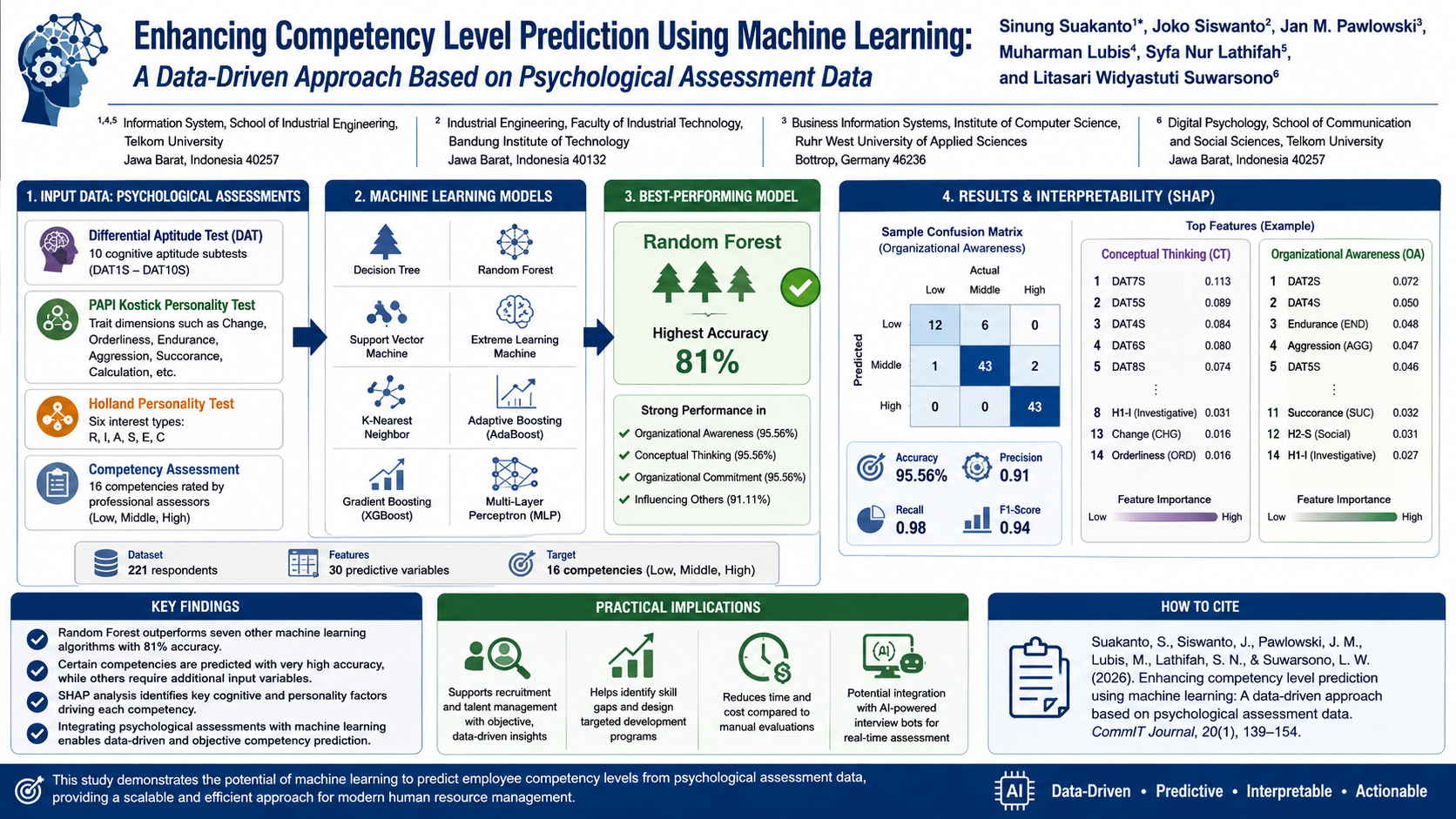
Competency level prediction plays a crucial role in competency-based human resource management such as talent management. Talent management is achieved by identifying individuals’ knowledge, skills, and attitudes through psychological assessment. Recognizing employees as a strategic asset by accurately predicting competencies supports targeted development, boosting individual and organizational performance. Current practices related to competency assessment require expert judgment from psychologists or assessors, which can be time-consuming. The research proposes a machine learning–based approach to predict competency levels using psychological assessment scores as input, designed to operate within digital, network-enabled interview platforms. Several machine learning methods, including Random Forests, k-Nearest Neighbors (KNN), and Support Vector Machines (SVMs), are applied to historical assessment datasets to identify patterns and relationships between psychological assessment scores and competency levels. The dataset comprises 1,220 records from a psychological assessment. The experimental results indicate that the Random Forest model achieves the highest accuracy of 81%, outperforming other models in competency level prediction. The key novelty lies in its data-driven methodology, which enhances the objectivity and efficiency of competency evaluation while reducing reliance on expert interpretation. By enabling automated competency prediction in network-enabled interview environments, the proposed approach supports more efficient talent decision-making, workforce development, and recruitment processes. The findings demonstrate that machine learning can accurately predict competency levels from a clean dataset of psychological assessment scores, achieving accuracy above 80%. Future research may enhance model robustness by incorporating additional assessment center criteria and real-world performance metrics.

References
[1] S. Vaishnavi and G. Rajini, “Prediction of competencies during selection process: Correlation and mediation analysis,” Russian Law Journal, vol. 11, no. 3, pp. 50–66, 2023.
[2] S. Kadam, M. Negi, D. Khairnar, S. Nalawade, and S. Patil, “Student’s competency level prediction,” International Journal for Research in Applied Science & Engineering Technology (IJRASET), vol. 9, no. VI, pp. 4478–4480, 2023.
[3] C. Cao and Z. Zhang, “Machine learning-assisted competency modeling for human resource management jobs,” Mobile Information Systems, vol. 2022, no. 1, pp. 1–15, 2022.
[4] K. Agustian, A. Pohan, A. Zen, W. Wiwin, and A. J. Malik, “Human resource management strategies in achieving competitive advantage in business administration,” Journal of Contemporary Administration and Management (ADMAN), vol. 1, no. 2, pp. 108–117, 2023.
[5] B. ˇ Skrinjari´c, “Competence-based approaches in organizational and individual context,” Humanities and social sciences communications, vol. 9, no. 1, pp. 1–12, 2022.
[6] V. A. Jerin, “Potential appraisal and development in Human Resource Development (HRD): A review,” Asian Journal of Agricultural Extension, Economics & Sociology, vol. 39, no. 2, pp. 111–117, 2021.
[7] D. Y. Dai, “Rethinking human potential from a talent development perspective,” Journal for the Education of the Gifted, vol. 43, no. 1, pp. 19–37, 2020.
[8] J. M. Conte and R. K. Harmata, “Person-centered study of cognitive ability dimensions using latent profile analysis,” Journal of Intelligence, vol. 11, no. 5, pp. 1–12, 2023.
[9] P. B. Andreatta, C. H. Renninger, M. W. Bowyer, and J. M. Gurney, “Measuring competency: Improving the validity of your procedural performance assessments,” Annals of Surgery Open, vol. 4, no. 4, pp. 1–7, 2023.
[10] W. Febri Surya and A. Kasim, “The role of assessment center in career development in POLDA Bangka Belitung Islands,” International Review of Humanities Studies, vol. 7, no. 2, pp. 457–472, 2022.
[11] C. Atkinson, J. Barrow, and S. Norris, “Assessment practices of educational psychologists and other educational professionals,” Educational Psychology in Practice, vol. 38, no. 4, pp. 347–363, 2022.
[12] T. V. Tran, S. Lepist¨o, and J. J¨arvinen, “The relationship between subjectivity in managerial performance evaluation and the three dimensions of justice perception,” Journal of Management Control, vol. 32, no. 3, pp. 369–399, 2021.
[13] J. M. Cucina, N. R. Martin, N. L. Vasilopoulos, and H. F. Thibodeuax, “Self-serving bias effects on job analysis ratings,” The Journal of Psychology, vol. 146, no. 5, pp. 511–531, 2012.
[14] K. Y. Wilson, “An analysis of bias in supervisor narrative comments in performance appraisal,” Human Relations, vol. 63, no. 12, pp. 1903–1933, 2010.
[15] A. Alsharif, “Transforming HR Practices: Using AI to revolutionize employee performance management,” International Journal of Academic Publishing in Educational Sciences and Humanities (IJAPESH), pp. 43–51, 2025.
[16] R. N. Landers, E. M. Auer, L. Dunk, M. Langer, and K. N. Tran, “A simulation of the impacts of machine learning to combine psychometric employee selection system predictors on performance prediction, adverse impact, and number of dropped predictors,” Personnel Psychology, vol. 76, no. 4, pp. 1037–1060, 2023.
[17] Y. Liu, “Application of machine learning in human resources management: Research on employee performance prediction model,” in Proceedings of the International Conference on Decision Science & Management. Hong Kong: Association for Computing Machinery, April 26–28, 2024, pp. 134–139.
[18] Z. Nayem and M. A. Uddin, “Unbiased employee performance evaluation using machine learning,” Journal of Open Innovation: Technology, Market, and Complexity, vol. 10, no. 1, pp. 1–11, 2024.
[19] N. Talpur, N. C. G. Alier, H. Matsom, M. H. A. Abdullah, and S. Khatoon, “Predicting employee performance using machine learning to enhance workforce efficiency,” in 2024 8th International Conference on Computing, Communication, Control and Automation (ICCUBEA). Pune, India: IEEE, Aug. 23–24, 2024, pp. 1–4.
[20] J. Huang, L. Li, L. Zhang, X. Qiao, and F. You, “Exploration of a deep learning-based mechanism for predicting the work competence of community caregivers,” Applied Mathematics and Nonlinear Sciences, vol. 9, no. 1, pp. 1–14, 2024.
[21] Z. Wei and L. Shuquan, “Prediction model of safety competency of construction workers based on machine learning,” China Safety Science Journal, vol. 33, no. 7, pp. 51–57, 2023.
[22] G. Ibarra-Vazquez, M. S. Ram´ırez-Montoya, M. Buenestado-Fern´andez, and G. Olague, “Predicting open education competency level: A machine learning approach,” Heliyon, vol. 9, no. 11, pp. 1–15, 2023.
[23] R. Farooqi and N. Iqbal, “Performance evaluation for competency of bank telemarketing prediction using data mining techniques,” International Journal of Recent Technology and Engineering, vol. 8, no. 2, pp. 5666–5674, 2019.
[24] S. Fukui, W. Wu, J. Greenfield, M. P. Salyers, G. Morse, J. Garabrant, E. Bass, E. Kyere, and N. Dell, “Machine learning with human resources data: Predicting turnover among community mental health center employees,” Journal of Mental Health Policy and Economics, vol. 26, no. 2, pp. 63–76, 2023.
[25] F. Guerranti and G. M. Dimitri, “A comparison of machine learning approaches for predicting employee attrition,” Applied Sciences, vol. 13, no. 1, pp. 1–8, 2022.
[26] M. Fadel, K. Kanasfi, and A. Wibowo, “Application of machine learning in predicting employee discipline violations in financial service company,” Jurnal Teknik Informatika (JUTIF), vol. 5, no. 1, pp. 171–178, 2024.
[27] C. Zhu, H. Zhu, H. Xiong, C. Ma, F. Xie, P. Ding, and P. Li, “Person-job fit: Adapting the right talent for the right job with joint representation learning,” ACM Transactions on Management Information Systems (TMIS), vol. 9, no. 3, pp. 1–17, 2018.
[28] H. G¨ulten and H. Barac¸lı, “A machine learningbased forecast model for career planning in human resource management: A case study of the Turkish post corporation,” Applied Sciences, vol. 14, no. 15, pp. 1–20, 2024.
[29] N. Dawson, M.-A. Rizoiu, B. Johnston, and M. A. Williams, “Predicting skill shortages in labor markets: A machine learning approach,” in 2020 IEEE International Conference on Big Data (Big Data). Atlanta, GA, USA: IEEE, Dec. 10–13, 2020, pp. 3052–3061.
[30] K. G. Ayu, D. W. Sari, I. Farida, D. Harsono, R. W. Kosaman, I. H. Sumitro, F. N. Iman, Mansuri, E. R. Kaburuan, and M. A. Fitri, “Classification of employee competency assessment using Na¨ıve Bayes and K-Nearest neighbor (KNN) algorithms,” Journal of Advances in Information Technology, vol. 15, no. 7, pp. 879–885, 2024.
[31] M. Harirchian, F. Amin, S. Rouhani, A. Aligholipour, and V. A. Lord, “AIenabled exploration of Instagram profiles predicts soft skills and personality traits to empower hiring decisions,” 2022. [Online]. Available: https://arxiv.org/abs/2212.07069
[32] J. Park, Y. Feng, and S. P. Jeong, “Developing an advanced prediction model for new employee turnover intention utilizing machine learning techniques,” Scientific Reports, vol. 14, no. 1, pp. 1–14, 2024.
[33] Y. Choi and J. W. Choi, “A study of job involvement prediction using machine learning technique,” International Journal of Organizational Analysis, vol. 29, no. 3, pp. 788–800, 2021.
[34] C. Chaiwichit and S. Samart, “The empirical research of teamwork competency factors and prediction on academic achievement using machine learning for students in thailand,” Perspectives of Sciences & Education, vol. 57, no. 3, pp. 540–556, 2022.
[35] K. Alipour, A. Ray, X. Lin, J. P. Schulze, Y. Yao, and G. T. Burachas, “The impact of explanations on AI competency prediction in VQA,” in 2020 IEEE International Conference on Humanized Computing and Communication with Artificial Intelligence (HCCAI). Irvine, CA, USA: IEEE, Sep. 21–23, 2020, pp. 25–32.
[36] M. S¸ims¸ek and A. S. Das¸, “The effect of handling imbalanced datasets methods on prediction of entrepreneurial competency in university students,” Turkish Journal of Forecasting, vol. 6, no. 2, pp. 53–60, 2022.
[37] P. Arjyotha, V. Promasatayaprot, and T. Promaruk, “Competency prediction equation for the performance of academic health personnel in subdistrict health promoting hospitals in the northeastern region of Thailand,” Journal of Southwest Jiaotong University, vol. 56, no. 2, pp. 1–11, 2021.
[38] M. F. N. Adillah, S. Suakanto, and N. I. Utama, “Implementation of machine learning-based classification model in employee recruitment decision prediction,” Journal La Multiapp, vol. 6, no. 2, pp. 341–352, 2025.
[39] L. M. Spencer and S. M. Spencer, Competence at work: Models for superior performance. Wiley, 1993.
[40] J. M. A. Pacheco, “Gesti´on por competencias: Propuesta de cara a la realidad organizacional en Per´u (Competencies management: Proposal facing the organizational reality in Peru),” Revista de Filosofia (Venezuela), no. 98, pp. 310–326, 2021.
[41] R. Nurahaju and N. S. Widanti, “Effect of competencies and personality on employee performance,” Research on Humanities and Social Sciences, vol. 10, no. 24, pp. 53–58, 2020.
[42] D. P. Diwanti and M. Hariyanto, “The influence of human resource competence in Spencer’s concept to organizational entrepreneurship,” Jurnal Manajerial, vol. 9, no. 02, pp. 117–137, 2022.
[43] A. Barman and K. Das, “Whether B-Schools Care Spencer & Spencer’s workplace competency framework in the 21st century? Revalidating through reliability,” International Journal of Advanced Science and Technology, vol. 29, no. 11, pp. 2910–1920, 2020.
[44] Y. Zou and C. Gao, “Extreme learning machine enhanced gradient boosting for credit scoring,” Algorithms, vol. 15, no. 5, pp. 1–20, 2022.
[45] R. Genuer, “Variance reduction in purely random forests,” Journal of Nonparametric Statistics, vol. 24, no. 3, pp. 543–562, 2012.
[46] D. Valkenborg, A. J. Rousseau, M. Geubbelmans, and T. Burzykowski, “Support vector machines,” pp. 754–757, 2023.
[47] G. Li, M. M¨uller, B. Ghanem, and V. Koltun, “Training graph neural networks with 1000 layers,” in Proceedings of the 38th International Conference on Machine Learning. PMLR, 2021, pp. 6437–6449.
[48] M. Ac¸ıkkar and S. Tokg¨oz, “An improved KNN classifier based on a novel weighted voting function and adaptive k-value selection,” Neural Computing and Applications, vol. 36, no. 8, pp. 4027–4045, 2024.
[49] M. Zaman and A. Hassan, “Fuzzy heuristics and decision tree for classification of statistical feature-based control chart patterns,” Symmetry, vol. 13, no. 1, pp. 1–12, 2021.
[50] O. Horny´ak and L. B. Iantovics, “Adaboost algorithm could lead to weak results for data with certain characteristics,” Mathematics, vol. 11, no. 8, pp. 1–24, 2023.
[51] B. A. Hamed, O. A. S. Ibrahim, and T. Abd El-Hafeez, “Optimizing classification efficiency with machine learning techniques for pattern matching,” Journal of Big Data, vol. 10, no. 1, pp. 1–18, 2023.
[52] S. A. Hicks, I. Str¨umke, V. Thambawita, M. Hammou, M. A. Riegler, P. Halvorsen, and S. Parasa, “On evaluation metrics for medical applications of artificial intelligence,” Scientific Reports, vol. 12, pp. 1–9, 2022.
[53] J. Somasekar, B. Unhelkar, S. S. S., and P. Chakrabarti, “A novel approach to movie recommendation using weighted collaborative filtering with activity and rating variability analysis,” Journal of Informatics Education and Research, vol. 4, no. 3, pp. 2313–2322, 2024.
Downloads
Published
How to Cite
Issue
Section
License
Copyright (c) 2026 Sinung Suakanto, Joko Siswanto, Jan M. Pawlowski, Muharman Lubis, Syfa Nur Lathifah, Litasari Widyastuti Suwarsono

This work is licensed under a Creative Commons Attribution-ShareAlike 4.0 International License.
Authors who publish with this journal agree to the following terms:
a. Authors retain copyright and grant the journal right of first publication with the work simultaneously licensed under a Creative Commons Attribution License - Share Alike that allows others to share the work with an acknowledgment of the work's authorship and initial publication in this journal.
b. Authors are able to enter into separate, additional contractual arrangements for the non-exclusive distribution of the journal's published version of the work (e.g., post it to an institutional repository or publish it in a book), with an acknowledgment of its initial publication in this journal.
c. Authors are permitted and encouraged to post their work online (e.g., in institutional repositories or on their website) prior to and during the submission process, as it can lead to productive exchanges, as well as earlier and greater citation of published work.
Â
USER RIGHTS
All articles published Open Access will be immediately and permanently free for everyone to read and download. We are continuously working with our author communities to select the best choice of license options, currently being defined for this journal as follows: Creative Commons Attribution-Share Alike (CC BY-SA)